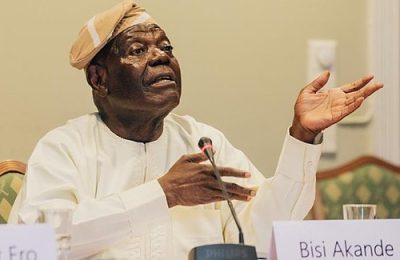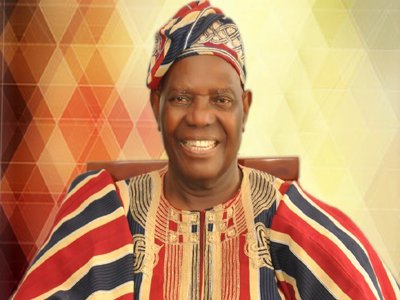

Chief Bisi Akande
First Interim Chaurman of the All Progressives Congress,APC,Chief Bisi Akande has identified the Renewed Hope Agenda of the administration of President Bola Ahmed Tinubu as the surest way to returning the country to development and glory as obtained in the former Western Region during the first republic .
In the speech he delivered at the Joel Babatolas Annual lecture organised by the Ekiti Council of Elders, the former civilian governor of Osun state said that in the Renewed Hope Agenda lies- Self Sufficiency in Food production, Rapid infrastructural development like building of roads and electricity, development of human capital needed for science and Technology and Strengthen the unity of Nigeria against the Indigenous retrogressive saboteurs and neo colonialist grumblers.
Said he, ‘ In the RHA lies Strengthening the Nigerian unity against the indeginous retrogressive saboteurs and the neo-colonialist grumblers; and, extricating Nigerian resources from the massive illegal foreign exploitations, perhaps and perhaps, at least pending the furry of the threatened invasion from the global powers and the international municipalities.”
Full speech below:
Governance, structural reforms & the economic landscape of Nigeria in the present 21st century
The Guest Speech by Chief Bisi Akande, CFR at the Joel Babatola’s Annual Lecture, organized by the Ekiti Council of Elders, on 7th November, 2025.
A. Introduction
In this talk, like in any compulsory question in school examinations, the organizers gave me no choice of topics, except to address what they couched as “Governance, structural reforms, and the economic landscape of Nigeria in the present 21st century”. I have lived more than half of my life spans in the 20th century but I am being drilled to examine the economic landscape of the 21st century! What if I score no pass marks?
As a beginning, before attempting any understanding of the topic, let me appreciate the Ekiti Council of Elders, who, because they themselves are great men and women, recognize the value of greatness in any of their own – either still living or posthumously. Today, the same Ekiti Elders Council has arranged for us to gather here to celebrate the anniversary of the life and the greatness of Chief Joel Babatola who was a Nigerian leader from one of the Ekiti kingdoms.
B. The Historical Settings.
3. What are the historical and the geographical landscapes and structures? From the time immemorial, there had been the continuous mounds of hills and mountains growing from among the Kukuruku communities through the large expanse of the Yoruba lands into the Borgu territories with numerous chains of glens through which waters drain into either the River Niger or into the Atlantic Ocean. Historically, the dales men dwelling along some of the ridges and glens of these mounds of hills and mountains founded the kingdoms of Ekitiland.
4. Much later, Nigeria was made by the expeditionary forts of the British Empire who used the people of the Atlantic community living around the slave coastal markets along the Bight of Benin and the Bight of Biafra to yoke together the Igbo hamlet communities in the east with the Yoruba city-states in the west before merging them with the Fulani and the Kanuri empires of the north just in 1914. This tells us that even though Babatola was born in one of the Ekiti kingdoms as a Nigerian, Ekiti kingdoms must have been very much older than Nigeria. Specifically, Nigeria began, some 111 years ago in 1914 while Joel Babatola was born four years later – on the 7th November, 1918 towards the beginning of the end of some era of interminable transitions of Anachism in Nigeria and in the world.
5. Let us be reminded that, for 500 years before this Nigeria, the West African peoples, of which Nigeria was a part, were being hunted round in the bush like mere animals. They were being inhumanly captured and kidnapped from their abodes in the villages or cities and were being sold by the native leaders either to the Arabian or to the European and American slave merchants. They were also being gagged and matched about into slavery through the Sahara desert or being shipped away like chattels to the Europe and the America plantations and mining pits.
6. Along the lines, the African communities were waging wars against one another for reasons of expansionism into city-states or into kingdoms, or from single community kingdoms into multi-community kingdoms and, ultimately, in some cases, into empires with a view to increasing tributes for the running of the polities. Even when there were Ekiti kingdoms, there similarly were the Ilorin and the Ibadan war invasions into Ekiti lands for reasons of pan-Yoruba supremacy. The global worlds were then just about to wrap up also with the First World War when our Babatola was born in 1918.
7. In other words, the emergence of Nigeria in the early part of the 20th century was a mere part of the transitions of Anarchism which, for the purpose of today’s discourse, is now being described as ‘governance’ and ‘structural reforms’. Anarchy can be defined as a society without rules or without a government. It is like the animal jungle, where the lion can eat the antelope with impunity! In 1918, when our Babatola was born, Nigeria was just transitioning from the anarchy of monarchical absolutism into the British colonial fascism and authoritarianism.
8. It was, also, an era of strange municipalization of the native authorities for tax imposition being punctuated by revolts and protest revolutions – like the Iseyin/Okeho peasant uprising of 1916 and 1917, and the ‘Ogun Adubi’ in Egbaland of June and July 1918. It was a period of panics among the Nigerian traditional leadership and their people when the colonial masters were trying to experiment on governance of “multi-kingdom centrality” into administrative Divisions, provinces and, also, into the “regions” and “the center”. It was a time of the British colonial autocratic rules and powers.
C. What is Governance?
9. With the above scenarios in mind, “Governance” can, therefore, be defined as the action and manner of ruling an organization, a society, or any community of people like a family, a village, a town, a city, a state or a nation. Nigeria, with her large expanse of lands and divergence of numerous tongues, tribes, ethnics, religions and cultures, is a complex combination of all these associations of diverse people. Therefore, the search for her structural reforms and for her suitable types of government must be scrupulously studied and carefully designed.
10. The original purpose of the European sponsored expeditions like those of Mungo Park, Hugh Clapperton and the Lander Brothers to West Africa (otherwise then being described as the “western Sudan”) was purely economic. Therefore, Nigeria of the British colony was absolutely designed for the exploitative extractive economy among the populations of the various city states in the forests surrounding the River Niger and its tributories. In other words, the colonists purposely came to exploit the Nigerian labours in extracting the Nigerian mineral and agricultural resources to provide raw materials for the British factories to manufacture goods in Britain for sale back in the Nigerian markets. At that beginning, the British concern for Nigerian politics was minimal and restricted to the manipulation of the native rulers to provide the required cheap labour and, at the same time, to collect taxes from the native populations to fund the services of the European administrative supervisory staff being used for the exploitative ventures!
11. From 1922 or thereabouts, a kind of Nigerian nationalism began and some kind of awareness emboldened certain Nigerian leaders to converse and deliberate among themselves and with the British officials, at least, on the politics of the city of Lagos. Between the First and the Second World Wars, the tempo of the rhetorics of those nationalists was becoming resounding enough to gain the attention of the British authorities concerning the politics and the economy of Nigeria. This led to the Macpherson constitution that provided the opportunity for Nigerians to participate in governance around 1950. Hence the chance for participation in governance by the people of the age of Chief Joel Babalola.
12. Consequently, debates began in earnest on the search for the Nigerian structural reforms and for the suitable types of government. As for the suitable types of governments, emergent Nigerian intelligentsia began to talk about some ancient fathers of political philosophy like Aristotle and Plato and about some political jargons like gerontocracy, autocracy, absolutism, tyranny, despotism, fascism, authoritarianism and oligarchy as potent rivals to ‘democracy’. Things were becoming clearer with softer appellations when the Action Group was inaugurated as a political party in Nigeria in 1951 with its motto “Freedom for All, Life more abundant” and with the specific manifesto for the type of governance, structural reforms embodying an economic agenda for Nigeria that looked forward to true Independence of all times!
D. Struggling for Independence from ignorance and poverty.
13. We have talked about how the rule of one kingdom over another kingdom seemed unjust and led to disruptions and wars. In family and clan communities, adaptable gerontocracy (leadership of the elders) was previously embraced. Because selfishness is inherent in the nature of man, so also would the controls of one individual over another individual not always be convenient. And, in the wake of prevalent ignorance and diseases, acute poverty would be grinding conspicuously. Usually, poverty stricken people are the easiest prey to political enslavement and economic exploitation. Therefore, the Action Group’s lines of argument were that, under the British colonial rule, Nigeria had remained riddled with ignorance, diseases and poverty and, so, that the struggle for independence should be the struggle for freedoms from ignorance, from diseases and from poverty.
14. Show me your friends to let me know who you are! Therefore, it is the joining of the Action Group in those days that made Chief Joel Babatola the great man we gather here to celebrate today in Ekitiland. He joined in the selfless struggle to find ways for the free education of the children of his people, for the free health for the masses and for the general prosperity of the workers and the farmers of his age. In the process of joining in these selfless struggles, he became popular and was elected first as a councilor and later as a regional legislator, before being appointed as a government minister. From then, the formulation of the acceptable principles for the designing of good governance, for structural reforms and for the economic landscape of an independent Nigeria was being established and worked upon. And, to the credit of the leaders of our Babatola’s age, Nigeria eventually won the freedom from the British colonial rule.
E. Nigeria’s Freedom Became Arrested
15. Unfortunately, that freedom was, however, soon arrested by the shackles of dictatorship of the military oligarchs. The military, in most civilized world and over most of the ages, is never designed to govern the civil society because its members are truly trained to kill, to destroy and to plunder the enemy in defense of the civil society! Therefore, the military cannot have the patience for the finicky requirements of civil laws and administrative regulations necessary for the good governance that are expected in progressive civil administration. The military are often regarded as vandals in war territories! After conquest, they are used to creating “thrones of impunity and of self-aggrandizement” pending the return of a regime of normalcy. And every grizzling opulence enjoyed by the military leaders around such thrones of impunity and self-aggrandizement is always at the expense of the citizens, the followers, the serfs and the hostages. Over the ages, whenever the military occupies the government of any civil society, the aberrations of the military acting as the emperor and the citizens becoming the serfs and the hostages prevailed! In civic terms, another word for the ‘military in governance’ is ‘Political Vandalism’. In Nigeria, indeed, it was the ‘Army Robbery’! It is from such legacy of vandalism and impunity of the ‘Army Robbery’ that the recurrent budgeting totally swallowed the capital expenditure in the public finances. With such horrible legacy, also, the general public imbibed the obnoxious notion of free money as the Nigerian new economic culture, which has now infused miracle wealth into our religious supplications and ultimately puts Nigeria into chronic international debts. And the general masses were, as a result, driven into poverty once again.
F. New Economic Landscape – In An Era of Renewed Hope.
Also Read:Nigeria will emerge stronger amid Trump’ threats – Tinubu
Troops will sustain offensive until insurgents, terrorists are denied sanctuary, says COAS
How to Stop Trump ,Pastor Adeyemi
16. In similar situations, in the 20th century, Chief Obafemi Awolowo, together with his associates like Joel Babatola, crafted a kind of welfarist economy for the western region of Nigeria which boosted the patriotic energy of the then Yoruba youths and which resulted in the fanatical loyalty of the entire people of the western region towards the Nigerian state ever since. It can be done again for the entire people of Nigeria through a ‘President Bola Amed Tinubu’ (PBAT) Renewed Hope Agenda’. In the PBAT Agenda, the way to navigate into the new economic landscape of the 21st century has been scrupulously enacted. In the policy agenda, even if Nigeria remains the global economic chessboard, opportunities would be easily opened for Nigerians to become the captains of the players also!
17. In summary, the PBAT Renewed Hope Agenda is designed to lead Nigeria to:
a) Self-sufficiency in food security – food production, food preservation and food packaging within Nigeria by Nigerians and that may also facilitate food surpluses and export promotions;
b) Rapid infrastructural provisioning (especially in transportation and electricity supply) by the joint efforts of the private sector and different tiers of governments to assist agricultural and industrial material processing and movements between the cities and the rural communities;
c) Developments of human capital in especially science and technology, with a view to promoting youth capacity and capability in meeting the enormous employment opportunities that could result from the effective implementation of the renewed hope agenda; and,
d) Strengthening the Nigerian unity against the indeginous retrogressive saboteurs and the neo-colonialist grumblers; and, extricating Nigerian resources from the massive illegal foreign exploitations, perhaps and perhaps, at least pending the furry of the threatened invasion from the global powers and the international municipalities.
18. The Ekiti Council of Elders, ladies and gentlemen, blessed be the memory of our Joel Babatola, blessed be the unity and progress of Nigeria and thank you for listening.
Chief Bisi Akande, CFR.
The Asiwaju of Ila Orangun,
Osun State – Nigeria.