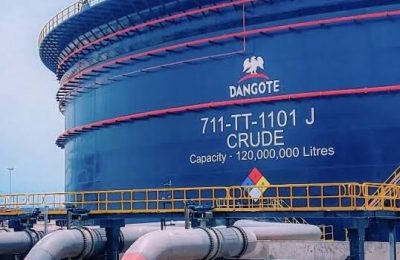
Photo:NNPC Truck Loading Petrol from Dangote Refinery
The pricing strategy at the Dangote Petroleum Refinery—Africa’s largest single-train refinery—is emerging as a key incentive for a fresh wave of refined petroleum imports into Nigeria, according to a new report by S&P Global.
Despite recent reductions in petrol prices by the 650,000 barrels per day capacity refinery, analysts say the cuts are marginal compared to global declines in crude oil prices, prompting fuel marketers to turn to cheaper international sources.
Between April 1 and April 9, global petrol benchmarks like the Eurobob M1 fell sharply by 17.9% from $734.25/MT to $603/MT. However, the Dangote refinery only reduced its gantry prices by 1.7%—from ₦880 per litre to ₦865—during the same period, according to data from the Major Energy Marketers Association of Nigeria (MEMAN).
Background: Market Disruption Meets Domestic Constraints
Dangote Petroleum Refinery, which began operations in late 2023, initially triggered a price war in Nigeria’s downstream sector. Petrol prices fell from over ₦1,100 per litre in September 2024 to ₦860 in March 2025.
The drop was widely welcomed, seen as a move toward self-sufficiency and price moderation in the oil-dependent economy.
However, a temporary suspension of the government’s naira-for-crude-oil swap deal—a critical mechanism for accessing feedstock—reversed the trend, sending prices back upward.
Now, despite global crude crashes, the refinery has yet to fully pass on the savings. S&P Global argues this disconnect is fuelling an import resurgence.
“This has encouraged a flood of products to West Africa, where high domestic prices have led marketers to import from international traders in greater volumes,” the report noted.
Petrol shipments to Nigeria are forecast to hit 4 million metric tonnes by April 27, marking the highest monthly volume in over two years. Ship-tracking data also indicates diverted flows from the U.S. Atlantic Coast to West Africa amid seasonal shifts and U.S. tariff concerns.
New Prices, Competitive Pressures
On April 10, the Dangote refinery announced a fresh gantry price cut to ₦835 per litre, with retail partners instructed to sell between ₦890 and ₦920 depending on location. While the move was marginal, it signalled a renewed push to retain domestic market share amid growing competition.
Some of the refinery’s partners—such as Heyden and MRS—have adjusted pump prices to ₦885 and ₦890 per litre, respectively. Independent operators are also joining the race. SGR, a retailer with four filling stations in Mowe and Sagamu, now sells below Dangote’s prices at ₦878 per litre.
A senior source within Dangote Group confirmed to Global Financial Digest that the company had planned a major petrol price drop to coincide with founder Aliko Dangote’s 68th birthday on April 10.
“That plan was shelved due to the temporary suspension of the naira-for-crude policy,” the source said, adding that a more substantial price drop could be imminent now that the policy has been reinstated.
“The crash in global crude prices, combined with resumed local feedstock access, will give the refinery room to offer more competitive prices,” the source added.
Outlook: Volatility, Regulatory Friction, and Legal Battles Ahead
Despite the competitive atmosphere, challenges remain. The refinery is still locked in a legal dispute with the Nigerian Midstream and Downstream Petroleum Regulatory Authority (NMDPRA) over its decision to issue import licences to fuel marketers—a move Dangote argues undermines domestic refining.
NMDPRA’s Chief Executive, Farouk Ahmed, recently disclosed that daily petrol imports dropped from 44.6 million litres in August 2024 to 14.7 million litres in April 2025—an indication that domestic production has already begun to reshape Nigeria’s energy landscape.
But with international arbitrage now more favourable, analysts caution that sustained price misalignment could reverse this progress.
Also Read:Kyari, refineries and a green ribbon
Dangote Refinery:MRS announces fresh reduction of petrol price
45 African journalists selected for 2024 digital infrastructure fellowship
Dangote Refinery: 70 tank farms shut down after subsidy removal
“There is a real risk of Dangote losing market share unless its pricing becomes more dynamic,” said one downstream analyst in Lagos. “Importers will always exploit any arbitrage opportunity, especially when local gantry prices are sticky.”
As Nigeria seeks to balance domestic refining expansion with energy affordability, the coming weeks will be critical.
Price signals from the Dangote refinery will likely determine the direction of fuel import volumes, with broader implications for inflation, trade, and forex demand.