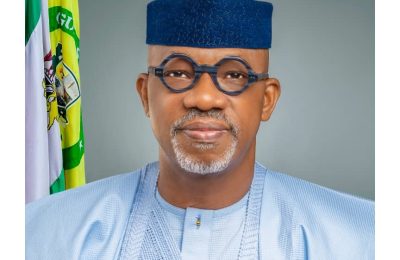
The struggle did not begin today. To understand what is happening around Senator Olamilekan Adeola, Yayi, we must first understand where Ogun politics has travelled from.
This is a long letter. I know.
But I plead with every Yewa-Awori son and daughter, and indeed every citizen of Ogun State who cares about fairness, history and the future, to read it to the end.
There are times when a people must stop, look backwards and ask themselves a difficult question: How did we get here?
Many of our young people were either children or not yet born when some of the events I am about to recount took place. To them, today’s political battles may appear new. They are not.
Former President Olusegun Obasanjo once described the governorship inequality in Ogun State with the imagery of “Igba Aro” — the lame man’s calabash. He told our delegation that the Egbas held one part while the Ijebus held another.
He advised that if Yewa-Awori genuinely wanted to produce the governor of Ogun State, we must go and procure what he called “Cold Spell” Epe tutu.
What he was prescribing, in essence, was unity. Strong unity.
Because political adversaries with deep pockets do not simply surrender power because justice demands it.
Fast-forward to June 2026.
From the paramount ruler of Yewaland (who has done all that is needful to see the dream of Ogun West come to fruition), Obas and chiefs to Baales; through the length and breadth of Ogun State, from heads of consequential families to trade associations; from artisans to students, Yewa-Awori and good people of Ogun State are increasingly united behind Senator Olamilekan Adeola—Yayi, the Aremo of Yewaland. That unity is significant.
Therefore, in my view, every political war waged against him becomes, inevitably, a battle whose consequences extend beyond one individual to the wider Yewa-Awori aspiration.
But for those who were ten years old or not even born in 1998, permit an old participant and observer to take you backwards. Not because history should imprison us. But because history should instruct us.
THE STORY DID NOT START TODAY
Let us return briefly to 1999.
Following Nigeria’s transition from military rule to democracy, the Alliance for Democracy, AD, emerged as a major political platform in Ogun State.
Among the respected stakeholders and leaders of that period were late Pa Abraham Adesanya, late Pa Tunji Otegbeye, Pa Olanihun Ajayi and several others.
There was a strong view that consensus would be the best way to choose the party’s governorship candidate. The political understanding between Ogun West and Ogun East was that Ogun West would be supported to produce the candidate, with Dr. Ayinde Ibikunle emerging as the candidate of choice from Ogun West.
Before the decisive meeting, discussions had taken place between leaders of Ogun East and Ogun West. There was an understanding: Ogun East would support the candidate from Ogun West, as reciprocal political support. The Egbado had supported late Chief Olabisi Onabanjo against Chief Soji Odunjo during the second republic.
A meeting was subsequently fixed at Aiyepe, in Ogun East Senatorial District. But that meeting descended into chaos.
The meeting, chaired by Chief Gbenga Kaka, was disrupted by thugs led by Egbas before the political question could be peacefully settled.
Our Ogun West leaders, led by the late Dr. Tunji Otegbeye, protested, but in vain.
Another meeting was fixed for the following Saturday. It never happened. Before it could hold, Chief Olusegun Osoba was announced as the AD consensus candidate instead of Dr. Ayinde Ibikunle, whom Ogun West had expected to carry the flag.
And so began another chapter in the political story of Ogun West.
My account of that episode is not being invented for today’s politics. I wrote publicly about these events years ago, including the Aiyepe meeting, Dr. Ayinde Ibikunle’s candidature and the eventual emergence of Chief Osoba in The Nation of August 14, 2011. Contemporary retrospective reporting also recorded that account.
There was, however, an understanding that mattered enormously to Ogun West: Chief Osoba would support the governorship returning to Ogun West after his tenure. That promise became important. But history had other plans.
THEN CAME 2003
By 2003, the political waters had become turbulent again.
Chief Olusegun Osoba sought another term. The decision led to the division of Alliance for Democracy into two factions. One group led by Alhaji Tayo Sowunmi in Ogun State and by Alh. Ahmed Abdulkadri at the national level. The other was led by Chief Adeniji at the state level and Alh. Maman Yusuf at the national level.
At that point, the INEC recognized the Sowunmi-led faction known as “AD Authentic”. The faction led by late Chief Adeniji was known as “AD Osoba”.
Unknown to us, the then president, Chief Olusegun Obasanjo had set up Ahmed Abdulkadri to put a wedge in the party. For over 18 months leading up to the election, “AD Authentic” was recognized by the INEC, Engr. Femi Tetede was the anointed candidate but at the last National Convention, Ahmed Abdulkadri-led Executive turned 360 degrees and announced Chief Osoba as the candidate.
It was a great strategic plan. The PDP knew that Ogun West would vote against Chief Osoba en bloc and their candidate, Otunba Gbenga Daniel, would defeat the sitting governor.
The political alignment changed. The PDP entered the battle with enormous force, and controversy.
Recall that Chief Dele Arojo had been murdered in front of Engr. Femi Tetede’s office at Abeokuta shortly after the Ogun West PDP led by Chief (Mrs.) Iyabo Apampa resolved to vote en bloc for Arojo at the primary election. At this point, Ogun West was left with no governorship candidate.
The governorship eventually changed hands. But the deeper question remained: When would Ogun West’s turn come?
Governments changed.
Parties changed names.
Alliances were made and broken.
Political actors moved from one platform to another.
But Ogun West continued waiting.
THE GREAT POLITICAL REALIGNMENT
By the period leading to 2011, Ogun politics had become even more complicated. The PDP was badly divided. One faction was associated with Chief Olusegun Obasanjo, while another was associated with then Governor Otunba Gbenga Daniel.
Chief Obasanjo’s faction backed General Adetunji Olurin. Ironically, both Obasanjo and Daniel had the best chance to produce a governor of Ogun West extraction. Yet they fought bitterly. The Olubara of Ibara, Oba (Dr.) Jacob Olufemi Omolade (Lafa II) led other Yewa Obas to mediate and reconcile both strongholds, but the efforts failed. Without leaving PDP, Otunba Daniel “secured” PPN for Hon. Gboyega Nosiru Isiaka and largely funded the campaign.
Meanwhile, the other political forces moved differently. Senator Ibikunle Amosun, meanwhile, emerged on the platform of the Action Congress of Nigeria, ACN, by the grace of Asiwaju Ahmed Tinubu. The result is now history.
Amosun, a kinsman of Obasanjo, took about two-thirds of Egba votes and won the 2011 governorship election. INEC’s declared figures gave him 377,487 votes, ahead of General Adetunji Olurin and Gboyega Isiaka. When both votes are merged, it defeated the ACN. Unfortunately, it was widely alleged that Amb. Sarafa [Isola], who was imposed as the Chairman of Olurin Campaign Organization, surreptitiously supported Amosun.
Once again, Ogun West’s aspiration had to wait.
And that is precisely why younger readers must understand that today’s agitation did not fall from the sky. It carries decades of memory.
THEN CAME 2019
By 2019, Senator Ibikunle Amosun was preparing to leave office after two terms. Again, the question arose: Who succeeds him?
Amosun decided that the governorship platform should go to a Yewa man. He backed Hon. Adekunle Akinlade, popularly called Triple A, from the Yewa axis. Again, he never left APC, but “secured” and funded the APM platform for Akinlade.
Senator Ahmed Tinubu, however, proved his political strength in the contest for the APC ticket. Prince Dapo Abiodun, from the Remo district, eventually became the APC candidate. Public reporting from that period confirms both Amosun’s support for Akinlade and the bitter controversy surrounding the APC governorship ticket.
The dream was alive again.
And once again, it failed.
Prince Dapo Abiodun won the 2019 governorship election with 241,670 votes against Akinlade’s 222,153.
Ogun West bit the dust again.
Pause here. Different parties. Different personalities. Different political circumstances.
Yet one question keeps returning:
When will Ogun West produce the governor of Ogun State?
AND NOW, YAYI
That brings me to the present.
Senator Olamilekan Adeola (Yayi) has emerged as a dominant figure in the contemporary political landscape of Ogun State.
And Chief Olusegun Osoba has firmly stood with him.
Whatever anyone thinks about the personalities involved, we must understand the historical weight behind the present struggle.
This is bigger than political slogans.
It is bigger than WhatsApp propaganda. It is bigger than one election cycle. It reaches backwards into decades of political negotiation, disappointment, alliances, betrayals, reconciliation and renewed hope.
Among those now caught in the opposing political currents are people such as Chief Alani Bankole, Chief Joju Fadairo, Madam Iyabo Obasanjo-Bello and many others within Ogun Central’s political establishment. And that brings back memories. Please remember Ambassador Sarafa Isola, who chaired the Tunji Olurin campaign organisation. At a point, concerns arose within the campaign about its direction.
Please also remember the late Chief Dele Arojo, whose death remains one of the painful episodes of that political era. These are not just names on fading newspaper pages.
They are chapters in the political education of Ogun State.
WHY I AM WRITING THIS LETTER
My open letter to the Yewa-Awori people is therefore simple:
Do not look at today’s political contest without looking at yesterday.
In my assessment, the political resistance confronting Senator Yayi bears similarities to the resistance that Ogun West has encountered at critical moments since the return to democratic government.
But there is another dimension that deserves serious investigation.
The question of Ogun West is not merely political. It is also economic.
Look at representation in the Civil Service. Look at representation in the Judiciary. Look at the distribution of government opportunities. Examine the geographical spread of major contractors. Compare Ogun Central, Ogun East and Ogun West.
Read Also:Provide evidence of my Ekiti origin within 24 hours or,Yayi tells Hunye,Marcus Bello
2027: INEC expresses concern over smear campaigns among political parties
Abiodun Moves to Reconcile Aggrieved APC Members in Ogun East
Caps, Marabouts and Politics of Envy
Oyo APC unveils Alli, 49 other candidates for 2027 elections+ Full List
Study the value of contracts awarded across the three senatorial districts since 1976. Compute the major projects. Follow the money.
Follow the infrastructure. Follow the appointments. Follow the opportunities. Then ask:
What does the evidence tell us?
That is the investigation journalists, historians, academics and public-interest researchers should undertake—not with emotion, but with records and figures.
HISTORY MUST NOT BECOME A PRISON
Let me make one point very clear.
History should not teach us to hate.
It should teach us to recognise patterns. The children of today’s political actors should not inherit the quarrels of their fathers. Neither should Egba, Ijebu, Remo, Yewa or Awori people become enemies because politicians disagree.
Ogun State belongs to all of us.
But unity cannot mean that history must be forgotten. Peace cannot mean that legitimate political aspirations must permanently be postponed. And fairness cannot mean that one section should forever be told:
“Wait for another time.”
Former President Obasanjo’s metaphor of the Igba Aro remains instructive. A calabash carried unevenly will eventually spill its contents. For Yewa-Awori, therefore, the first requirement is not anger.
It is unity. The second is vigilance. Die-hard enemies killed Arojo. Ask yourself, in a free and fair election, and with governor’s and presidential backing, can Yayi be defeated? What other options do they have?
The third is political memory.
And the fourth is the discipline to distinguish between propaganda and history.
MY CLARION CALL
The dominance of Senator Olamilekan Adeola in today’s political landscape is, in my view, one major reason his opponents are determined to stop him by every means available to them. But propaganda must not blind us.
Neither should political excitement make us careless. Pray with vigilance. Study our history.
Interrogate every claim—including mine. Ask the elders.
Read the old newspapers.
Look at the election results.
Examine the records.
And above all, remain united.
Because a people who forget how yesterday was negotiated may wake up tomorrow wondering how their future was negotiated away.
For decades, Ogun West has waited.
The question before this generation is no longer simply what happened in 1999, 2003, 2011 or 2019.
The question is: What have we learnt from all of them?
And when history opens another door, will Yewa-Awori recognise it?
Read. Remember. Reflect.
The future will be written by those who understand the past.