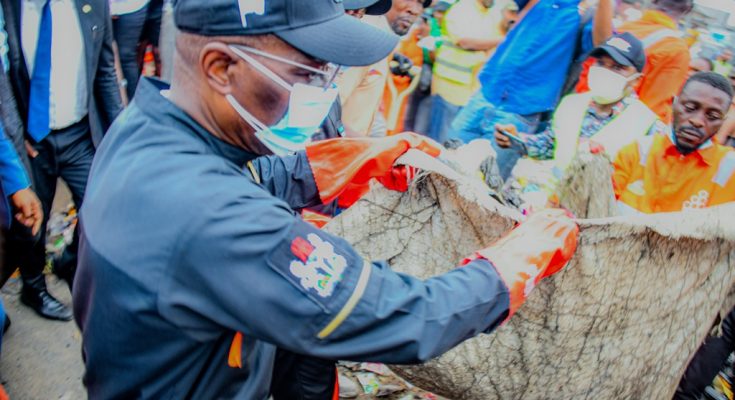

Governor of Lagos State, Governor Babajide Sanwo-Olu, assisted by a staff of LAWMA to remove refuse during the flag off of the monthly Environmental Sanitation program at Mushin-Agege Motor road in Lagos, 14 March 2026.
After years of suspension, Lagos State Government has revived the monthly environmental sanitation exercise, with Governor Babajide Sanwo-Olu officially flagging off the exercise this morning at the Mushin–Agege Motor Road corridor, alongside his deputy, Obafemi Hamzat.
The exercise, which had been abandoned for years following a court ruling that nullified compulsory restriction of movement during sanitation hours, will now hold on the last Saturday of every month between 6:30 a.m. and 8:30 a.m. without any restriction on movement.
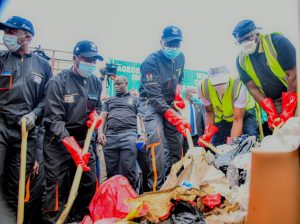
Pix 0674 l-r: Deputy Governor of Lagos State, Dr. Obafemi Hamzat; Governor Babajide Sanwo-Olu; his Special Adviser on Works, Dr. Abiodun Olayinka; Head of Service, Lagos State, Mr. Olabode Agoro; Special Adviser, Central Internal Audit, Dr. Oyeyemi Ayoola and the Permanent Secretary, Office of Environmental Services, Dr. Gaji Omobolaji during the flag off of the monthly Environmental Sanitation program at Mushin-Agege Motor road in Lagos, 14 March 2026.
♦
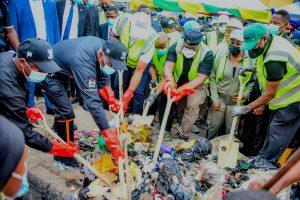
Commissioner for the Environment and Water Resources, Mr. Tokunbo Wahab; Deputy Governor of Lagos State, Dr. Obafemi Hamzat; Governor Babajide Sanwo-Olu and the Head of Service, Lagos State, Mr. Olabode Agoro during the flag off of the monthly Environmental Sanitation program at Mushin-Agege Motor road in Lagos, 14 March 2026.
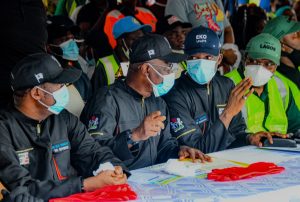
Pix 0768 l-r: Deputy Governor of Lagos State, Dr. Obafemi Hamzat; Governor Babajide Sanwo-Olu; SSG, Barr. ‘Bimbola Salu-Hundeyin and Special Adviser, Central Internal Audit, Dr. Oyeyemi Ayoola, during the flag off of the monthly Environmental Sanitation program at Mushin-Agege Motor road in Lagos, 14 March 2026.
Speaking during the flag-off, Sanwo-Olu said the reintroduction of the sanitation exercise was part of efforts by the state government to restore environmental cleanliness and instill civic responsibility among residents.
Also Read:Lagos warns residents of possible flooding, excess rainfall in 2026
Environmental Infraction:Lagos seals Ladipo Spare Parts Market
89th birthday: Obasanjo targets 10,000 Lagos residents for free healthcare
He lamented the level of dirt across several parts of the state, noting that the monthly sanitation previously observed nationwide contributed significantly to the cleanliness recorded in the past.
The governor said Mushin was deliberately selected for the flag-off because of the noticeable environmental challenges in the area, urging residents to voluntarily participate in the exercise.
“This monthly exercise used to be a national pride. This flag-off is a defining moment for us. We decided to choose this corridor because of the amount of filth here. A clean city is built by the people who live in it,” he said.
Sanwo-Olu stressed that the condition of drains and gutters in many communities showed the need for collective action, adding that maintaining a clean environment must be seen as a civic duty rather than a government obligation alone.
The governor explained that the exercise would be voluntary in compliance with the court judgement which stopped the enforcement of compulsory stay-at-home sanitation in the state.
Commissioner for Environment and Water Resources, Tokunbo Wahab, described the reintroduction of the sanitation exercise as a major step toward improving public health and environmental sustainability in the state.
Wahab said the initiative aligned with the T.H.E.M.E.S Plus Agenda of the Sanwo-Olu administration, aimed at ensuring a safe, clean, flood-free and livable environment for residents.
He commended the governor for his commitment to providing a conducive environment for Lagosians, noting that the monthly sanitation exercise was once a strong culture in the state used to promote cleanliness, community participation and disease prevention.
According to him, residents are expected to clean their homes, surroundings and drainage channels in front of their houses, while officials of the Lagos Waste Management Authority (LAWMA) will be on ground to evacuate properly bagged waste.
Wahab stressed that environmental sanitation helps promote hygiene, safeguards public health and contributes to longer life expectancy through a cleaner environment.
He said the government would continue to educate residents on the need to take ownership of their environment by disposing of waste responsibly and keeping their surroundings clean at all times.
The commissioner added that agencies under the Ministry of the Environment and Water Resources, including LAWMA, LASPARK, LASEPA and the Kick Against Indiscipline (KAI) corps, would strengthen collaboration to ensure a cleaner Lagos.
He warned residents against illegal waste disposal, trading on undesignated spaces, burning refuse, patronising cart pushers and other environmental offences, stressing that the Lagos Environmental Law remains in force.
Wahab also noted that sustained sanitation would help reduce flooding across the state, urging residents to support government efforts by complying with environmental regulations.
In 2015, Lagos lawyer, Ebun-Olu Adegboruwa, filed a suit against the Inspector-General of Police and the Lagos State Government, challenging the legality of restricting residents’ movement during the monthly sanitation exercise.
He argued that there was no law in Lagos State authorising the compulsory stay-at-home order for three hours on the last Saturday of every month for environmental sanitation.
The Lagos State Government had, however, argued that Section 41 of the 1999 Constitution allowed laws that could limit freedom of movement in the interest of public safety, adding that the Environmental Sanitation Law of Lagos State, 2000, permitted such action.
The government also maintained that the restriction was necessary to ensure a clean and safe environment, noting that essential workers, emergency responders and ambulance services were exempted.
In his judgement, Justice Mohammed Idris of the Federal High Court, Lagos, nullified the monthly restriction of movement, holding that there was no existing law in the state that made it compulsory for residents to remain indoors during sanitation hours.
The court ruled that the Constitution guarantees freedom of movement and that such freedom cannot be withdrawn without a valid law backing the restriction.
Justice Idris further held that there was no regulation authorising the government to confine residents to their homes on the last Saturday of every month for environmental sanitation.
Following the ruling, the exercise gradually went into decline until its reintroduction by the present administration.
Sanwo-Olu said the new approach would focus on voluntary compliance, community participation and enforcement of environmental laws without infringing on citizens’ rights.
He called on residents, traders and transport operators to keep their surroundings clean, clear blocked drains and properly dispose of waste.
The governor also urged market leaders, community development associations and local government authorities to mobilise residents ahead of each sanitation exercise.
According to him, environmental cleanliness remains critical to public health, flood control and sustainable urban development.
Sanwo-Olu reiterated that the government would continue to strengthen waste management and sanitation enforcement across the state to achieve a cleaner and safer Lagos.
Photos:Lagos Photo Crew