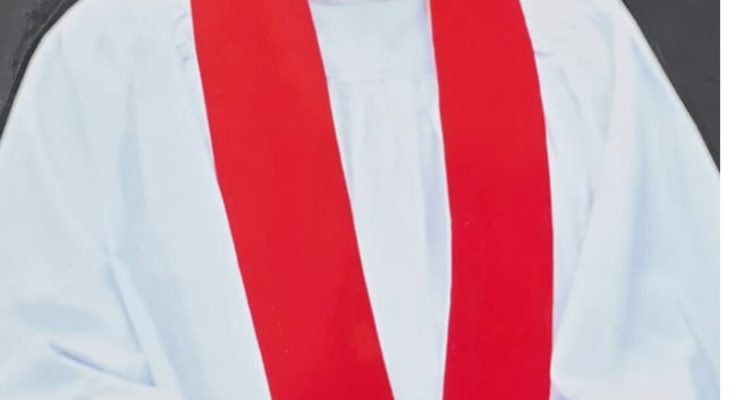

Rev’d Mobolade Adeboyejo Omonijo was an ordained Anglican priest and Vicar of the Anglican Church of Pentecost, Dopemu, Agege, Lagos, until 15 October 2026, when he answered the greater call.
He was also a member of the Editorial Board of The Nation newspaper, bringing his wealth of journalistic experience, intellectual depth and analytical ability to public discourse.
Before fully embracing ordained ministry, he was associated with the Christ Ambassadors Society at Christ Church, Elere, Agege. Interestingly, the society has produced five priests, three of whom have since crossed the realm.
His life reflected a remarkable combination of professional journalism and Christian ministry. He understood the world of ideas, public communication, faith and human relationships. Indeed, the late Rev’d Omonijo was a man of two worlds: the pulpit and the newsroom.
Not many people successfully combine the demands of journalism with the responsibilities of Christian ministry. Rev’d Omonijo was one of those who navigated both worlds with distinction.
The newsroom demands critical thinking, scrutiny, courage and intellectual discipline. The pulpit, on the other hand, requires spiritual discernment, compassion, biblical understanding and moral responsibility. He brought elements of both disciplines into his professional engagements and ministry.
One of the outstanding descriptions of him was that he possessed a robust analytical mind. He was not someone who accepted issues at face value. He examined situations, interrogated arguments and developed his own positions. He had a distinctive point of view.
This is an important quality in any society. We need people who can think independently, challenge assumptions constructively and contribute meaningfully to conversations. His association with the Editorial Board of The Nation newspaper speaks to his continued engagement with journalism and public affairs.
Journalism is not merely about reporting events; it is also about helping society understand those events, their implications and their consequences. His professional identity as a journalist remained an important part of his contribution to society.
He was also described as an Ijesa man through and through. There is something admirable about someone who maintains a strong connection with his cultural identity while engaging confidently with people and institutions beyond his immediate community. He demonstrated that professional exposure, intellectual development and spiritual growth need not disconnect anyone from their roots.
His commitment to Christian service and his ministry as an Anglican priest constituted another significant dimension of his life. His journey from the Christ Ambassadors Society at Christ Church, Elere, to ordained ministry illustrates a continuing relationship with the Christian faith and the Church.
What does the life of Rev’d Omonijo teach us? I believe there are profound lessons to be drawn from his story.
Read Also:Faces at the funeral and Thanksgiving service of Mrs Folashade Olukeji Otegbolade
TRIBUTE: *The Dotun Oladipo I Knew*
Never allow your professional designation to limit your contribution to society.
Rev’d Omonijo was a journalist and a priest. His life demonstrates that our gifts can find expression in different fields. A person can be intellectually accomplished, professionally relevant and spiritually committed.
 +
We must not imprison our potential within one title, occupation or professional designation. God can use the different abilities, experiences and opportunities He has given us to make meaningful contributions to society.
Cultivate an independent and analytical mind.
His analytical ability and distinctive point of view are qualities worth emulating. In a world where people readily subscribe to popular opinions, there is a need for individuals who can think deeply, examine issues objectively and express informed positions.
The intersection of his professional calling as a journalist and his spiritual responsibility as a minister of the Gospel revealed a man who had developed a mind of his own.
The lesson is simple: do not merely exist as a participant in conversations; contribute something meaningful to them.
Your professional experience can enrich your calling.
His continued engagement with journalism alongside Christian ministry reminds us that our gifts and calling can complement one another.
We should not abandon the values, talents and experiences that shaped us simply because we have entered another phase of life. Our professional experiences can become instruments through which God uses us to serve humanity and advance His Kingdom.
Invest in relationships and never postpone expressions of love.
One aspect of his passing is particularly sobering.
A conversation that took place on Wednesday, 7 October 2026, involving a lengthy discussion and a promise to visit, unexpectedly became our last earthly conversation.
Who would have imagined that there would be no opportunity for another conversation or the fulfilment of that promise?
This is perhaps one of the most poignant lessons from his death.
We often assume there will always be another opportunity to visit, make a phone call, settle a misunderstanding, appreciate someone or continue a conversation. Unfortunately, life does not always give us that opportunity.
We must therefore:
• Appreciate people while they are alive.
• Maintain meaningful relationships.
• Make time for friends and colleagues.
• Resolve disagreements wherever possible.
• Never unnecessarily postpone expressions of love and appreciation.
Sometimes, an ordinary conversation becomes an extraordinary memory.
Lessons from His Passing
Death is a solemn reminder of human mortality. No matter how intellectually accomplished, professionally distinguished, spiritually committed or socially influential we become, we remain mortal.
Death reminds us that our earthly journey is temporary. Our positions, accomplishments, influence and possessions cannot exempt us from the inevitable reality of human existence.
But the Christian response to death is not despair; it is hope.
As Apostle Paul declares:
“For to me to live is Christ, and to die is gain.” — Philippians 1:21.
Revelation 14:13 also offers this assurance:
“Blessed are the dead which die in the Lord from henceforth: Yea, saith the Spirit, that they may rest from their labours; and their works do follow them.”
This is where the legacy we leave behind becomes important.
People may eventually forget many of the positions we occupied, the offices we held and even the arguments we won. But they are more likely to remember how we influenced their lives, the values we represented, the contributions we made and the memories we created.
Rev’d Omonijo’s life brings an important question before all of us:
When we are no longer here, what will people remember us for?
Will they remember our kindness, intellectual contributions, professional excellence, Christian witness, friendship and service?
That is a question every living person must endeavour to answer.
There is a profound difference between merely passing through life and leaving an imprint on the lives of others.
Rev’d Mobolade Adeboyejo Omonijo belonged to a category of people whose lives cannot be adequately described by their professional titles alone. He was a journalist who understood the importance of ideas, a clergyman entrusted with spiritual responsibility, and a man whose intellectual disposition gave him a distinctive voice.
His life challenges us to cultivate our minds, deploy our gifts, serve faithfully and maintain meaningful relationships.
His death challenges us to reflect on our mortality, value the people around us and prepare for eternity.
Perhaps the greatest tribute we can pay him is not merely to mourn his departure but to identify the virtues that distinguished him and allow those virtues to challenge the way we live.
Adieu, Rev’d Omonijo!
You occupied two important spaces — the newsroom and the pulpit. You brought your intellect to public discourse and your faith to Christian ministry. You demonstrated that professional excellence and spiritual commitment can coexist and complement each other.
Your earthly journey has ended, but the memories of your life, your contributions and your distinctive voice will remain with those whose paths crossed yours.
May your family, the Diocese of Lagos West, your congregation, your media colleagues, friends and all who mourn your departure find comfort and strength in the unfailing promises of God.
May your soul, and the souls of all the faithful departed, through the mercy of God, rest in peace and rise in glory.
Amen.