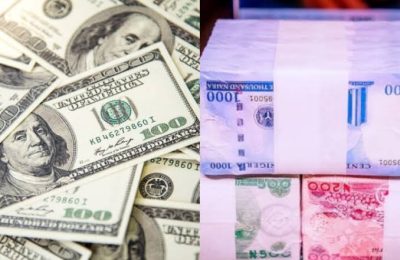
The Nigerian naira came under renewed pressure on Monday, sliding to ₦1,845 per euro on the parallel market, as the euro extended its bullish run against the U.S. dollar in global markets.
The development highlights a widening gap between the naira’s black market rate and the official rate, reinforcing investor concerns over Nigeria’s constrained foreign exchange (forex) supply and central bank interventionism.
The euro surged 1% against the greenback in early trading, pushing the EUR/USD pair past the critical 1.15 threshold—its highest level since 2022—fuelled by safe-haven flows amid heightened geopolitical and trade tensions involving the United States and its global trade partners, particularly China.
While the naira had held support near ₦1,800 per euro in previous sessions, the latest movement signals further weakening as forex scarcity bites deeper.
Black market operators cited increased demand for the euro for offshore transactions and personal travel allowances (PTAs), alongside persistent dollar shortages exacerbated by the Central Bank of Nigeria’s (CBN) tight forex rationing regime.
The euro’s momentum was underpinned by a sharp decline in the U.S. Dollar Index (DXY), which dropped to 98.2—its lowest level in over three years. The index has been trending downward following escalating trade disputes between the U.S. and key economic blocs.
Analysts say the Trump administration’s latest probe into tariffs on critical mineral imports has rattled investors and stoked fears of a return to protectionist economic policies.
The uncertainty has shifted investor sentiment towards the euro and other alternative currencies, widening the demand-supply gap for foreign currencies in fragile economies like Nigeria, which still relies heavily on dollar and euro inflows for external obligations.
“The naira’s inability to hold firm against the euro despite the absence of major eurozone economic data reflects Nigeria’s underlying forex liquidity problem,” said Seyi Martins, an independent macroeconomic analyst based in Lagos.
“Until the CBN normalises access to forex at official windows, the black market will remain the de facto pricing mechanism.”
Background: Trade Wars and Policy Uncertainty Fuel Currency Volatility
Global financial markets were jolted last week when U.S. President Donald Trump authorised an investigation into new tariffs on critical minerals, a move that risks further straining already fragile trade relations with China and Europe.
This has reignited safe-haven demand for non-dollar assets, particularly the euro and gold.
The turmoil deepened with reports that Trump’s inner circle is exploring legal avenues to oust Federal Reserve Chair Jerome Powell—an unprecedented move that drew sharp criticism from lawmakers and economists.
U.S. Senator Elizabeth Warren warned that dismissing Powell would destroy investor confidence and signal the politicisation of monetary policy.
“If political whims dictate monetary policy, we’re removing the very structure that gives our economy credibility,” Warren said in an interview with CNBC, stressing that such a scenario could lead to a market collapse “beyond recovery”.
The implications of a weakened dollar—and a politically compromised Federal Reserve—could reverberate globally, especially in emerging markets like Nigeria, where external shocks easily spill over into currency and inflationary volatility.
Outlook: Nigeria’s Naira Faces Mounting Headwinds
Despite CBN efforts to stabilise the foreign exchange market through limited interventions and FX auctions, the euro’s appreciation is expected to sustain pressure on the naira in the short to medium term.
Traders expect resistance around ₦1,860 and support near ₦1,800 in the unofficial market, with a potential spike if U.S.-China tensions escalate or if euro strength persists.
Nigeria’s path to exchange rate stability hinges on reforms that expand forex supply, diversify export earnings beyond crude oil, and rebuild investor confidence through transparent and independent monetary policy.
Also Read:Yuan weakens to 7.1980 against dollar
U.S. Consulate Supports Year-Long Training Program for Emerging Journalists.
CBN scraps free withdrawal from other banks’ ATMs
Electricity tarrif, gas price increase capable of pushing Nigerians to the wall – Gani Adams
As global currencies realign and the dollar’s dominance weakens, the CBN may need to reassess its approach to forex management to avert deeper devaluation risks.
“Only with a competitive and stable naira can Nigeria transition into a capital-rich and investment-attractive economy,” said Martins.
Global Financial Digest