By Tunde Rahman
I welcome you all to this international award ceremony. Those who have been honoured with these awards are patriots, progressives and eminent Nigerians who played a leading role in our agitation for the rebirth of democracy in Nigeria after the military truncated it. They are truly deserving of these awards. And I congratulate them.
As most of us know, President Bola Tinubu ranks highly in this category of patriots who fought stridently for our democracy. As a Senator in 1993 after the annulment of June 12, he led a team of lawmakers who did the unthinkable under a military regime: they demanded an end to military rule.
When General Abacha came, Tinubu and others formed NADECO. For his agitation for democracy, he was hounded. His residence in Ikeja was petrol-bombed by agents of the state who thought he had died inside the house. He then escaped abroad where he continued the agitation, providing support and assistance to pro-democracy activists abroad to sustain the struggle.
I have been asked to speak on the achievements of President Tinubu in one year in office. Before I proceed, let me say that one year in the life of an administration is like a drop in the ocean. This is not to say that the regime has not done much in one year. Indeed a lot has been achieved, though some may not want to admit this.
President Tinubu has moved to reset the economy and our governance processes, and also reawake the spirit of patriotism in us by rekindling our national values.
I will elucidate on this shortly.
When I mentioned resetting the economy, I did not mean to really dwell on the removal of the fuel subsidy, which only benefited a few oil cabals at the expense of the poor it was meant to help and which is a heavy burden on the economy. I also did not plan to dwell much on the unification of the multiple exchange rates, which allowed arbitrage to walk on all fours. These two policies are important policies no doubt. They have been adjudged so both locally and internationally as necessary if the country is to move forward. I choose not to focus on them because they are yet to produce the kind of salutary outcomes we envisaged. Suffice to say, however, that we will soon get there. The pains being experienced at present will soon give way for the full realization of the benefits of the two policies.
In spite of that, I must say, however, that we are recording a gradual growth. For instance, according to the National Bureau of Statistics, the nation recorded a 2.98% growth in the first quarter of this year, higher than 2.31% recorded in the same period in 2023.
There is improving security in the land, especially in the oil producing Niger-Delta region, which has engendered increased oil production. Daily oil production has jumped up from barely 1million to about 1.5million barrels per day following the statistics provided by the Minister of State for Petroleum Resources (Oil), Senator Heineken Lokpobiri. Though it dipped a little a few days ago.
The increasing flow of investments into the economy, like the $30 billion Foreign Direct Investment commitments already secured during the year to grow the economy among others are worth mentioning.
But I want to dwell on those silent and salient achievements that are being recorded by the administration, which are largely unsung. These achievements are by no means insignificant. They are so concrete and substantial that in some instances, they are ground-breaking, either laying or re-laying the foundation for growth and development in the country.
One defining feature of the achievements recorded is that they emerged from the vision or ideas President Tinubu espoused and developed overtime, and embodied in his Renewed Hope Agenda as eight priority areas.
It is pertinent to highlight some of these gains and initiatives.
Let me begin with electricity. We have recorded some remarkable successes in the area of power, though many would insist the sector has left much to be desired given its importance as an enabler of the economy.
But believe it, a silent retooling, which promises to change the electricity situation in the country, is ongoing. Unknown to many, power generation is gradually increasing. For instance, 5000MW of power was achieved in May for the first time in three years. “Precisely on May 3, 2024, we generated, transmitted, and distributed 5,003.45MW of power. This is expected to further rise to 6000MW by the end of this year,” the Minister of Power, Chief Adebayo Adelabu, said recently.
President Tinubu did three key things, among others, to tackle the issues in the electricity supply value-chain and set the sector on the path to recovery and optimal performance. Number one, in June 2023, President Tinubu signed the 2023 Electricity Act into law, marking a significant milestone in the sector. The new law focuses on enhancing the regulation and management of the electricity value chain with the active participation of the sub-national governments. This has resulted in the process of devolution of regulatory powers to three states thus far namely Enugu, Ekiti, and Ondo to set up their electricity markets.
Two, the President gave approval to defray legacy debts owed gas companies to allow efficient gas supply for the sector going forward and payment mechanism to address generation companies’ debts.
Thirdly, there has also been a series of infrastructure upgrades in the last one year. The ongoing Siemens Power project under the Presidential Power Initiative was one of the programmes that ensured improvement of power assets in Nigeria. In December 2023, President Tinubu and German Chancellor Olaf Scholz witnessed the signing of an accelerated performance agreement aimed at expediting the implementation of the PPI to improve electricity supply in Nigeria.
Also, let me talk briefly about the laudable projects executed by the Minister of the Federal Capital Territory, Mr. Ezenwo Nyesome Wike, for to understand its significance. The catalyst for those monumental achievements in just one year, is the full autonomy granted FCT by President Tinubu over the resources accruing to the territory. By removing FCT from the Treasury Single Account, the FCT Administration’s resources were unlocked for Wike to deploy in addressing the developmental challenges of the city. Yet that singular action of the President, among others, remains unsung and perhaps unappreciated by many.
As a result of these presidential approvals, Minister Wike unleashed infrastructure on the FCT, opening up new districts with a network of roads and bridges, and resurfacing arterial roads. The minister has completed the construction of many bridges, refurbished the moribund metro line in Abuja and created access roads to the train stations, which had earlier rendered the stations inaccessible even when it was briefly operational.
With respect to the food situation in the country, and that’s the elephant in the room, the Ministry of Agriculture and Rural Development launched dry season farming involving 118, 651 hectares in 15 states, with Jigawa State alone getting 40,000 hectares. This intervention injected an estimated N309 billion into the economy. The ministry also supported a total of 107, 429 wheat farmers with inputs resulting in output of 474, 628 metric tonnes. More importantly, about 60,000 jobs were created across the agric value chain within the first year.
All of these may appear like just speaking grammar to our people. I must say however that as the administration’s substantial investments in enhancing security across the country begin to post concrete yields, this will positively impact agricultural productivity going into the President’s second year in office.
There are several other innovative programs like the Consumer Credit designed to mobilise the manufacturing sector to produce again. This will happen when the people can fund their purchases. The sum of N100billion has been earmarked for this.
There is also a mortgage fund to support the creation of mortgages.
There is the Compressed Natural Gas initiative meant to transition our people to a cheaper form of energy than petroleum for our vehicles. This is designed to restore energy competitiveness so that our manufacturing sector, our transport sector, and our economy will benefit from a cheaper form of energy that will support the economic reform.
Under the Tinubu government, the projects and initiatives undertaken thus far did not emerge by happenstance or by luck. They are well thought-out. They emerged from a vision to reengineer the country and put it on the lane to economic recovery. One of these landmark initiatives is the Renewed Hope Infrastructure Development Fund, aimed at revitalising Nigeria’s crumbling infrastructure. This fund has earmarked substantial investments for constructing and rehabilitating roads, bridges, and public amenities. The construction of the Lagos-Calabar coastal road connecting nine littoral states has already taken off.
There is also the Students Loan Fund for indigent students in tertiary institutions, which registration portal has since opened. The operating law has been reworked to accommodate skills-based students in technical schools.
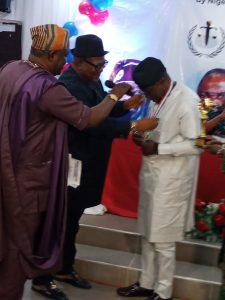
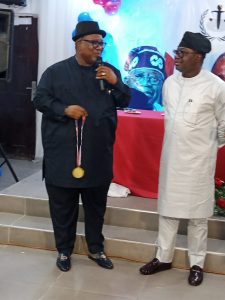
Rahman, being conferred With the Award on behalf of the Presudent
On governance process, President Tinubu has spearheaded the agitation for local council autonomy. The country needs this to further decentralise governance. We all know what operates at present and how funds that should ordinarily go to the councils do not get to them. The local governments as the closest level of government to the people deserves all the resources accruing to them to spend on their people. The local governments must get their dues. And that is what Mr. President’s agitation is all about.
I must admit here that the country may not be where it should be at present. There are still challenges; notable among them is the cost of living, which is still high.
Food prices are still high and also inflation, which rose to 33.95% in May, according to NBS. The Naira is also struggling to find its level against the dollar, hovering around N1,400 to N1,500/1$ at the parallel market. The point, however, is the Central Bank of Nigeria is gradually achieving stability for the Naira.
My appeal to our people is we must invest in our country, in our own success and in the success of this administration. Often times we appear to be the architects of our own problems, by making things difficult for ourselves.
I came across two trending videos last week that I would like to comment on and close my remarks with. There is one that showed the quantity of pepper our people sell for instance for N500 compared with what people from other ethnic group also sell for the same amount within our own domain. This is bad! We are exploiting ourselves. We must change for better.
There is another one appealing to our state governors and our people generally to take agriculture seriously and invest in our food crops in order to drive down the high cost. We will continue to impress it on our state governors who own the lands to invest in agriculture. We must take agriculture as a priority if we drive down. The food situation is a challenge to all of us. The government has a responsibility to power agriculture, we also have own too to engage in some form of subsistence farming. We must play our parts as well.
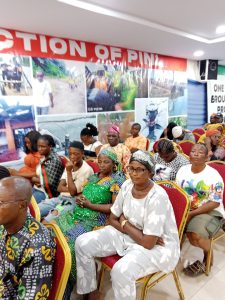
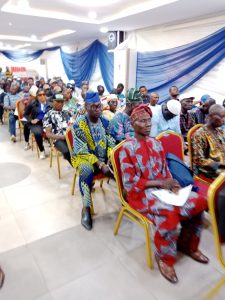
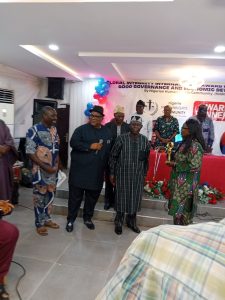
Other Faces at the Award Ceremony
The President promised that his administration would do all it takes for the average Nigerian to feel the impact of governance. He said governance must be transformative and must address the critical needs of citizens.
He spoke when he received a delegation of the Yoruba Leaders of Thought at the State House, Abuja on Friday May 24. He said the country is no longer “bleeding”, but moving gradually into prosperity.
Let me quote him partly: “We took over, and we have stopped the bleeding. I can say categorically now that Nigeria is no longer bleeding. And it will not bleed to death, but rather will now move to prosperity.” The country is gradually turning the corner.
I verily believe Mr. President will fully turn things around. I thank you for listening to me.
…..Few Remarks at the Global Integrity International Award
on Thursday, June 20, 2024 at Airport Hotel, Ikeja.
Tunde Rahman is Senior Special Assistant to the President on Media
ALSO READ:Ministers:Now the Ball in your court by Tunde Rahman
To Receive FREE Newdawn News Online on your phone, text your number to +2348104502834





Tinubus strides to Reset the Economy and Governance Process –
 By NewdawnJun 20, 2024, 14:53 pm0
808By Tunde Rahman
I welcome you all to this international award ceremony. Those who have been honoured with these awards are patriots, progressives and eminent Nigerians who played a leading role in our agitation for the rebirth of democracy in Nigeria after the military truncated it. They are truly deserving of these awards. And I congratulate them.
As most of us know, President Bola Tinubu ranks highly in this category of patriots who fought stridently for our democracy. As a Senator in 1993 after the annulment of June 12, he led a team of lawmakers who did the unthinkable under a military regime: they demanded an end to military rule.
When General Abacha came, Tinubu and others formed NADECO. For his agitation for democracy, he was hounded. His residence in Ikeja was petrol-bombed by agents of the state who thought he had died inside the house. He then escaped abroad where he continued the agitation, providing support and assistance to pro-democracy activists abroad to sustain the struggle.
I have been asked to speak on the achievements of President Tinubu in one year in office. Before I proceed, let me say that one year in the life of an administration is like a drop in the ocean. This is not to say that the regime has not done much in one year. Indeed a lot has been achieved, though some may not want to admit this.
President Tinubu has moved to reset the economy and our governance processes, and also reawake the spirit of patriotism in us by rekindling our national values.
I will elucidate on this shortly.
When I mentioned resetting the economy, I did not mean to really dwell on the removal of the fuel subsidy, which only benefited a few oil cabals at the expense of the poor it was meant to help and which is a heavy burden on the economy. I also did not plan to dwell much on the unification of the multiple exchange rates, which allowed arbitrage to walk on all fours. These two policies are important policies no doubt. They have been adjudged so both locally and internationally as necessary if the country is to move forward. I choose not to focus on them because they are yet to produce the kind of salutary outcomes we envisaged. Suffice to say, however, that we will soon get there. The pains being experienced at present will soon give way for the full realization of the benefits of the two policies.
In spite of that, I must say, however, that we are recording a gradual growth. For instance, according to the National Bureau of Statistics, the nation recorded a 2.98% growth in the first quarter of this year, higher than 2.31% recorded in the same period in 2023.
There is improving security in the land, especially in the oil producing Niger-Delta region, which has engendered increased oil production. Daily oil production has jumped up from barely 1million to about 1.5million barrels per day following the statistics provided by the Minister of State for Petroleum Resources (Oil), Senator Heineken Lokpobiri. Though it dipped a little a few days ago.
The increasing flow of investments into the economy, like the $30 billion Foreign Direct Investment commitments already secured during the year to grow the economy among others are worth mentioning.
But I want to dwell on those silent and salient achievements that are being recorded by the administration, which are largely unsung. These achievements are by no means insignificant. They are so concrete and substantial that in some instances, they are ground-breaking, either laying or re-laying the foundation for growth and development in the country.
One defining feature of the achievements recorded is that they emerged from the vision or ideas President Tinubu espoused and developed overtime, and embodied in his Renewed Hope Agenda as eight priority areas.
It is pertinent to highlight some of these gains and initiatives.
Let me begin with electricity. We have recorded some remarkable successes in the area of power, though many would insist the sector has left much to be desired given its importance as an enabler of the economy.
But believe it, a silent retooling, which promises to change the electricity situation in the country, is ongoing. Unknown to many, power generation is gradually increasing. For instance, 5000MW of power was achieved in May for the first time in three years. “Precisely on May 3, 2024, we generated, transmitted, and distributed 5,003.45MW of power. This is expected to further rise to 6000MW by the end of this year,” the Minister of Power, Chief Adebayo Adelabu, said recently.
President Tinubu did three key things, among others, to tackle the issues in the electricity supply value-chain and set the sector on the path to recovery and optimal performance. Number one, in June 2023, President Tinubu signed the 2023 Electricity Act into law, marking a significant milestone in the sector. The new law focuses on enhancing the regulation and management of the electricity value chain with the active participation of the sub-national governments. This has resulted in the process of devolution of regulatory powers to three states thus far namely Enugu, Ekiti, and Ondo to set up their electricity markets.
Two, the President gave approval to defray legacy debts owed gas companies to allow efficient gas supply for the sector going forward and payment mechanism to address generation companies’ debts.
Thirdly, there has also been a series of infrastructure upgrades in the last one year. The ongoing Siemens Power project under the Presidential Power Initiative was one of the programmes that ensured improvement of power assets in Nigeria. In December 2023, President Tinubu and German Chancellor Olaf Scholz witnessed the signing of an accelerated performance agreement aimed at expediting the implementation of the PPI to improve electricity supply in Nigeria.
Also, let me talk briefly about the laudable projects executed by the Minister of the Federal Capital Territory, Mr. Ezenwo Nyesome Wike, for to understand its significance. The catalyst for those monumental achievements in just one year, is the full autonomy granted FCT by President Tinubu over the resources accruing to the territory. By removing FCT from the Treasury Single Account, the FCT Administration’s resources were unlocked for Wike to deploy in addressing the developmental challenges of the city. Yet that singular action of the President, among others, remains unsung and perhaps unappreciated by many.
As a result of these presidential approvals, Minister Wike unleashed infrastructure on the FCT, opening up new districts with a network of roads and bridges, and resurfacing arterial roads. The minister has completed the construction of many bridges, refurbished the moribund metro line in Abuja and created access roads to the train stations, which had earlier rendered the stations inaccessible even when it was briefly operational.
With respect to the food situation in the country, and that’s the elephant in the room, the Ministry of Agriculture and Rural Development launched dry season farming involving 118, 651 hectares in 15 states, with Jigawa State alone getting 40,000 hectares. This intervention injected an estimated N309 billion into the economy. The ministry also supported a total of 107, 429 wheat farmers with inputs resulting in output of 474, 628 metric tonnes. More importantly, about 60,000 jobs were created across the agric value chain within the first year.
All of these may appear like just speaking grammar to our people. I must say however that as the administration’s substantial investments in enhancing security across the country begin to post concrete yields, this will positively impact agricultural productivity going into the President’s second year in office.
There are several other innovative programs like the Consumer Credit designed to mobilise the manufacturing sector to produce again. This will happen when the people can fund their purchases. The sum of N100billion has been earmarked for this.
There is also a mortgage fund to support the creation of mortgages.
There is the Compressed Natural Gas initiative meant to transition our people to a cheaper form of energy than petroleum for our vehicles. This is designed to restore energy competitiveness so that our manufacturing sector, our transport sector, and our economy will benefit from a cheaper form of energy that will support the economic reform.
Under the Tinubu government, the projects and initiatives undertaken thus far did not emerge by happenstance or by luck. They are well thought-out. They emerged from a vision to reengineer the country and put it on the lane to economic recovery. One of these landmark initiatives is the Renewed Hope Infrastructure Development Fund, aimed at revitalising Nigeria’s crumbling infrastructure. This fund has earmarked substantial investments for constructing and rehabilitating roads, bridges, and public amenities. The construction of the Lagos-Calabar coastal road connecting nine littoral states has already taken off.
There is also the Students Loan Fund for indigent students in tertiary institutions, which registration portal has since opened. The operating law has been reworked to accommodate skills-based students in technical schools.
Rahman, being conferred With the Award on behalf of the Presudent
On governance process, President Tinubu has spearheaded the agitation for local council autonomy. The country needs this to further decentralise governance. We all know what operates at present and how funds that should ordinarily go to the councils do not get to them. The local governments as the closest level of government to the people deserves all the resources accruing to them to spend on their people. The local governments must get their dues. And that is what Mr. President’s agitation is all about.
I must admit here that the country may not be where it should be at present. There are still challenges; notable among them is the cost of living, which is still high.
Food prices are still high and also inflation, which rose to 33.95% in May, according to NBS. The Naira is also struggling to find its level against the dollar, hovering around N1,400 to N1,500/1$ at the parallel market. The point, however, is the Central Bank of Nigeria is gradually achieving stability for the Naira.
My appeal to our people is we must invest in our country, in our own success and in the success of this administration. Often times we appear to be the architects of our own problems, by making things difficult for ourselves.
I came across two trending videos last week that I would like to comment on and close my remarks with. There is one that showed the quantity of pepper our people sell for instance for N500 compared with what people from other ethnic group also sell for the same amount within our own domain. This is bad! We are exploiting ourselves. We must change for better.
There is another one appealing to our state governors and our people generally to take agriculture seriously and invest in our food crops in order to drive down the high cost. We will continue to impress it on our state governors who own the lands to invest in agriculture. We must take agriculture as a priority if we drive down. The food situation is a challenge to all of us. The government has a responsibility to power agriculture, we also have own too to engage in some form of subsistence farming. We must play our parts as well.
Other Faces at the Award Ceremony
The President promised that his administration would do all it takes for the average Nigerian to feel the impact of governance. He said governance must be transformative and must address the critical needs of citizens.
He spoke when he received a delegation of the Yoruba Leaders of Thought at the State House, Abuja on Friday May 24. He said the country is no longer “bleeding”, but moving gradually into prosperity.
Let me quote him partly: “We took over, and we have stopped the bleeding. I can say categorically now that Nigeria is no longer bleeding. And it will not bleed to death, but rather will now move to prosperity.” The country is gradually turning the corner.
I verily believe Mr. President will fully turn things around. I thank you for listening to me.
…..Few Remarks at the Global Integrity International Award
on Thursday, June 20, 2024 at Airport Hotel, Ikeja.
Tunde Rahman is Senior Special Assistant to the President on Media
ALSO READ:Ministers:Now the Ball in your court by Tunde Rahman
Newdawn
Reactions to stories published can be sent to us at info@newdawnngr.com
Related articles
How I curb Davido’s love for cars and extravagance – Sister
No Nigerian President in the last 40 years has better plans for the country than Tinubu- Masari
OK Movement independent, not subject to NDC internal management