A highly remarkable advancement in technology which is bound to affect billions of lives worldwide is presently taking shape and it is termed Artificial Intelligence or AI. This phenomenon has the power and capability to contribute positively and negatively to all aspects of life as we know it. Although the making of it spanned many years, governments, companies and individuals are just scrambling to find ways to understand how the technology works and how it will impact life as it grows exponentially. This and other concerns are the subject of this article. How can we take advantage of it? How can we urgently identify and address potential ethical concerns and how can the government and the legislature come up with the best regulations and guardrails that will be in line with our own constitution. It is interesting to note that Artificial Intelligence was never discussed or imputed into any of the manifestos presented in the just concluded general elections. This is why it is pertinent to open the issue up.
Artificial Intelligence and Machine Learning popularly termed AI and ML respectively would contribute $13 trillion to the global economy by the third quarter of 2024 according to a study by the McKinsey Global Institute. The expected areas of the on-going ‘never before seen’ impact includes transportation, healthcare,finance, construction, software and hardware, communication, weaponries, goods manufacturing and retail and much more. The potential to create new types of jobs is huge and AI’s ability if used in fighting corruption can be extremely successful in very short time.
On the other hand, initially there would be job losses mostly in the white collar sectors, AI driven robots will likely displace factory workers, while doctors and teachers would need to re-train to earn money for their livelihood in the long run.
Or in the wrong hands, it’s ability to manipulate, fake images, cloned voices and motions could be extraordinarily devastating.
Dictators will use the technologies to target or profile opposition and locate perceived enemies without due diligence. Criminals would strive to take advantage of AI’s ability to access big data to perpetrate fraud easily and also make It hard to discover or detect in good time. Banking and identity thefts would be much more common and cyber wars are already becoming prevalent even by state actors. Worst still, weapons of war will become handy to terrorists and authoritarian regimes will be emboldened to start new wars or maximize the use of trackers and facial recognition adversarially.
So, what exactly are AI and Machine learning that has so great a potential to aid rapid development both at micro and macro level, and yet so dangerous that world leaders currently in Japan are so worried for?
In trying to explain what AI meant, the duo who coined the term, John McCarthy and Marvin Minsky defined *”Artificial Intelligence”* as ‘the domain which will train computer programs to do thing human do in a much more better, accurate and faster way’.
However as more and more development take shape, pundits now see Artificial Intelligence as the ability of machines to perform tasks that requires human intelligence on prompt. It is trained to identify objects, translate languages and make decisions without any emotions. Given that humans can not sift through very large amounts of Data with speed and accuracy , AI can crawl the millions of databases and search out precise answers for any tasks in seconds. Complex tasks like brain surgeries, Satellite photography and even soil testing from miles above are being done; talk less of traffic lights and navigations on roads and on the sea.
Machine Learning on the other hand is a subset of AI which is made to learn from data and improve performance without human interference. Just as Google map make use of ML to predict traffic situations based on previous data so that you are able to plan your journey or choose the route to your destination successfully, AI is trained to help driverless cars take decisions based on images received from cameras and from data made available by sensors. So, in actuality, ML is a tool that helps implement AI.
Meanwhile, a lot of people in the ‘developing’ countries and especially Nigeria are so enthusiastic and excited about the prospects of AI. They should be. But they must understand that there is work to do. To get a pounded yam, one must cook and beat the yam with pestle.
On the 19th of May 2023, Sam Altman, the CEO of Open AI and one of the developers of ChatGPT was at an exclusive Open AI event at Muscion Center Lagos just days after attending a Congressional hearing on AI in Washington DC. Present at Lagos event were Investors, Founders and Tech-Executives.
Sudhanshu Gaurav, the Co-founder of Incash, excitedly said “We are Looking forward to integrating AI into our startup and cannot wait to see how it makes a huge difference to the African Tech space in the next few years.” But what makes AI and ML run smoothly can be daunting and very challenging when it comes to the developing countries. Which is why governments, especially the incoming administration of Asiwaju Bola Ahmed Tinubu and Alhaji Shettima must raise the status ante very high and very fast. But what exactly is the mission of Altman in Nigeria? Investment, talent hunt or recruitment of behind the curtain zombies that power AI for peanuts?
Power, roads, railways, broadband, satellites and all communication stations are the physical infrastructures upon which digital innovations and indeed digital economy stand. In other words, AI and ML will not work optimally without them.
According to a study by African Development Bank(ADB), the African Continent, the home to over I.3 billion people needs $130-$108 a year as infrastructure funding for the next 10 years to keep pace with “chasing” the advanced countries fundamentally. If Africa must reduce poverty or if the government of Tinubu/Shettima would lift at least 25 million people out of poverty in 8 years, they must do all in their powers to industrialize Nigeria. Period!
Howbeit, they are coming in at a very bad and disadvantaged period in our history. The eras of 1980s and 90s brought unimaginable retardation to Nigeria. It was then that the so-called Washington Consensus forced the hand of our government to implement Structural Adjustment Policy known as SAP. Our government and indeed most governments in Africa were “instructed” to divert the allocation of their resources from infrastructure into importation and debt servicing and for whatever reasons, that was what happened. It is glaring today that the long term damages evident from poor or zero infrastructures militates against our ability to tap fully into the digital economy or compete in any form with countries in the advanced countries. Malice aforethought?
Well, if you doubt me, let’s consider the impact of AI in the advanced countries for a moment. Take healthcare for instance. AI is currently helping research centers to develop new drugs and innovative treatments, and to accurately diagnose diseases. In transportation, AI is being used to develop self driving vehicles, powerful unmanned aerial vehicles and to improve traffic flows. Chief of its role is in developing precision educational systems such that learning can be personalized and students can have more engaging and interactive experiences.
Furthermore, AI is helping the advanced economies to become highly competitive in the global economy especially by the automation of tasks, and precise decision making. These automatically lead to high productivity and super efficiency. By implication, brand new jobs are created and the net worth of companies increases and so are profits.
Therefore, the mistakes made by our leaders in the 80s and 90s and the current advantages of technology especially the AI are now bitting us to the bones and widening the gap between our people and their own people to about 50 years in my own personal opinion.
I will readily agree that it is difficult to calculate the exact number of years of economic and technological advancement between us, but as things stand, we have nothing on the ground to suggest we can make a quantum leap as being touted by some naïve people during the recently concluded elections. However, there are some ways that the ever widening gap can be reduced by the incoming administration led by Asiwaju Ahmed Tinubu. I know this because l have read the manifesto of APC several times. But we must not relent in reminding the power that be of their promises.
* Invest massively in education and research: Advanced countries invest more in education and research thus they always have head start in developing new technologies and knowledge.
* Find new ways for companies, start ups and scientists to access capital: Advanced countries make it easy for their citizens in various ways. People of the developing nations even when they live abroad find it hard to lay hands on capital of any kind. This particular advantage is crucial in terms of investment in new businesses or processes and new technologies.
* Take the infrastructural development as gospel! Advanced economies continually invest in infrastructures like power or green energy, roads, bridge projects, air transportation, satellites and all manners of communication networks. No business will thrive without them. Technologies can’t work in vacuum or like magic. As is our norm, we will mine natural resources to buy goods from abroad. Is this even sustainable?
* Re-engineer government policies to support economic growth and innovation deliberately and persistently. A large number of companies and young entrepreneurs l have been talking with are bullish that the new administration will make ‘ease of doing business’ a priority. The International investors, especially those in manufacturing are expecting the judicial system to be revamped so to be transparent and fast. Tax breaks are high on their shopping list; given that the risk premium for Nigeria is exceptionally high. And most people expect the governments at all levels to get into Public Private Participation (PPP) in the are of research and development (R&D) instead of service or manufacturing.
* Establish a robust Regulatory Agency for AI and Sciences related to it. As an emerging technology, AI should be constantly evaluated on daily basis in order to actively facilitate the use of new tools in a robust regulatory settings. Put ‘square pegs in square holes’: Advanced countries are yet to come up with regulations and guardrails, but when they do we should not copy them willy-nilly. Our situations and cultures are miles apart.
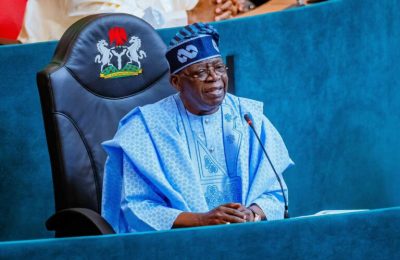
It is important to underscore the fact that given the history of Asiwaju Bola Ahmed Tinubu’s successes in private businesses and in governance, and given his penchant for team based approach to solving knotted problems, and given the caliber of people around him, the question remains: will he be able to rise up to take advantage of the potentials of AI and stand up against its dark side? Or will excuses be made that it is people around him or that some cabals are the obstacles as it was often said about Mohammed Buhari’s administration?
Pertinent is the fact that for China to make the glaring significant advancements in economic and technological development, and for the communist government to lift over 600 million people out of poverty; they needed to invest massively in education and research consistently for 30 years!
With Tinubu in the driving seat: How will he handle AI? How will the incoming government build cutting-edge Data Infrastructure? Will his team see the importance of manufacturing sensors and making access to internet cheaper and seamless just as China did? Would he and his team ensure that at least in some designated areas, Compute Infrastructure, Networking and security Infrastructures are available? These and more are pertinent questions!
Needful also to say Artificial Intelligence and Machine Learning can be seen as God sent at an auspicious time like this. Nigeria can shoot down the obstacles and leapfrog some of the advanced countries if we doggedly invest in critical key infrastructures and necessary technologies. Education will automatically make available skilled talents. Access to capital will engender investment in new and innovative businesses and will birth new players or entrepreneurs. Unrelenting investment in infrastructure will guarantee positive energies and expand the business environment that creates real and productive jobs. Re-engineering government policies will attract local and foreign investors. And, robust regulations will help check negative and serve as deterrent.
The expectation of Nigerians are great on the warrior aptly entitled the Jagaban of Borgu!