
By Charles Okogene and Dayo Emmanuel
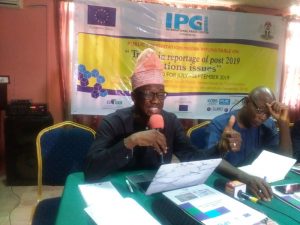
The Chief Press Secretary to the Chairman of Independent National Electoral Commission (INEC), Mr. Rotimi Oyekanmi, is worried that the Nigerian media is not holding political parties and their candidates accountable to the promises they made to the people on the soapbox during their electioneering campaign. Instead, he said they focus so much on how INEC organises the election.
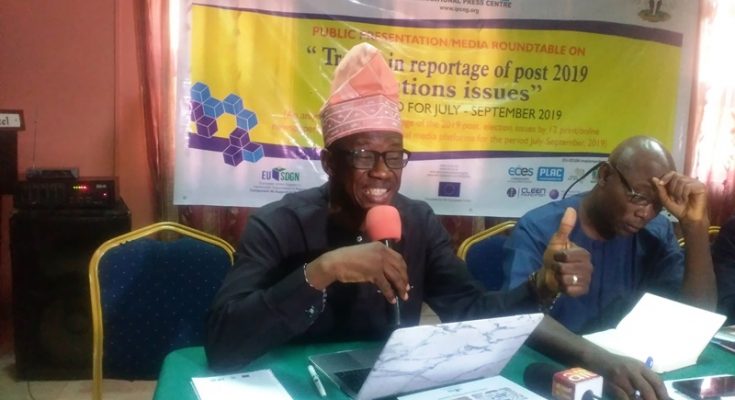
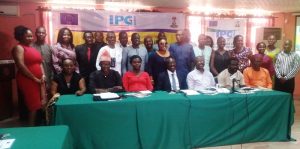
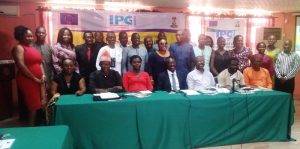
Oyekanmi made his worry known when he spoke in Lagos during the Public presentation/Media stakeholders’ roundtable, “Trends in reportage of post 2019 elections issues” (Scorecard for July -September 2019) by the International Press Centre (IPC). A journal produced in conjunction with EU-SDGN European Union Support to Democratic Governance in Nigeria.
Not only that, he also believed that if politicians play the game of political electioneering and stop sponsoring those who resort to violence on election days, the cases of election violence will be minimised.
He told the gathering that INEC is open and transparent and that the commission is trying as much as possible to provide information to the electorate and agreed that it still has a long way to go.
According to him measures are being taken to encourage youths to register and vote. The measure, he said, include cooperation with the European Union, Nollywood stars, 2baba to sensitise them.
He observed that in compiling the journal, IPC considered only INEC’s twitter handle but did not bother about its facebook page that has over 300,000 followers though, very small, compared to the number of registered voters.
However, on his worry that the has neglected the aspect of holding the politicians accountable to to their promises, Mr. Femi Owolabi of the Cable, an online platform, who was one of the panelists at the event, disagreed with him that the media do not hold politicians to their promises.
Owolabi cited the case of a promise made by the Governor of Lagos State Governor, Mr, Babajide Sanwo-Olu, that he will clear the Apapa gridlock in 100 days if elected and that The Cable started a count down when he assumed office and that when it was 100 days and nothing was done to clear the gridlock, The Cable wrote the story and Sawo-Olu said he was misquoted.
The question by the INEC spokesman to know why people are eager to vote for Big Brother Nigeria (BBN), instead of the general elections which determines their life, a participant simply answered that because the process of BBN election is more credible, transparent and that voters’ vote do count unlike that of INEC.
ALSO READ:Sanwo-Olu plans to restrict trucks’ movement to ease traffic in Lagos
As his contribution to the roundtable discussion segment, Mr. Sakibu Olokojobi, the publisher of Frontpage, an online platform called on journalists to be cautious of press releases from government or governors’ spokesmen as it could be skewed to favour their principal and not necessarily the truth .
Earlier, while reviewing the journal, Dr, Akintunde Akanni, senior lecturer, School of Communication, Lagos State University, LASU. commended IPC for a job well done and described the report as “invaluable for research and consider it as indispensably didactic for the media, INEC and the rest of us.”
Not only that he further said, “distinguished colleagues, IPC’s role here is commendably developmental. Specifically it fulfils that of a peace builder. It did not elect to merely romance with the vast data but goes on to offer what I deem as clearly as constructivist and actionable suggestions as evident in the report especially in the recommendations. It’s a thorough scientific study of contents of selected media and INEC website, distinguished colleagues, NOT SERVER!
“This intervention is in line with the vision of the duo of Diamond and McDonald in 1996 as the brains behind multi-track diplomacy originally conceptualized for conflict situations in the international context though. It is a web of interrelated but distinct entites considered to be very relevant to conflict resolution from time to time. Don’t we all agree that elections are like wars in Nigeria?
“The idea originated from the increasing concern with the inefficiency of pure government mediation. It is a design intended to incorporate all aspects of mediation from the ground-level work of private citizens to the top-level meetings of heads of governments. Ladies and gentlemen, please recall that IPC states clearl in the report being presented that it set up “quarterly media roundtables are normally convened… to enable media and other electoral stakeholders draw relevant lessons relating to the need to adhere to professional and ethical standards in the coverage of the electoral process and governance issues with a view to avoiding hate speech, being conflict-sensitive and giving prominence to the issues of citizens, women, youths, persons living with disabilities (PLWDs), etc.
“Nine in all, media and communication/public opinion is the ninth but central to the rest eight. This Media and Communication/Public Opinion track is the realm of the voice of the people including how public opinion gets shaped and expressed by the press and other genres of mass media. Peace Activism such as encompassing Non governmental organizations which is the category IPC falls constitute(s) Track 6 of MTD. Such is the acceptability of MTD today that a whole institute is dedicated to it to perpetuate its understanding by serving and potential diplomats.
“IPC’s trajectory in peace activism dates back to 2006 when it published its first work on media and religious conflicts. It reinforced this with yet another publication in 2008. So, it is indeed a case of working on familiar turf.
“However, perhaps for reasons ranging from multiple deadlines for projects and the likes, this report could have attained a better perfection. Most fundamental in this regard is the obvious uncertain deployment of some technical concepts the most conspicuous being on page 5, 6 and 17”