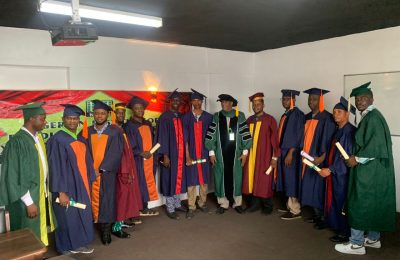

In its bid to contribute to increasing performance and enhance productivity in the manufacturing sector in the country, the Nigerian Institute of Production management is organising a talk show to mark it’s annual general meeting.
According to the President and chairman of the bodies governing council,Dr Olaniyi Opanuga,in a press statement,the topic of this years National workshop and AGM is :STRATEGIES FOR EFFECTIVE MANUFACTURING,SUPPLY CHAIN AND LOGISTICS COST REDUCTION
He said the need to discuss on this have become imperative if the federal government must address the issue of graduate unemployment caused by closure of industries relocating out of the country for better deals outside.
He said that the federal government must faithfully implement the industrial policy to encourage big industries to remain in the country and help cut cost and boost employment.
Said he,”Cost is not just a component of value but it is also a chief determinant of competitiveness of organisations and the economic wellbeing of a nation. Cost is a key performance indicator ( KPI) in manufacturing companies globally. ”
He stated that government industrial policies and microeconomic initiatives not directed at taming costs and boosting productivity will not help consumer price index ( CPI) and general inflation rate adding, “the Central Bank of Nigeria (CBN) will continue to tinker with its regulatory framework to no avail until production is given its rightful place in the country.”
Opanuga argued further that the need for strategic cost reduction by Nigerian Manufacturers has become more pronounced in view of the need to achieve global, regional and local competitiveness,profitability and growth in the face of daunting challenges of the nation’s economic environment.
According to him “Nigerian manufacturers are operating in a difficult and dicey business terrain given such factors as high cost of energy,multiple taxation, infrastructural deficit, high cost of borrowing, epileptic power supply, inadequate security, inflation, currency devaluation among other factors militating against industrialisation and price competitiveness of MADE- IN – NIGERIA.”
“As professional production and operations management practitioners we are concerned about productivity, quality,safety and customer value for rapid industrial development and economic growth of the country. ” he added
He further disclosed that “at this 2019 National Workshop and Annual General Meeting we are gathering to discuss ways and means by which company CEOs and directors, managers and executives responsible for production, operations, supply chain and logistics can save costs for enhanced customer value and sustainable profitability and growth”.
The NIPM he stated is “looking at sustainability in terms of responsible manufacturing with consideration for safety and environmental protection, leveraging technology for continuous improvement, production of high quality and reliable products, excellent customer service,and the use of renewable energy resources. We are reviewing the trends and challenges regarding drivers of manufacturing,supply chain and logistics costs in organisations with a view to profering solutions for better bottomline results.We are also cross learning and sharing knowledge on global best practices in an attempt to achieve greater efficiency and effectiveness of our industrial operations”.
He said this years AGM is also informed by its belief that, “As a professional body that regulates the practice of production and operations management in the country, the Nigerian Institute of Production Management( NIPM) and its affiliated training institution…the College of Production And Operations Management ( COPOM) want the Federal Government to tackle the hyraheaded issues of youth unemployment, insecurity ,poor infrastructure and inflation as a matter of urgency”.
Still on tackling the problem of unemployment,the institute wants the federal government to pursue the Nation’s industrial policy with seriousness adding,”the Nigerian business environment is uncertain and costly. It stiffles innovativeness and creativity. It discourages entrepreneurship and business start ups. It kills investment ideas. It cages effective industrial capacity utilisation. It is absurd that companies like Dunlop Nigeria Plc and Michelin have relocated to Ghana where they are now doing well…..and others are planning to leave or close down their factories in Nigeria. ”
Dr Opanuga contended that it is the institutes belief that the country “should not be a dumping ground for foreign goods.Rather, our economic base should be diversified with manufacturing at the front burner…providing value added for exports and earning desired foreign exchange. With the right industrial incentives and by creating an
enabling business environment the government will be able to stabilize the nation’s balance of payment position.”