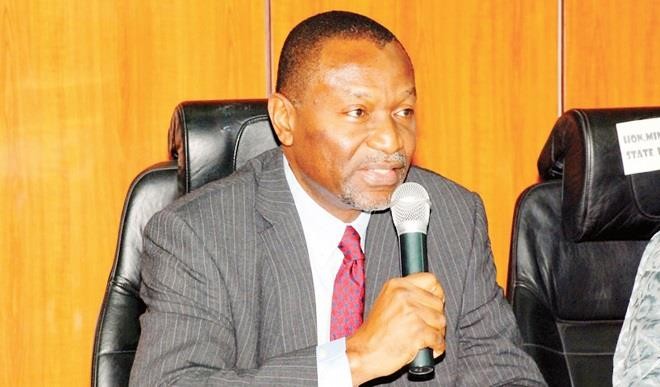

Today in Lagos, the Minister of Budget and National Planning, Senator Udoma Udo Udoma, was the keynote speaker at the 42 Annual Conference of the Institute of Chartered Secretaries and Administrators of Nigeria ICSAN). He spoke on the theme: Exploring the diversification agenda towards the emergence of a resilient economy.
KEYNOTE ADDRESS
By Senator Udoma Udo Udoma, CON Honourable Minister of Budget and National Planning At The 42nd Annual Conference of Institute of Chartered Secretaries and Administrators of Nigeria Shell Hall, Muson Centre, Onikan, Lagos November 8, 2018.
Protocols,
I am delighted to join you today at your 42nd Annual Conference. This is a very busy period for us at the Ministry of Budget and National Planning and my schedule has been quite hectic. Apart from having been tied up in negotiations with labour to avert the threatened strike over the issue of a new national minimum wage, I am also very busy holding meetings to finalise the 2019 Budget.
2. However, I felt it was important to honour your kind invitation to speak at this conference, particularly given the theme you have selected for the Conference namely: ‘Exploring the diversification agenda towards the emergence of a resilient economy’. This theme aligns completely with the aims and objectives of this Administration’s agenda as set out in the Economic Recovery and Growth Plan (ERGP). The ERGP was launched with the objective of, firstly, leading Nigeria out of recession and then, thereafter, placing the economy on the path of growth. But this time, growth that is truly diversified; growth that is also inclusive, carrying all segments of society along; and, most importantly, growth that is sustainable and resilient. In short, the Economic Recovery and Growth Plan represents the Buhari Administration’s agenda towards the emergence of a resilient Nigerian economy. So, let me thank the President and Council Members of the Institute for giving me an opportunity today to speak to you about the ERGP, which, as the Minister of Budget and National Planning, is indeed my passion.
3. Before addressing you on the ERGP, permit me to commend you for a well managed Institute, which I understand has been in existence for over 50 years; first, as an associate of the international body and later as an autonomous body since 1988. I understand that ICSA has, over the years, helped in the development of critical skills, knowledge and experience for governance professionals, particularly in the areas of professional certification, training programmes, quality guidance and technical expertise and know-how. Please keep up the good work.
4. Distinguished Ladies and Gentlemen, now to the topic ‘Exploring the Diversification Agenda towards the emergence of a resilient economy’. I recall when I was in secondary school in the 1960’s the concern of our policy makers was about our dependence on the export of a few agricultural crops, namely; cocoa from the West, groundnuts from the North and palm oil from the East. Even as a school boy there was discussion about the need for Nigeria to go beyond the production of commodities and to aspire to becoming an industrial society.
5. It is most embarrassing for us in Nigeria that over 40 years later we are still lamenting the same condition. Now our dependence is no longer on crude palm oil exports, or groundnuts exports, or cocoa exports, but on the export of unrefined oil and gas. As you know large reserves of crude oil were discovered in the country and as our revenues from crude oil exports increased, we neglected agriculture and became more and more dependent on the oil and gas sector. Indeed, since the 1980’s the oil and gas sector has become the major source of government revenues. Even more worrying, the economy has become over reliant on oil and gas exports for our foreign exchange earnings. This over reliance has made the economy hostage to the fortunes of the oil and gas sector.
6. Prior to the coming into office of this Administration, as from the middle of 2014 oil prices began to drop dramatically. They declined from US$111 per barrel in June 2014 to about US$64 by the time President Muhammadu Buhari was sworn in at the end of May, 2015. Thereafter, it continued its precipitous drop, falling to below US$30 per barrel by January 2016. President Buhari therefore came in to meet a crisis of major proportions!
7. In the absence of any fiscal buffers built up when the price was high, the economy was set on a downward spiral. The situation was compounded by a fall in oil production caused by the disruption of oil production in the Niger Delta region by a resurgence of militant activity. The resulting foreign exchange scarcity led to a suffocation of many businesses. This caused a general reduction of economic activity, forcing some employers, particularly in construction, to lay off staff. Consequently, tax collections and customs revenues dwindled, thereby constraining the ability of government to generate non-oil revenues. This, in turn, led to a loss of confidence in the economy by both foreign and local investors. In short, we came in as an Administration to meet a perfect storm!
8. Just to share some numbers with you. Oil revenue accruable to the Federation Account declined from N4,075.5 billion in 2014 to just N1,438.8 billion in 2016. Foreign reserves dropped from $37.33 billion in June 2014 to as low as $23.81 billion in September, 2016. The Capital Market went into a prolonged bear run and the balance of payments turned negative. It was no surprise, therefore, that growth initially slowed and then turned negative as the economy slid into recession by the second quarter of 2016 registering GDP growth of -1.49%, from where it dipped further to -2.34% by the third quarter of 2016. To compound matters, inflation increased from 9.2% in June 2015 and to 18.5% by December, 2016. We were in what economists refer to as stagflation! That is to say, low growth at a time of high inflation and worsening unemployment.
9. Distinguished Ladies and Gentlemen, those were very worrying times. However, as you may recall President Buhari had promised to do three things – fight corruption; restore security; and fix the economy. We were therefore determined to halt the economic decline. We accomplished this, first, by introducing an expansionary fiscal budget in 2016 to reflate the economy and stimulate economic activity. This expansionary budget was accompanied by the Strategic Implementation Plan (SIP). The SIP consisted of a series of short-term measures aimed at boosting economic activities so as to restore confidence. We followed this up, after extensive consultations with all segments of society, with the launching by the President of the Economic Recovery and Growth Plan (ERGP) 2017 – 2020. In developing the ERGP we consulted the States; we consulted the National Assembly; we consulted our development partners; we consulted members of academia and leaders of thought. And, most importantly we consulted the private sector, including small and medium scale enterprises. And when the ERGP was launched it received broad acceptance. It was designed to stop the economic decline and restore the economy to the path of sustained, inclusive and diversified growth driven mainly by the private sector.
10. As you are aware, the ERGP has three broad objectives of restoring and sustaining growth, investing in our people and building a globally competitive economy. The Plan seeks to achieve growth that also generates jobs for Nigerians and widens economic opportunities for all our people. Chapter 3 of the ERGP is devoted to strategies to deliver on the diversification objective. It focuses on initiatives to expand the productivity of key sectors of the economy such as agriculture, manufacturing, solid minerals, services as well as construction and real estate.
11. The aim of the ERGP is to change Nigeria from a nation with high import dependence to one that makes most of the products it consumes; from a nation that relies on a single commodity for survival to one that runs on multiple engines of growth; and from a nation of consumers to a nation of producers. As Mr. President has said, the ERGP is aimed at building a new Nigeria where “we grow what we eat, consume what we make and produce what we use”.
12. The five key execution priorities in the ERGP are tailored towards building a diversified and resilient economy. These are ensuring stability in the macroeconomic environment, achieving agricultural transformation and food security, ensuring energy sufficiency in power and petroleum products, improving transportation infrastructure, and driving industrialization focusing on Small and Medium Sized Enterprises (SMEs).
13. As the Minister of Budget & National Planning I have tried to ensure that budgetary allocations reflect these priorities. For instance, in Agriculture, from a rather small capital allocation of N8.8 billion in 2015, capital allocation to Agriculture has improved to N46.2 billion in 2016, N103.8 billion in 2017 and to N149.2 billion in 2018. Allocations to the Ministry of Water Resources whose activities impact on agriculture have also been increased from N15.78 billion in 2015, to N46.08 billion in 2016, N104.25 billion in 2017 and N147.2 billion this year.
14. Through the Anchor Borrowers’ Programme, over N120.6 billion has been disbursed as concessionary loans to more than 800,000 farmers for the cultivation of 12 different commodities including rice, wheat, cotton, soya beans, cassava, and groundnuts. To date, 11 Fertilizer Blending Plants with the capacity to produce 2.1 million metric tonnes have been revitalized, leading to a significant drop in fertilizer prices per bag. With these initiatives, we have witnessed a significant drop in rice importation. Other agricultural initiatives include the National Sugar Master Plan and the new Tomato Policy, which have both been approved by the Federal Executive Council (FEC). This has led to increased local production of sugar, particularly in Niger and Adamawa States by Golden Sugar Ltd. and Savannah Sugar Ltd.
15. Successful agriculture requires an expansion in processing and other facilities to ensure sustained demand. Under the ERGP we are committed to intensifying the implementation of the Nigeria Industrial Revolution Plan (NIRP). In this context, we have commenced the establishment of new industrial parks, as well as upgrading existing industrial parks. We are also establishing, in partnership with the private sector, Special Economic Zones (SEZs) across the six geo-political zones in the country. In the 2018 Budget, N44.2 billion was set aside as counterpart funding for Special Economic Zones.
16. In addition, government has set up an Industrial Policy & Competitiveness Advisory Council (Industrial Council), with extensive private sector membership, as a vehicle for partnering with the private sector on the industrialization drive. One of the projects supported by the Industrial Council, is a project to increase broadband penetration across all geopolitical zones of the country. This project is intended to ensure that within the next four years every single one of the 774 LGAs in the country will be provided with fibre connectivity.
17. As I indicated, the ERGP emphasises the need for industrialisation policy to be focused on the MSME’s. Because many of our small-scale enterprises lack capacity, Government has been running MSME Clinics to build capacity. These Clinics which are being held across the country have been personally led by His Excellency, the Vice President, Prof. Yemi Osinbajo. The first clinic was held in Aba in January, 2017.
18. To improve access to finance, which is another problem faced by many MSMEs, the Bank of Industry (BOI) is operating the Youth Entrepreneurship Scheme (YES) programme that provides discretionary funding for National Youth Service Corps (NYSC) members as well as other young entrepreneurs that wish to start their own businesses. To date, the BOI has approved over N1.7 billion to more than 1000 beneficiaries and is collaborating with 21 state governments on implementing similar arrangements. The Bank’s total lending to MSMEs in 2017 was over N112.5 billion. To enhance their capacity N15 billion was provided in the 2018 Budget to support the recapitalization of the Bank of Industry (BOI) and the Bank of Agriculture (BOA).
19. To reduce our dependence on crude oil for our foreign exchange, we are committed to expanding our exports of other goods and services. To this end, a National Committee on Export Promotion was set up in September last year to implement the Zero Oil Plan (ZOP) as envisioned in the ERGP. This Committee, which is working in close collaboration with the State Governments, has promoted the establishment of Domestic Export Warehouse and Aggregation Centres in each of the 6 geo-political zones of the country. The Committee is also promoting Project MINE. The acronym ‘MINE’ stands for Made-in-Nigeria for Export. Under Project MINE the Special Economic Zones will be used as the mechanism for making Nigeria the pre-eminent manufacturing hub in Sub-Saharan Africa and a major exporter of Made-in-Nigeria goods and services regionally and globally. This project, which has been approved by FEC, has secured early commitments from domestic and foreign investors in textile & garments and agro-processing. Government is also reactivating the Export Expansion Grant (EEG) Scheme and the Export Development Fund (EDF) Scheme, with the sum of N13.28 billion provided in the 2018 Budget.
20. As you can see from all of the above, the ERGP aims to expand and increase private sector investment. We have therefore prioritized improvements in the business climate to make Nigeria an attractive place for business to be conducted. The Presidential Enabling Business Committee (PEBEC) was set up to focus attention on this. These efforts are bearing fruit as recent surveys conducted by the Nigeria Investment Promotion Commission (NIPC), indicate that there has been a significant rise in interest in investing in Nigeria. The NIPC reports that for the first 3 quarters of 2018 (January to September 2018), a total of $73.08 billion worth of proposed investments were announced for 65 projects in 18 states and the FCT. The sectoral analysis of the announcements indicates 11 sectors of interest with mining & quarrying accounting for 43% of the total value, construction 25%, manufacturing 23%, electricity, gas, steam and air conditioning supply, and transportation and storage, each 3%, and the remaining sectors accounting for 2%. Whilst not all announcements become successfully executed projects the increase in announcements signals improved confidence in the economy.
21. Also, earlier in the year, as part of the many initiatives we are introducing to help investors, we conducted Sector Specific Focus Labs in Agriculture and Transportation, Manufacturing and Processing and in Power and Gas. These are some of the execution priority areas identified by the ERGP. Basically, the Focus Labs involve inviting potential investors to meet with key government officials and regulators with the objective of addressing any bureaucratic issues the investors might face in setting up projects in Nigeria. This time we kept them together for about six weeks during which all the relevant Ministers dropped by to see the potential investors and deal with their issues. Some of the early successes recorded in this first set of Focus Labs was our development of a National Gold Development Policy and the establishment of a Federal Gold Reserve Scheme in Nigeria. After this first set we are committed to holding more Focus Labs.
22. Distinguished Ladies and Gentlemen, we are not where we want to be, but there is no doubt that we are making significant progress in resuscitating the economy. Not only is Nigeria out of recession, the country is beginning to grow again particularly in the non-oil sector. The non-oil sector of the economy grew by 2.05% by the second quarter of this year – representing the strongest growth in the sector since the fourth quarter of 2015. The Manufacturing sector, which had experienced consistent quarterly contraction since Q1 2015, except in Q4 2015, has started growing again. At 0.68% in the Q2 2018, this growth is still quite low, but it is movement in the right direction. The Textile sub-sector improved from 0.2% in Q2 2017 to 2.73% in Q2 2018, while Cement which contracted by -4.16% in Q2 2017 by Q2 of this year is now growing at 3.84%. Whilst still very far from our targets these are very positive movements.
23. By way of further illustration of the direction of movement, the Purchasing Managers’ Indices (PMI) for manufacturing which had consistently stayed below the 50 points threshold between January 2016 and April 2017, has risen to 56.8 index points in the month of October 2018. This indicates expansion in the manufacturing sector for the 19th consecutive month. This expansion was driven by improvements in business activities, production and employment across most sectors.
24. Other economic indices are also improving. Inflation rates have maintained their declining trend. From a peak of 18.7% in January 2017, inflation started trending down gradually to 11.14% in July 2018. However, it went up slightly to 11.28% in September 2018. The external reserves have nearly doubled since September 2016, from $23.81 billion to $41.79 billion by early November this year. The exchange rate gap has narrowed, and confidence in the economy is returning. Capital inflows have risen from $710 million in the first quarter of 2016 to $5.5 billion by the second quarter of this year. Supported by a gradual recovery in oil prices, as well as the level of oil production, our exports have grown by 59.5%, from N8, 527 billion in 2016 to N13, 598 billion in 2017, and our trade balance has grown from a deficit of N290.1 billion in 2016 to a surplus of N4, 035.5 billion in 2017. The good news is that this increase in exports includes a significant increase in non-oil exports.
25. There is no doubt that we are making good progress in our efforts to revive and diversify the economy. However, is the economy sufficiently diversified? My answer is not yet. Whilst the oil and gas sector constitutes less than 10% of our GDP, it still represents too large a percentage of our foreign exchange earnings. We need to grow our non-oil exports to overtake oil in terms of our foreign exchange earnings as countries such as Malaysia and Indonesia have achieved. This will take some time. However, there is no doubt in my mind that we are on the right track. If we consistently and faithfully continue with the implementation of the ERGP we will become an economic production powerhouse. We will be able to feed ourselves and have extra for export. We will be able to manufacture many of our basic requirements. We will be able to grow our non-oil exports to overtake our oil exports in value.
26. We have been implementing the ERGP for only 18 months. If we stay the course and continue implementing the programme in a focused and consistent manner we will surely have the Nigeria of our dreams where we grow what we eat, consume what we make and produce what we use.
27. Let us all work together to achieve that new Nigeria. I thank you for your attention and wish you a very successful Conference.