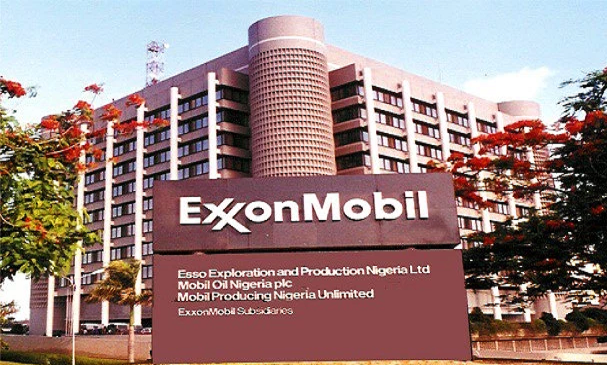

The blockade of ExxonMobil facilities by former employees in Nigeria threatens over 550, 000 barrels of crude oil production at the company’s installations in Nigeria, the United States (U.S.) oil giant has said.
The company, Reuters said in a report disclosed this, adding that “disruptions to these operations have the potential to significantly impact revenues.”
The company made the announcement in a statement after a six-week blockade by former workers at the oil facilities.
Mobil Producing Nigeria, the ExxonMobil subsidiary that released the statement, produces over 550,000 barrels per day of crude oil, condensates and natural gas liquids, according to the company website.
Nigeria’s average production in the second quarter of 2018 was 1.8 million barrels per day, according to the country’s statistics office.
The blockades were described in ExxonMobil’s statement as the “playing of loud music, defacing of company facilities and intimidation of personnel.”
The “continued denial of access to production facilities could impact the company’s ability to safely continue production operations,” ExxonMobil said.
Eight hundred and sixty spy police sacked by Exxon- Mobil have, added a new twist to their protest, threatening major operations of the company, including crude lifting.
The bickering, which began on July 13, over the interpretation of Supreme Court judgment in the industrial case, is already turning out to be the major threat to the company’s operations in Nigeria.
The enraged protesters who had, for over a month, barricaded the company’s major offices, including its headquarters in Lagos, have now blocked the water route, which has been serving as the alternative road for, officials of the company.
The operations and other offices’ activities of the company, which is the second biggest international oil company in terms of assets and production in Nigeria, is already under threat due to blockage of alternative routes into its headquarters.
Until the 2016 sale of its downstream assets to NIPCO Plc, Exxon Mobil was also a big time player in the nation’s multi-billion dollars downstream sector. Clad in red attires, the protesters, who had been sleeping at the gates of the company, told newdawnngr last weekend that they are mulling further actions that could “make the company to reconsider its (alleged) disobedience for Nigeria’s law.”
Besides, picketing of company’s air hanger, one of the protesters said, is on the card. “It takes us this long to act in that direction because ExxonMobil uses the hanger with other companies, but we shall act accordingly,” one of the protester said, expressing joy over the effect that the blockage of alternative water route into the company’s headquarter is having on its operations.”
ExxonMobil and the 860 spy police sacked by the company have also continued bickering over the interpretation of Supreme Court Judgment in the case, as well severance benefits and pension earmarked for the disengagement.
The benefits totaling about N1.2 billion, according to a source at the company, include severance benefits, pension and full month salary for July and August. While 500 of the spy police were sacked in July, the remaining over 360 security men have been disengaged before the Supreme Court’s judgment of April 20, 2018.
The company shut its Nigeria headquarters’ gate as protest, which started at the company’s Qua Iboe Terminal (QIT) in Ibeno Local Government of Akwa Ibom State in Akwa Ibom last weekend, spread to Lagos.
Newdawnngr observed that the workers who had earlier on July 13 barricaded Mobil Housing Estate at Marina road, Eket Local council of Akwa Ibom, came to Lagos on July 17 with similar placards they displayed in Akwa Ibom with various inscriptions such as “ExxonMobil masters of slave labour;“ and “Calculated disobedience of supreme court judgement on its employees is an insult to the Federal Republic of Nigeria. ExxonMobil comply with Supreme Court Judgment.”
Other inscriptions include, “ExxonMobil sacked 860 Nigerian workers after over 22 years of slave labour,” “Exxon- Mobil respect the rule of law”, “Supreme Court of Nigeria is higher than ExxonMobil,” among others.