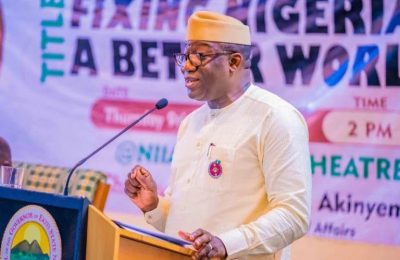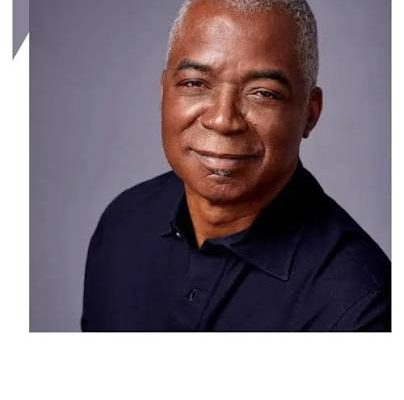

Dr Tunji Olowolafe
After the Kiriji War of 1877 to 1886, our forefathers chose these iconic hills, for their majestic
beauty, strategic security and temperate climate. Perhaps that is why Ekiti people carry such unmistakable pride in our heritage, our value and our good looks. Some may even boldly argue
that we are the best-looking people in Africa.Both my parents came from Are-Ekiti, the heart of
Ekiti, making me – a true son of the soil. Perhaps that is my principal qualification.
My father was just six years old when his parents passed away. Orphaned and destitute, he became an apprentice to a travelling babalawo, moving from town to town. My father shared that, they would contaminate the local streams ahead of their arrival in a village and enter the settlement offering herbal remedy. That was how a six-year-old child found food, a few coins and shelter.
Then Christian missionaries spotted him in one of those villages and asked why such a bright boy was not in a classroom. They enrolled him in school, and that destitute boy went on to excel in his studies, becoming one of the indigenous corporate directors at Total Nigeria Limited.
First, on governance – Ekiti has been blessed with successive leaders, who each contributed to building our State. We honour Otunba Niyi Adebayo, Ekiti’s first elected civilian governor, who established the foundation of our democratic governance, and his wife, Erelu Angela Adebayo, now Nigeria’s Ambassador to Portugal. We are equally grateful to every governor who has served since then: our current standing reflects their cumulative stewardship.
Second, our education tradition. Education is the central priority in Ekiti homes. Our state hosts seven federal, state and private universities, alongside seven polytechnics and eight colleges of education, health, science and technology. Among them are Ekiti State University, today the best state-owned university in Nigeria, and Afe Babalola University, one of the top three private universities in the country. Per capita, we are an intellectual powerhouse. In an average Ekiti household, if you do not have a master’s degree by thirty, your family may begin organizing midnight prayer sessions for you. This year, the highest-scoring candidate in the national JAMB examination came from our State. I recall, forty-two years ago, when I informed my family that I would not pursue specialist clinical residency training after my MBBS – I kid you not, they wept openly!
Third, our collective future. Artificial intelligence, robotics, biotechnology, automation and new energy systems are transforming how humanity learns, works, produces and trades at an unprecedented speed. Disruption is inevitable, what remains to be determined is who will lead and who will lag behind. AI will always be directed by people with knowledge, skill, imagination and integrity.
Ekiti has comparative advantages to lead – a culture that values merit and ethics, strong tertiary institutions, and a disciplined work ethic. Our professionals excel naturally from Journalism, Medicine, Engineering to Law, where figures like chief Wole Olanipekun SAN, represents our tradition of excellence.
The central question is, how do we translate – our academic knowledge – into social and economic transformation that eliminates poverty in communities and creates sustainable wealth. It requires emphasis on three fundamentals: reliable power, practical vocational skills and direct connections to industrial supply chains and global markets.
Ekiti State comprises 177 political wards. I propose an immediate, ward-by-ward technical audit to establish local microgrids powered by renewable energy in each ward. In many wards a solar microgrid of 300 to 500 kilowatts can power a school, a health Centre and a cluster of workshops and small businesses. These projects are bankable, and within the States execution capacity. Support from Rural Electrification Agency (REA) will accelerate this effort.
The future economy will reward practical competence. Our primary investment as a state must be vocational education: solar installation, welding, fabrication, machinery repair, food processing and high-value technical trades.
Ekiti has already established six government technical colleges equipped with modern workshops and apprenticeship pathways. However, six colleges cannot truly address the demand from the hundreds of thousands of youths across our sixteen local governments who want practical training. We must expand this capacity by modernizing the curriculum and directly hiring master vocational instructors from nations with elite technical education systems – such as Switzerland, Germany, Canada and South Africa – to train our faculty and connect our colleges digitally to clients and employers everywhere.
We must elevate technical professions. Skilled trades are primary, high value career positions. Industry partnership is key to this transition. When major industrial firms participate in curriculum design, deploy engineers to teach, and recruit directly from technical workshops, youth participation will follow employment opportunities. We have seen this model succeed: EKSU civil engineering students have undergone practical training on the Lagos Calabar Coastal Highway for 6 months!
When, and not if, industrial developments like Dangote Refinery routinely recruit certified welders, fitters and instrumentation technicians from our own Ekiti Technical Colleges, technical education will be recognized as a promising career path. Pathways must be flexible, allowing certified technicians to advance to academic leadership and University Engineers to master specialized practical trades.We must link power with skills, skills with enterprise, enterprise with physical and digital infrastructure.
On the digital side, the Ekiti Knowledge Zone is now under way. Conceived under former Governor Kayode Fayemi and being implemented by Governor Biodun Oyebanji. Once complete, it will give our young people a place to build technology ventures without leaving Ekiti, serving clients in Lagos, London and Singapore, and bringing that income home to Ekiti. That is how education becomes wealth.
On the physical side, the Ekiti Agro-Allied International Cargo Airport perfectly illustrates what continuity in leadership can achieve. The former Governor Engineer Segun Oni conceived the idea. Former Governor Dr Ayodele Fayose, acquired and cleared the site. Dr Kayode Fayemi began construction and I congratulate Governor Biodun Oyebanji who brought this vital gateway to completion.
Equally vital are our road networks. Few people understand this better than Aare Afe Babalola, SAN. He was one of the strongest voices in the struggle for Ekiti State. At an age when most people retire, he founded Afe Babalola University. A few months ago, Baba Afe expressed concern about the Ado-Ijan-Ilumoba-Ikole federal road, which leads to his university.
Thanks to the advocacy of Senate Majority Leader, Senator Opeyemi Bamidele, the contract has been awarded and work has begun. For this, we are deeply grateful to the President, Bola Ahmed Tinubu, GCFR.
Ekiti’s development requires a strong culture of empirical inquiry.
When I was a young boy, I was bitten by a snake. My grandmother quickly prepared a traditional herbal remedy and applied it to the bite. She assured me with absolute conviction that it would neutralize the venom and permanently protect me from snakes in future.
My childhood friends took that second promise very seriously. Whenever our football landed deep in the bush, they would send me in to fetch it. After all, I was the boy the snakes had officially agreed to leave alone!
However, my late uncle, Professor Femi Elegbeleye, took me to Lagos University Teaching Hospital for a clinical antivenom treatment, years later, during my medical training, I understood lethal risks of untreated snake bites.
My grandmother acted out of love, using the knowledge she trusted. My uncle also acted out of love, using empirical medical science. The lesson is not to disparage tradition, but to insist that when lives, health or livelihoods are at stake, we must seek the best evidence available. That is the culture I want for Ekiti: where a child can question an assumption without being accused of disrespect, and where our universities, workshops and artisans test ideas and put working solutions into people’s hands.
In Are-Ekiti, the town where I am reliably informed that all Ekitis originated from, the Tunji Olowolafe Foundation, which Governor Oyebanji inspired me to set-up is investing in that future – where assumptions are tested and practical solutions verified. It began by listening to our community.
The Are-Ekiti Progressive Union told us plainly what the community needed most. Are-Ekiti had no secondary school of its own. Together, we set out to implement to achieve this objective. The Gbemisola Olowolafe Memorial Community Secondary School, approved and managed by the State Government, opened in September 2025 with 100 students, and today it has over 170.
Our ambition is to grow into a world-class school of 600 students grounded in science, technology, languages, arts, and sports. Adjacent to the school, an ICT Centre – GOMTECH – offers courses in artificial intelligence, coding, graphic design, and Mandarin.
People often ask me why I have not built myself a big country mansion in Are-Ekiti. Perhaps I will someday. But right now, I would much rather build a school where a child can discover what he or she is truly capable of. My hope is that one of its graduates will become so successful that he or she will build me a beautiful home in Are. That would be a return-on-investment worth waiting for!
The same thinking drives our work at Ekiti State University, where the Governor appointed me Chancellor in 2024. Through Project Digi-Teach EKSU, we are bringing all 650 lecturers to full digital teaching proficiency, and our Trading Room has grown into a Senate-approved diploma programme in financial markets.
We have also installed high-speed Starlink internet at twelve locations across the campus, from the library and the faculties to the ICT Experience Centre. Across board, the idea is the same: converting knowledge into application. The result is a graduate who leaves EKSU with practical, digital and industry-ready skills.
Read Also:Provide evidence of my Ekiti origin within 24 hours or,Yayi tells Hunye,Marcus Bello
Police rescue Kidnapped CAC worshippers in Ekiti
More Ekiti residents benefit from ongoing free surgery
Certificate Fraud:FG, NYSC move to link education records
Insecurity:Tension as four Pakistani suspects arrested in Ekiti
None of this would be possible without a committed partner. The Vice-Chancellor of Ekiti State University, Professor Joseph Babatola Ayodele, together with his management team and faculty, has worked hand in hand with us on every one of these initiatives. Prof., please be upstanding, Sir. Ladies and gentlemen, let us give the Vice-Chancellor and his team a round of applause.
This brings me back to my central question: how do we turn what we know into progress that lifts our communities out of poverty? I believe the answer lies in bringing knowledge and innovation together.
When I was a boy travelling home for Christmas, I would see cocoa farmers drying their beans on tarpaulins beside the road. Then the ideregbes, our notorious local goats, would stroll by and eat the harvest as though it had been laid out as their afternoon snack. To a young child, it was a funny sight.
Today, as an investor, it is no longer funny if our farmers still dry cocoa on open roadsides, where it is spoilt or eaten by livestock – ideregbes are eating dollars. So, I ask, with all our universities, engineers, scientists and skilled artisans, why have we not produced an affordable, solar-powered cocoa dryer for every cocoa-growing community in Ekiti?
Cocoa is a major crop. According to the Ministry of Agriculture, Ekiti produced 4,500 tonnes in 2025, and that is not counting unrecorded production, or the share consumed by the goats! Let us set a clear state objective: cocoa must become chocolate at source.
The same principle applies to our solid minerals. Honorable Minister Dele Alake has championed the policy that Africa must stop exporting raw minerals and build the capacity to process them at home. That work begins with knowing what lies beneath our soil. To support this, the Tunji Olowolafe Foundation is collaborating with Ekiti State University to modernize its Department of Geology with dedicated solar energy, high-speed Starlink connectivity, computer hardware and advanced field-testing equipment. EKSU geology students already rank among the top three in international academic competitions; within five years, our goal is to establish this department as the premier geology faculty in Africa.
Dr. Tunji Olowolafe
Chancellor, Ekiti State University