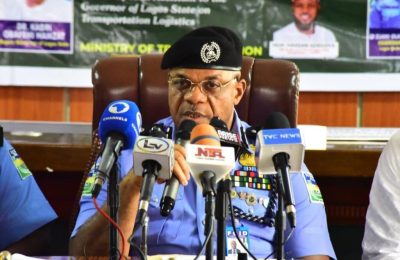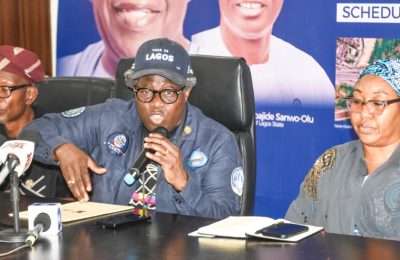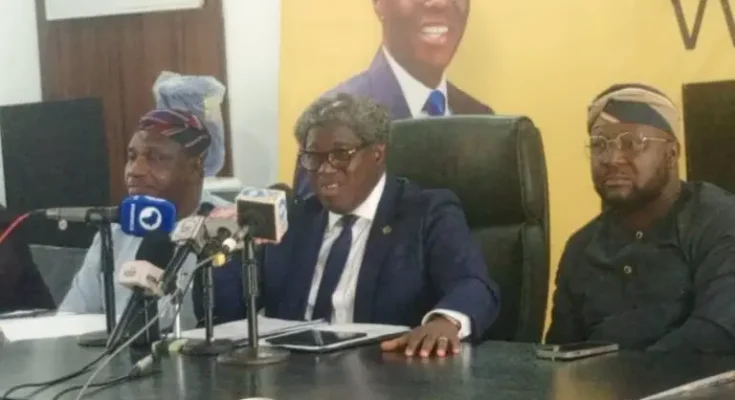

At the press confrence held at the Baguda Kalto Press Centre
The Lagos State Government has reaffirmed its commitment to implementation of urban regeneration and renewal projects.
The government said on Monday that its interventions in communities were guided by safety, compensation and continuous engagement.
The Commissioner for Information and Strategy, Mr Gbenga Omotoso, gave the reassurance at a press confrence at Alausa, Ikeja.
He said the state had a responsibility to safeguard communities, provided its actions would not infringe on the rights of others.
Omotoso spoke on ongoing regeneration projects involving Makoko, Okobaba, Adeniji-Adele, Dosunmu, Alaba-Arago and other settlements.
Also Read:Demolitions:Group Warns Igbo on threats against LASG
Lagos Demolition of Distressed Buildings, to protect life of Residents – Sanwo-Olu
Half of Iddo Bridge for demolition next week -FG
According to him, regeneration projects in Lagos did not begin of recent.
He noted that the government had consistently pursued urban renewal initiatives since 2019, with detailed media briefings held in 2024 and 2025.
Dr Babatunde Olajide, the Special Adviser to Lagos State Governor on E-GIS and Urban Development, said at the news conference that urban regeneration was a remarkable policy of the Babajide Sanwo-Olu administration.
“If you go back to our press briefings for 2024 and 2025, you will see that regeneration projects have been ongoing since the beginning of this administration.
“We have continued what we met on ground and expanded on it,” he said.
Olajide explained that Makoko, a fishing community comprising land and waterfront sections, had drawn public attention, particularly with its waterfront area.
He said the government interventions were informed by safety concerns, environmental standards and international best practices.
“Makoko is not an area we joke with. It has attracted global attention. Our goal is to improve living standards, not to endanger lives,” he said.
He cited the administration’s successful relocation of sawmill operators from Okobaba to Timberville, Amuwo-Odofin, describing it as a major achievement.
“Against all odds, we relocated the Okobaba sawmillers peacefully and provided about 300 houses at zero cost.
” Equipment worth billions of naira was also provided to enable them to operate at international standards,” he said.
According to him, the relocation eliminated recurring fire outbreaks in the area and created a safer, more organised industrial hub.
He added that the area now known as Timberville also hosted the permanent site of National Youth Service Corps (NYSC) Orientation Camp.
On markets redevelopment, the special adviser said the government was working on 21 markets across the state, adding that traders were compensated and resettled without conflict.
“On Lagos Island alone, areas such as Pelewura, Jankara, Bombata and others were redeveloped.
“People were compensated and resettled because we did it the right way,” he said.
He said similar redevelopment efforts were ongoing at Alaba-Arago, where thousands of modern market stalls were being constructed for original occupants.
“The first sets of shops were allocated to the Hausa community. We are currently building additional blocks, each with 60 shops, to ensure inclusiveness and fairness,” he said.
On Adeniji-Adele, he said government had committed about one billion Naira to provide housing units and continued to pay rents for displaced residents pending completion of new buildings.
He also spoke on the Dosunmu fire incident, saying that the government opted to redevelop the area in partnership with property owners, in spite of legal provisions allowing outright takeover.
“Mr Governor, in his wisdom, decided to work with the owners.
“Government paid over N1 billion in compensation because safety of lives is the priority,” he said.
Olajide explained that regeneration efforts were also driven by lessons from fire disasters, including the Mandilas and Dosunmu incidents, which exposed challenges of poor building layouts and lack of access for emergency services.
“We learnt that physical, human and building obstacles can cost lives.
“That is why we are enforcing land pooling, proper setbacks and minimum plot sizes under the new building code,” he said.
On Makoko’s future, he disclosed that the state had committed two million dollars to the Water Cities Project, describing it as the most environmentally-friendly option.
“We dropped shoreline extension because experts advised it was not environmentally friendly.
“Water Cities is the sustainable option, and that is what we are pursuing with the Makoko community,” he said.
He added that areas under high-tension power lines were cleared in line with the government’s safety policy.
“Wherever high-tension cables exist, people must be moved away. It is about saving lives, not punishment,” he said.
He said that the government’s approach to regeneration was consultative rather than forceful.
“Our approach is bottom-up, not top-down. We engage communities, negotiate and plan together.
“This government is not interested in gentrification,” he said.
The special adviser said that Lagos would continue to pursue regeneration in line with international conventions on adequate housing and urban safety.
“Everybody is entitled to adequate shelter, not dangerous shelter. For things to change for the better, we must be willing to change,” he said.(NAN)