
NCC
The Nigerian Communications Commission (NCC)
The Nigerian Communications Commission (NCC) has unveiled plans to open the 6GHz and 60GHz spectrum bands as part of measures to improve service quality, drive innovation and expand Nigeria’s digital economy.
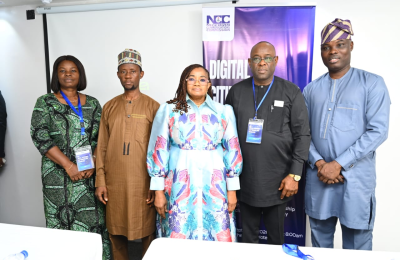
The move was disclosed at a 2-day Public Inquiry on draft regulatory instruments for the telecoms sector, held in Abuja on Monday and Tuesday.
The draft instruments include the Spectrum Roadmap for the Nigerian Communications Sector, 2025–2030, Guidelines for the Use of the 60GHz Band for Multi-Gigabit Wireless Systems and Guidelines for the Use of the Lower Part of the 6GHz Band for Wi-Fi 6 in Nigeria.
Addressing journalists at the forum, the Executive Vice Chairman (EVC) and Chief Executive Officer of the NCC, Dr. Aminu Maida, said the commission’s central objective is to put more spectrum resources into the industry to meet rising demand for wireless connectivity.
“The overview of all that we have done here is that the commission is opening two spectrum bands, 6GHz and the 60GHz band,” Maida said.
Represented by the Head of Spectrum Administration, Engr. Atiku Lawal, the EVC explained that spectrum remains the invisible backbone of all wireless communications, noting that over 90 per cent of connections in Nigeria are wireless and that the country is approaching 200 million connected lines.
“What is connecting our devices is spectrum. It is finite, and when something is finite, it has to be shared.
So the more spectrum you put into the industry, the better the quality and experience Nigerians will get,” he said.
According to him, opening the 6GHz and 60GHz bands will improve quality of service, enhance user experience and unlock room for innovation beyond basic voice calls.
He noted that increased spectrum availability would support banking transactions, digital businesses, innovation in healthcare and other productivity-driven services, including telemedicine in remote communities.
“Doctors in remote villages should be able to connect to consultants in places like Abuja without those consultants physically travelling. But this cannot happen without spectrum,” Maida noted.
Related News
One year after: 50% telco tariff hike leaves operators happier, consumers frustrated
NCC unveils spectrum roadmap to power Nigeria’s $1tr digital economy
NCC seeks fair, sustainable competition, plans new study
He added that the commission expects Nigerians to begin seeing the impact of the new spectrum windows before the end of the year, stressing that innovation often moves faster than regulation.
Responding to questions on the emerging technologies, Maida also spoke on Direct-to-Device (D2D) communication, describing it as another frontier the Commission is actively considering.
He noted that, unlike traditional satellite services, which require ground antennas before reaching user devices, new technologies now allow signals to go straight from space to mobile devices.
He added that the NCC has already published a consultation paper on the subject and invited stakeholders to submit their views.
“We actually have a paper on our website where we are seeking inputs, asking you what you think we should do there. We invite you to please go and check and give us your input,” he said.
Also speaking at the event, an IT consultant from the Federal University of Technology, Minna, Prof. James Agajo, described the public inquiry as a critical platform for stakeholder engagement and collective ownership of Nigeria’s digital future.
He noted that the ICT ecosystem should not be viewed solely through the lens of government budgetary allocations, but as a major revenue-generating sector with strong capacity to boost national productivity.
“The ICT ecosystem is an opportunity to generate funds for the country. The activities within this space will contribute significantly to GDP,” he said.
NCC commences consultation with stakeholders on new spectrum bands to boost digital economy
Agajo acknowledged budgetary constraints facing government agencies but stressed that innovation, policy alignment and strategic balance could still deliver strong economic outcomes.
He argued that emerging and future technologies under the sector’s supervision would generate value beyond initial funding constraints, adding that sustained activities in the digital space would translate into long-term GDP growth.
The NCC said the public inquiry is part of its consultative approach to regulation, aimed at ensuring transparency, stakeholder participation and policies that align spectrum management with Nigeria’s development goals.