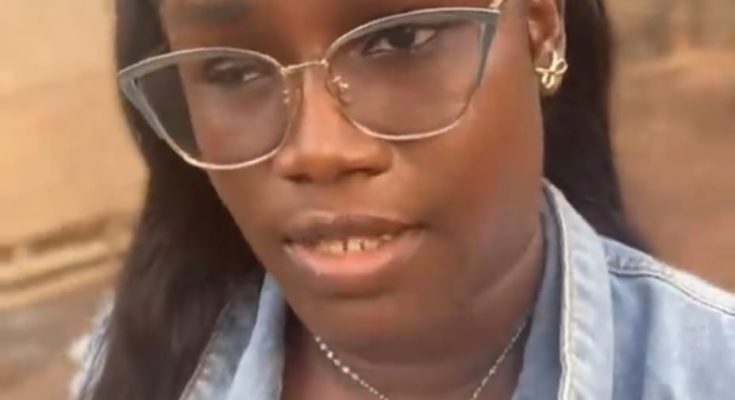

Uche Olivia
By Yinka Olaito
In Nigeria, losing one’s sight too often comes with something far worse than blindness: the loss of dignity. From examination halls to hospital corridors and government offices, visually impaired citizens are routinely denied basic accommodations, shamed for asking for help, and quietly pushed out of opportunities others take for granted.
This is not a story of personal misfortune.
It is an indictment of a system that treats disability as an inconvenience, not a question of rights. And in recent weeks, that indictment has found a human face in Uche Olivia.
Uche is not asking for sympathy. She is a registered nurse, licensed in 2022, who dared to pursue further training in mental health nursing after being diagnosed in October 2024 with optic nerve atrophy, a condition that causes severe vision loss. Her ambition collided head-on with an institution that appears unwilling or unable to understand that inclusion is not charity but a legal and moral obligation.
In a video that went viral in 2025, Uche alleged that the Federal Neuropsychiatric School of Post-Basic Mental Health Nursing in Enugu denied her reasonable accommodations during its entrance examination and hence she could not write an exam she applied and paid for.
She had done everything by the book: formally requested large-print question papers, a reader or extra time, and followed up days before the exam.
What followed, by her account, was a masterclass in bureaucratic cruelty. She arrived before 8 a.m., only to discover that accreditation began two hours later and the exam itself did not start until about 5 p.m.,a long, exhausting wait for any candidate, let alone someone with a visual disability.
Also Read:Disability:KFC Begs govt over ill treatment to Debola,disabled ex Govs Son
FG, World Bank partner on $500m programme to strengthen education, health sectors
Persons with disability day: Creating an enabling environment for all
Despite repeatedly alerting exam officials to her condition, no accommodations were provided.
When she struggled during the exam and asked for help, an examiner allegedly snapped: “If you knew you were not able to read, why did you come to school or apply?” It is difficult to imagine a sentence more revealing of how disability is viewed in some quarters of our public institutions—not as a protected status, but as a personal failing.
Uche says she later approached the provost, offered to present her medical documentation, and was waved off. The advice she claims to have received “Answer the ones you can see, leave the ones you cannot” was not just dismissive; it was devastating.
It told her, in plain language, that her disability placed her outside the institution’s concern.
At the time of writing, the school has not responded to repeated requests for comment. Silence, in cases like this, is not neutral. It is complicity.
The tragedy here is not that the law is unclear. Nigeria’s law is crystal clear.
The 1999 Constitution guarantees equal and adequate educational opportunities and prohibits discrimination. The Discrimination Against Persons with Disabilities (Prohibition) Act, 2018 goes further, mandating inclusive education and reasonable accommodation in all learning and assessment processes. For visually impaired candidates, this includes Braille or large-print papers, audio or electronic formats, approved scribes, extended exam time, quiet venues and the use of assistive devices.
Denying these accommodations is not a harmless administrative lapse.
It is illegal. In effect, it criminalises disability by turning a physical condition into grounds for exclusion.
As disability advocate Susan Ihouma Kelechi bluntly put it: “Keeping quiet without punishment is inappropriate. Today it is Uche Olivia; tomorrow it can be another person.”
Her warning has been echoed across the disability community. Leaders of the Joint National Association of Persons with Disabilities (JONAPWD) condemned the alleged treatment. Its National President, Abdullahi Usman, described it as “a display of ignorance in a federal institution” and pledged to push for accountability. State-level leaders went further, calling the episode “inhuman” and demanding apologies and systemic reforms.
 9
9
Other advocates, including Yusuf Olatunji and Susan Kelechi, see something deeper at play: a stubborn rigidity in a system that refuses to evolve while the rest of the world moves—slowly but surely—towards inclusion. Dapo Taiwo of the Association of Assistive Technology Professionals was even more pointed: in 2025, he argued, there is no excuse for any institution not to seek support from organisations equipped to help them serve students with disabilities.
Lawyers have weighed in too.
Felix Areo, himself visually impaired, called the case “a dangerous signal from a federal institution” and argued that oral exams or assistive measures should have been explored. Barrister Salami Abolarinwa cautioned that some details still require verification, but stressed that even on the face of it, there is “a clear element of discrimination and denial of rights.”
Government officials responsible for disability inclusion in several states have also expressed outrage.
Their frustration points to a painful irony: while policy statements and appointments multiply, lived experiences like Uche’s suggest that implementation remains dangerously thin.
So who must act, and why does it matter?
Educational institutions must stop improvising and start institutionalising disability support services.
Professional bodies must adopt and enforce clear, standardised accommodation protocols. Regulators and supervising ministries must move beyond issuing hollow circulars. And the National Commission for Persons with Disabilities must show that it has teeth—not just a letterhead.
The media, too, has a responsibility. Disability must be reported as a rights issue, not a charity case. When a candidate asks for Braille, assistive technology or extra time, they are not seeking an unfair advantage; they are demanding a level playing field.
Until Nigeria understands that inclusive assessment is not optional but foundational to education, our claims of progress will remain hollow. Disability is not inability.
Exclusion is.
Uche Olivia’s case should never have happened. What happens next will tell us whether justice in Nigeria can still see clearly enough to include everyone.
#Yinka Olaito is a journalist, media Development expert and Disability Inclusion Advocate