
Says only advancement in Technology can set Africa free
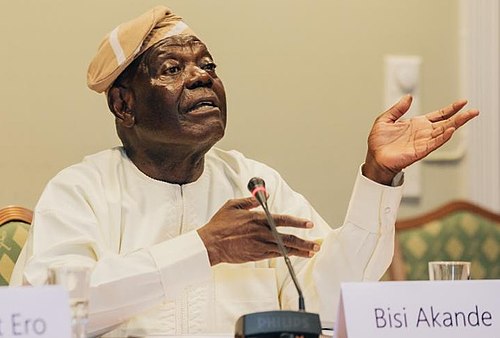
Chief Bisi Akande
First Interim Chairman of the All Progressives Congress,APC, Chief Bisi Akande, has urged the country to use the current security challenges facing it as a means of educating the youths in Science and Technology towards harnessing their potentials for the development of the country.
According to him,since youths account for 58% of our population,it is only by training them that the nation could be on the pathway towards ensuring the realization of its potentials after 65 years as an independent nation.
In a speech he delivered Tuesday at the 19th Annual International Conference and General Assembly of the Society for Peace Studies,in Ibadan,the former Osun governor said that the nation should use the youthful population to harness its abundant resources towards evolving a new order and arrest its underdevelopment.
Speaking further,in his address titled- Reflections on Nigerias Quest to Attain Sustainable Peace and Prosperity in a Globalised World, he said that recent developments occuring around the world is a function of the geopolitical tussle between the Super powers..China and USA.
As a result,he called on the government to tap the energy and resourcefulness of our youthful population so as to tap the vast forest,mineral and natural resources and also use it to enable them realise their potentials and by extension develop the society.
Said he,”Untill all these young populations of Nigerians are massively trained sufficiently enough in Science and Technology to exploit these resources for our wealth, the wars from ignorance,from poor health and from abject poverty would hold down all of us for the enslavement of the itinerant foreign scientists and their technologists disguising as native bandits,the local Boko Haram and various terrorists.”
He urged the country to strive to educate the youths who make up 58% of the population to prevent them from being used by foreigners to kill rest of us in order to occupy our space as the whites did to the Red Indians in present day United States of America .
See Full Speech below:
Reflections on Nigeria’s Quest to Attain Sustainable Peace and Prosperity in a Globalized World’
By Bisi Akande
Distinguished Guests, Ladies & Gentlemen,
It is a pleasure and an honour to be with you all today.
It is, of course, no surprise that the Society for Peace Studies and Practice (SPSP) emerged as an offspring of Nigeria’s premier university, the University of Ibadan, which I currently serve as the Pro-Chancellor and Chairman of the Governing Council. The contributions of the University of Ibadan to Nigeria’s development are unassailable and remain unmatched. Therefore, with a sense of pride, I accepted to be here with you today to present a Goodwill Message.
Introduction:
The timing of this Conference could not have been more auspicious. Various developments occurring across the world, in far and near places, such as the horrific wars in Gaza, the intractable conflict in Ukraine, the protracted wars in the Democratic Republic of Congo and in the Sudan, the carnages in the Sahel, as well as the fallout of the geopolitical tussling between the superpowers– China and the USA—impact upon us all. We are currently witnessing an era where the normative principles of justice, fairness, equality and human dignity and decency have been replaced with crass opportunism and transactional politics by the mighty against the weak. Before our eyes, a new global order is being ushered in by the actions of old and new actors alike.
As new and emergent powers tussle for prominence and seek advantage in blatantly exploiting the less-privileged, with no pretences about the intentions of certain countries to dominate the others, Nigeria has not been immuned from the immediate effects and longer-term implications of the shifting geopolitics that we are witnessing. As much as Nigeria is impacted from outside events, including the effects of increased insecurity across our borders, such as in the Sahel and the Lake Chad Basin, our own internal security challenges also impact negatively upon our daily lives and are felt beyond the shores of our territory. This is because the nature of widespread insecurity manifesting in terrorism and violent extremism, criminality and banditry, are cross-border in nature, and are not confined to one country, but occurring across borders and among neighbours. In view of the current security challenges that we are witnessing in Nigeria today, I hope that this Conference will afford its participants the opportunity to critically examine and proffer viable solutions and policy actions to those challenges, taking into cognizance the reality that threats to our security and progress derive from external and internal causes.
Distinguished Guests, Ladies & Gentlemen, the main thrusts of my message will be to highlight the inextricable linkages between peace, security and development; and to offer my reflections on some of our most immediate challenges and how to surmount them. I believe that of particular importance for us is the need to interrogate the field that peace scholars have referred to as the ‘peace-development nexus’. Some development and humanitarian practitioners have even, in recent times, expanded the phenomenon to what they refer to as the ‘triple nexus approach’, which links humanitarian actions with peace and development as a viable intervention in crisis-ridden contexts.
Since you have decided to bring an elderly retiring novice like me to the hallowed ivory towers to discuss a specialized and pertinent field of human endeavour, allow me not to indulge in academic definitions or postulations from ancient rhetorics in offering a number of conceptual clarifications that will guide our discourse.
Peace and Development: Main Arguments, Logic & Practical Realities
If Peace is generally described as the absence of war, strife or conflict, why can’t we seek for Peace by also preparing for war? Therefore, to interrogate the concept more thoroughly, one would realize that ‘peace’ has different connotations for different philosophical orientations, cultures and contexts. While Western definitions of peace tend to underscore the importance of a lack of violence, Eastern definitions tilt towards more positivity by underscoring the presence of certain characteristics such as ‘the whole’, ‘the undivided’, ‘harmony’ and ‘balance’. History has taught us that leaders such as Alexander the Great, Julius Caesar and Napoleon Bonaparte, all military conquerors who deployed the use of force for their conquests, believed that peace could only be attained through the use of force. Indeed, this strand of Western political thought is what influenced the “deterrent theory” propounded by International Relations Realists.
For us Africans, peace is beyond the mere absence of war or strife. The conceptual definition of peace postulates whatever promotes the integration of human society. It is always more reflective of the African belief that peace is not only an ideal that should be attained by the individual, but by the entire society. A harmonious society is a peaceful society. In line with this approach, and for the purpose of this Conference, allow me to adopt Amadei’s definition of peace.
“…organizing principle and an enabling violent-free state of dynamic equilibrium emerging from the right relationships among different populations and their interactions with the various systems in the community landscape upon which they depend” (Amadei, 2021: 1117).
Therefore, Sustainable peace has been seen by the international practitioners as an explicit and deliberate policy objective for all states, regardless of whether they are beset by violent conflicts and underpinned by a superstructure composed of institutions, norms, attitudes, and capacities spanning different sectors and levels of social organizations. It is ideally a multifaceted process that extends beyond the absence of war to include proactive conflict prevention through addressing conflict root causes, fostering reconciliation, strengthening of institutions, as well as the promotion of social justice and development. To my mind, this can also be simplified and put into two words – ‘good governance’.
Building a sustainable peace in any society requires such societies to adhere to certain tenets and humanistic principles. These include the principles of justice, fairness, transparency and respect for the rule of law. In societies where these important tenets have guided development, relevant institutions that could ensure social justice and re-engineering to guide society and ensure balance and harmony would have been put in place.
Having established that sustainable peace goes beyond the mere absence of war, strife or conflict, allow me to quickly examine the ‘security-development nexus’, or what some scholars refer to as the ‘peace-development nexus’. Kofi Annan, a former Secretary-General of the United Nations, had in 2004, underscored the inextricable link between security and development. He noted that:
A more secure world is only possible if poor countries are given a real chance to develop. Extreme poverty and infectious diseases threaten many people directly, but they also provide a fertile breeding ground for other threats, including civil conflicts. Even people in rich countries will be more secure if their Governments help poor countries to defeat poverty and disease by meeting the Millennium Development Goals. (Annan, United Nations, 2004).
Indeed, the security-development nexus has influenced several policy frameworks and is not entirely new to shaping thinking on how the world can attain peace and harmony through human development. In contemporary times, the implementation of and adherence to the tenets of the Millennium Development Goals (MDGs), and the Sustainable Development Goals (SDGs), represent and shape the objectives of multilateral institutions such as the UN, the African Union, regional economic communities (RECs), and states across the world. Nigeria, as a prominent member of the international community, has also adopted the Sustainable Development Goals as a guiding framework for socio-economic development. What these definitions and approaches tell us is that sustainable peace, as a precondition for sustainable development and prosperity, must be seen through the prism of the collective, and attainable when larger society is happy and contented. These philosophical underpinnings are found in ancient African collective philosophy such as Ubuntu, a Bantu African philosophical thought meaning: “I am because we are”; and which emphasizes interconnectedness, communalism, compassion and empathy, collective responsibility, and relational personhood.
Towards Attaining Sustainable Peace, Societal Harmony, Development and State-building.
We have established that at the core of societal development and harmony must be sustainable peace. It is not an over-exaggeration to assert that Nigeria at sixty five years of existence is yet to fully attain and harness the essential tools that are required for its advancement and eventual prosperity.
The World Bank estimates that by 2075, one-third of the world’s population and of the working age population will be African. Africa is the only region where the workforce will grow continuously in the coming decades. In other words, currently, almost 60% of Africa’s population is under the age of 25. This makes Africa the world’s youngest continent. Again, the World Bank reveals to us that Nigeria’s population of 230 million is skewed toward youth and that the median age is 18.1 years, and that 58% of Nigeria’s population is under the age of 30. Some have referred to it as a “demographic time bomb” while others, such as the United Nations Development Programme (UNDP), have put a more positive spin to it and referred to it as a “demographic dividend”. Now, if we have about 60% of our population below the age of 30 with no jobs, no social welfare plans and we do not have the wherewithal to generate jobs for them and harness their energies and talents, we are in trouble.
Also Read:Federal universities overburdened with bureacratic procedures-Akande
Youths declare another blockage of Lagos 3rd Mainland Bridge
Akpabio unveils counter-terrorism plan, advocates technology-driven security
Tinubu Rejects Use Of Mercenaries In Counter-terrorism Efforts
Trump’s comments fuelled renewed attacks by violent groups — FG
UK, Canada, Australia unveil joint campaign against visa fraud
Nigeria is a country blessed with abundant resources. We are an oil-rich country with significant reserves of approximately 38 billion barrels of crude oil (second largest in Africa), and 210.54 trillion cubic feet of natural gas (ninth largest globally). Apart from oil and gas deposits, Nigeria also has over two hundred minerals which include coal, iron ore, bitumen, limestone, gold, barite and lead/zinc. In addition, our country has significant reserves of critical minerals for the global energy transition, such as lithium, tin, niobium, columbite, and rare earth elements.
What we are saying here is that we have forest, mineral and natural resources with large populations of uneducated and untrained workers that have no knowledge and capacity to exploit these resources for our wealth. We are truly at wars with ourselves. Until all these young populations of Nigerians are massively trained sufficiently enough in Science and Technology to exploit these resources for our wealth, the wars from ignorance, from poor health and from abject poverty would hold down all of us for the enslavement of the itinerant foreign scientists and their technologists, disguising as the native bandits, the local Boko Haram and various terrorists.
Ladies and gentlemen, where would all the Nigerian universities be if and when the slave buyers entered our lands again, to use us as slave labour in the exploitation of our resources again, and to cart away our natural wealth to their own lands again? We shall be lucky indeed if the itinerant foreign scientists and technologists don’t use their knowledge and skills to kill all of us and occupy our lands as the whites did to the Red Indians in the present day America!
To act fast and effectively is to escape the fury of the anger of the untrained Nigerian youths!
Thank you for listening.
Chief Bisi Akande, CFR,
Pro-Chancellor and Chairman, Governing Council
University of Ibadan,
Ibadan, Nigeria
25th November, 2026
A Goodwill Message Delivered by Chief Bisi Akande, CFR, at the 19th Annual International Conference and General Assembly of the Society for Peace Studies, 25th November, 2025, Ibadan, Nigeria.