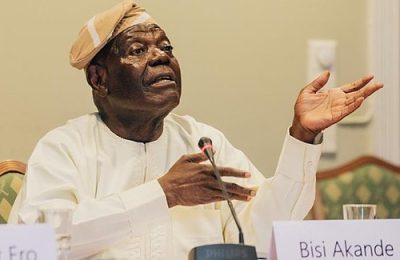
By Chief Bisi Akande
“Education” has conflicting definitions. However, for the purpose of our present discourse, “Education” may be viewed in the context of Nigeria’s stage of development seventy years ago, and may be defined, with perception and practice, as learning by apprenticeships and by imitations.
This definition was more applicable in the most rural parts of Nigeria and, particularly, then, in the Western Region which consisted mostly of rural communities where education, through the institutionalized learning such as what is now known as schools with classified curricula, was very scanty and scattered.
Learning through schools and similar institutions then was complicated and confusing to the illiterate parents who, in most parts of the Western Region – especially because of the existent of numerous ‘madrasa’ institutions for Muslim children, faced the free education reforms . To further compound the complications and the confusions, the free universal primary education project originally proposed in 1953 by Obafemi Awolowo’s Action Group government was to be compulsory along with sanctions of imprisonments for defaulting parents. It attracted loud opposition and criticisms of the then very popular NCNC, the opposition party in the west, led by Dr Nnamdi Azikiwe.
The search for acceptable definitions of free primary education through the school system then became a problem where people’s trades and vocations were still rudimentary, rural and crude; and when modern industrial innovations were almost non-existing. Having been defeated by the NCNC in the 1954 elections into the Nigerian Federal House of Representatives, the Action Group regional government in Western Nigeria hurriedly put a ‘tippet’ on the word ‘compulsory’ and reduced the proposals to ‘Free Universal Primary Education’.
Though free primary education began only in the Western Region of Nigeria in 1955, it became the foundational revolution of education throughout Nigeria. And, ever since, education is being developed as the process of learning, through schools and formalized college institutions, the requisite knowledge and skills for the purpose of producing, procuring, transporting and distributing nourishing foods, decent shelters and befitting apparels for good human life and the extramural practices for the moulding of characters socially acceptable for family cohesion, cultural values and peaceful community neighborhoods.
It is unfortunate however that the progress of such purposeful education, as then established, became stultified and bastardized by the military intervention in the Nigerian governance. Before the military forcefully imposed themselves as the government of Nigeria, most of all the educational institutions were being methodically established and scrupulously managed by the various diligent educationists among the religious and individual proprietors. There were four autonomous regions each of which was free to decide on its educational policies.
These proprietarily established and managed schools were appropriately and duly being grant-aided to accommodate the facilities of whatever type of scholarship and whatever type of free education desired by each of the regional governments that had policies for free education at various levels.
Suddenly, these various institutions of learning were forcefully taken over and appropriated by the federal military government in 1976. And these suddenly snatched educational institutions were being handed over to the numerous new states that were being created with new governments and new civil service structures having no proper trainings and experiences in institutional proprietorships. The various governments became overburdened and overwhelmed by the responsibilities of these expanded muddled facilities. Hence the present decay being experienced in educational infrastructure, in learning curricula and in teaching methodology.
Read Also:Akande, a truly progressive and committed Awoist-Tinubu
Delta-Five and Oborevwori’s education vision
To celebrate the remnant of the numerous innovations derived from such educational revolutions, which began seventy years ago, is the reason why we now assemble here tonight. I sincerely thank and congratulate the Independent Newspapers Limited for bringing us together as a reminder that Universal Comprehensive Education at all levels is the most important asset for man to be truly independent in any decent society and in a worthy independent country.
Long live the Independent Newspapers Limited. Long Live the Federal Republic of Nigeria.
Chief Bisi Akande CFR
Chief Bisi Akande’s Speech as the Chairman at the Independent Newspapers Limited’s Nigerian Independence Commemoration Events on Thursday; 9th October, 2025.