
by Folake Idowu
Joseph Eze’s latest exhibition, Stories from a barn 2, journeys through the artist’s imaginary and the conjures up stories of women who are regal and worthy of adulation.
Spanning three main series, this solo show invites the viewer to appreciate Eze’s broad vocabulary on representation and the role cultural identity plays in defining beauty.
Hosted by Filafriques, his gallerist in Geneva, the exhibition showcases more than 10 large works by Eze in which his artist evolution can be admired.
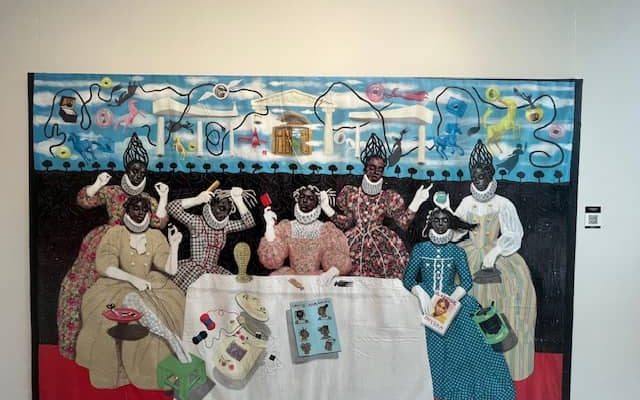
This collection of works is a subtle but powerful departure from his prior style where much attention was given to painting women on very dark backgrounds with foliage often used as the backdrop. More attention is given to collage application in these works.
The women’s heads are wrapped in wide cords of thread and they are posed almost as majestically as would a commissioned painting of the lady of the manor by a famous 18th century painter like Gainsborough.
These threaded structures harken back to the days when women sat on small plastic stools and had their hair threaded with cotton or rubber, until they formed long branches that could be twisted and wound into undulating sculptures to flatter the woman’s features.
These wove around the head until they were constructed into styles which had names and the more stylized they were made, the more revered they became. In truth, they are a masterclass in headdress artistry than mere hairdressing.
Eze has taken it a step further with his artwork. He shifts from the Nigerian viewpoint and expands outwards by questioning the placement of this traditional representation within the European or pre-colonial discourse.
One good example of this is I was born in the time of colors.
Here the butterflies in the European-styled gown are repeated in the snapshot photo of the same dressed model who delicately holds up the image on her gloved hand.
On her head perches rather nonchalantly, a vintage camera while her face bears the striations that remind one of the Ife terracotta heads.
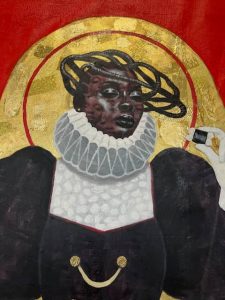
It is symbolic that Eze uses mixed media of acrylic paint, collage prints and historical referencing to style the women and the dresses they wear. In this collection, the high-necked ruff and wide shoulders of the dress present a woman who even from their side glance is assertive and confident.
Also Read:Jide Kuti, new kid on the bloc, rearing to go
Like Fela,like Arube: Delta musician set to marry three wives in one day + PHOTOS
They have their place in history and they cannot be denied their right to tell their own story within this narrative.
Traces of Eze’s Nigerian heritage happily delineate his canvases. From the green kerosene stove in We are not from her, we come from the sun to the African comb and his ubiquitous use of owu, the traditional black threads used in West African hairstyling in the Figure in the arch series.
Here is an artist who also weaves the nostalgic with the contemporary. Most women in West African countries continue to navigate between the modern appliances and their reliance on traditional tools and Eze reflects this from their clothing choices to the use of the threads .
(J. Eze’s first solo exhibition in Switzerland)