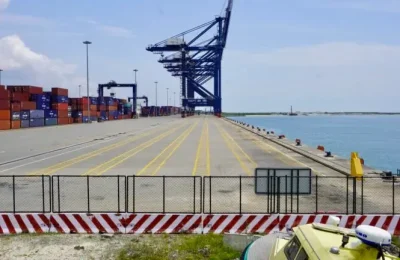
Photo Caption,:Imported vehicles
Vehicle imports into Nigeria saw a dramatic drop, falling from 28,024 units in the first quarter of 2023 to 10,991 units in the same period of 2024, marking a 60.8% decrease, according to a report by the Nigerian Ports Authority (NPA).
The report, titled “Nigerian Ports Authority: Ports Performance Report January to March 2024,” also indicated that 251 ships visited Nigeria’s ports in the first quarter of 2024, a 4.3% decrease from the 275 ships that docked during the same period in 2023.
“Vehicle importation dropped by 60.8% from 28,024 units in the first quarter of 2023 to just 10,991 units in 2024,” the report stated.
The document revealed a decline in total cargo volumes during the review period, reflecting a contraction in trade activities and signalling potential economic challenges or shifts in the import-export balance.
The 4.3% reduction in ship visits could be attributed to various factors, including changes in global shipping routes, adjustments in shipping line strategies, or the impact of economic policies affecting maritime trade.
In terms of cargo traffic, the total cargo throughput, excluding crude oil, reached 21,186,348 metric tonnes in the first quarter of 2024, compared to 18,243,644 metric tonnes in the same period of 2023, showing an increase of 16.1%.
“Inward cargo traffic reached 13,563,173 metric tonnes, representing 10.5% of the total cargo throughput in 2023, while outward cargo traffic was 7,623,175 metric tonnes, representing 27.7% of the total cargo traffic,” the report explained.
Despite the decrease in ship traffic, performance indicators showed positive trends, with the average turn-around time for vessels improving to 4.6 days from 5.1 days in 2023. This improvement is partly attributed to the efficiency of the Lekki Deep Seaport, which achieved an average turn-around time of just one day.
The berth occupancy rate averaged 29.8% in the first quarter of 2024, down from 34.5% in 2023. The lower berth occupancy rate indicates reduced congestion at the ports, potentially contributing to improved turn-around times and overall efficiency.
“The increase in gross register tonnage despite the drop in the number of vessel calls revealed the berthing of bigger vessels, especially at the Lekki Deep Seaport where the average GRT of vessels is 3,801,191.
This further highlights the importance of a deep sea to Nigeria’s maritime or port development,” the report concluded.
Reacting to the development, a chieftain of the Association of Nigerian Licensed Customs Agents, Kayode Farinto cited the fluctuating exchange rate as a significant factor impacting vehicle importation.
“It is the fluctuating exchange rate that is killing the business. And if you bring in older vehicles now, you are expected to pay higher duty and the exchange rate continues to go up daily and nothing has been done to address that,” Farinto said.
He suggested that the government should peg the exchange rate for cargo clearance at N1000/$ and increase the age limit for imported vehicles from 12 years to 15 years to see improvement.
Chairman of the Ports & Terminal Multipurpose Chapter of the National Council of Managing Directors of Licensed Customs Agents, Abayomi Duyile blamed the decline on levies and duties imposed on imported vehicles.
“It has to do with the levy introduced; the cost is too much. For example, if you have a vehicle of 15 or 20 years, you are going to pay the duty as if the vehicle is 10 years old. So it is because of the cost. When you bring them in, how do you sell?” Duyile asked.
READ ALSO:One year after: the Legacy Man and his strides
AfDB pledges $490m investment for African Youths in agri-business
Apapa access road:We’re poised to remove corrupt officers —NPA boss