
The death in a helicopter crash of Iran’s president, Ebrahim Raisi, disrupts a careful effort at a smooth transition to a new supreme leader to replace the aging Ali Khamenei.
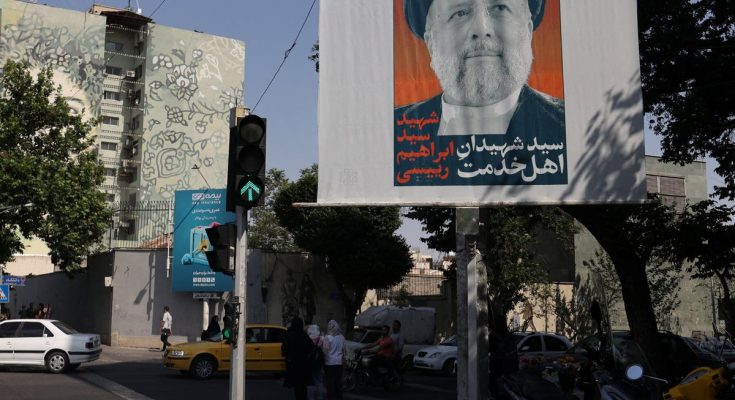
Caption:A banner with a picture of Iran’s president, Ebrahim Raisi, stands at an intersection.
A banner with a picture of President Ebrahim Raisi of Iran on Monday in Tehran. He had been seen as a top candidate to be the country’s next supreme leader.
By Steven Erlanger
Steven Erlanger covered the 1978-79 Iranian Revolution and has written about Iran’s regional and nuclear policies for years.
The sudden death of Iran’s president, Ebrahim Raisi, opens a new chapter of instability just as the increasingly unpopular Islamic Republic is engaged in selecting its next supreme leader. Mr. Raisi, 63, had been considered a prime candidate, especially favored by the powerful Revolutionary Guards.
Even before the helicopter crash that killed Mr. Raisi, the regime had been consumed with internal political struggles as the supreme leader, Ayatollah Ali Khamenei, 85, the longest-serving head of state in the Middle East, is in declining health.
But given the Islamic Republic is facing internal protests, a weak economy, endemic corruption and tensions with Israel, analysts expect little change in Iran’s foreign or domestic policies. Ayatollah Khamenei has set the direction for the country, and any new president will not alter it much.
Iran hits by deadly Earthquake Few Hours After President Died In Helicopter Crash
The system is “already on a trajectory to make sure that the successor of the supreme leader is completely in line with his vision for the future of the system,” said Ali Vaez, the Iran director at the International Crisis Group.
He described “a pretty hard-line vision” in which crucial areas of foreign policy, like support for regional proxy militias and developing components for a nuclear weapon, are not going to change.
Whoever is chosen as the next president, Mr. Vaez said, “has to be someone who falls in line with that vision, a subservient figurehead.”
Source:New York Times