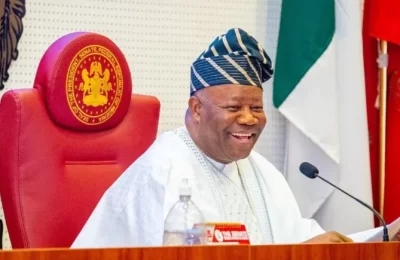

Caption:Barrister Mohammed Sani
Lesson Learnt:
It’s on record that the history of parliamentary system of government in Nigeria was dated back to 1960, based on the provisions of the 1960 and 1963 constitutions of Nigeria, wherein same is term as 1st republic. Parliamentary system of government, is a democratic form of government in which the party or a coalition of parties with the greatest representation in the parliament form the government, its leader thereby becoming the prime minister.
The federal parliament was the federal legislature of the federation of Nigeria and the First Nigerian Republic, seated at Tafawa Balewa square in Lagos and was composed of three parts. The Head of State (Elizabeth II as queen of Nigeria from 1960-1963, Nnamdi Azikiwe as President). The Senate and the House of Representatives. By constitutional convention, the House was dominant, Regional parliaments has similar chambers of House of Assembly and House of Chiefs. This indicates that the parliament of Nigeria is bicameral in nature as it consist of the senate and House of Representatives. The system operates from 1st October, 1960 and was disbanded in 1979 with the coming into existence of 1979 constitution. The Prime Minister then was Abubakar Tafawa Balewa, President of the Senate, Nwafor Orizu, Speaker of the House of Representative, Ibrahim Jalo Waziri. The parliament has 305 members and 12 senators.
Parliamentary system of government is the best system for Nigeria as it is a system of government where the prime minister is the head of the government and the cabinet ministers are heading each and every respective ministry for the discharge of their executive functions. Both the prime minister and cabinet ministers are members of the parliament.
The parliamentary system of government has the following features.
The separation of the head of state and head government.
The plurality of the executive.
Parliamentary character of the executive
The responsibility of the minister to the legislatures.
LESSON LEARNT.
The parliamentary system of government indeed avert civilian dictatorship and autocracy.
S.83 of the 1960 constitution provides:
“The cabinet shall be collectively responsible for any advice to the governor general by or under the authority of any minister of the government of the federation in the execution of his duties.”
This will make members of the cabinet to be more proactive in reasoning by providing policies that will be people oriented and the prime minister must abide by the advice or risk polarizing the cabinet and his party which if it’s not handle carefully will lead to the downfall of the prime minister.
The legislatures has greater control of the executive. Based on this, there is absolute check and balance between the executive and the legislatures, this is because the executive are indeed part of the legislatures.
The legislatures can pass a vote of no confidence on the prime minister or any of the minister. The 1960 and 1963 constitution has empowered the legislatures to recall any member of the executive back to the parliament, where he is not discharging his responsibilities in accordance to the law or wishes of the people.
Proper accountability and utilization of available resources. Both the executive and legislative arm of the government are accountable to the citizen at both federal and regional level.
The parliamentary system of government is cheaper to run. The cost of election is cheaper because candidates are limited within their constituencies. It’s also cheaper to maintain political office holders because members of the cabinet are chosen from the parliament unlike the presidential system of government. In terms of election, we have 774 local government and elections are based on the states, federal and senatorial zones which is more expensive to run. While under the parliamentary system is the region that matters i.e. South South, South West, South East, North Central, North East, North West region.
Even though there were some lacuna in the 1960 and 1963 constitution, which if we will practice same system of government today all those problems will be averted, therefore, I still hold that the parliamentary system of government is far better for us as a country than the presidential system of government. The system is more democratic and we will see more people oriented policies. Most of the policies are from the legislatures who are elected representatives of the people and are in touch with their constituencies, it will give the people greater participation in governance.
Thank you.
Bring part of contributions by
Barr. Mohammed Sani to the Webinar organized by PANAFSTRAG on the Parliamentary Reforms,Wednesday April 17,2024