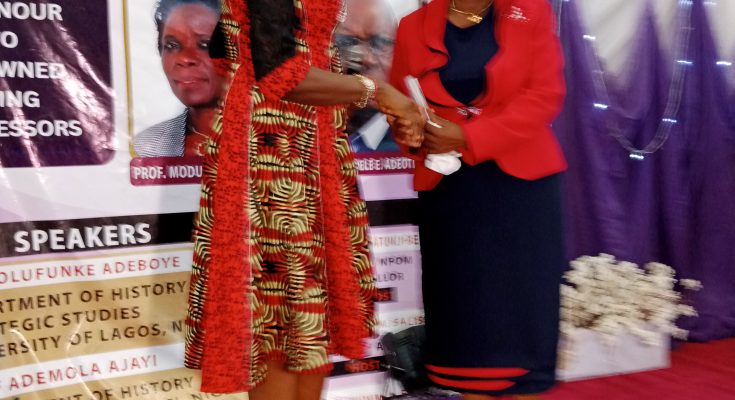

Caption: Receiving her award from Professor Ololade
By
Olufunke Adeboye
Dept. of History & Strategic Studies
University of Lagos
Protocols
It gives me great pleasure to be here today and I feel highly honoured to have been invited to deliver this address.
The two senior scholars being honoured today are my big ‘Egbon”. We all share the same roots from the Ibadan School of History. Professor Dele Adeoti and I also share the same academic father and mentor, Professor J.F. Ade-Ajayi of blessed memory.
I heartily congratulate both of them – Professor Modupeolu Faseke and Professor Oladele Adeoti. It is only by the grace of God that one can successfully conclude a fulfilling career and retire at the age of 70 in today’s Nigeria. I thank God on their behalf and celebrate the two families.
Since I have been asked to speak specifically on Professor Modupeolu Faseke, I shall do exactly that. However, I need to commend my colleague, Professor Ademola Ajayi for doing such a fantastic job of reviewing Professor Adeoti’s scholarship.
I also want to appreciate the Department of History and International Studies for putting together this colloquium in honour of both Senior colleagues. I thank members of the Organizing Committee too. I pray that you shall all be honoured and celebrated too. Many of the faces here are familiar faces. We all belong to the same historical clan. I may not be able to acknowledge you one by one. But you are all welcome.
The Modupeolu Faseke that I Know: A Patient and Inspiring Teacher
The year was 1983 at the Polytechnic, Ibadan. I had just been admitted for A-Levels, then called Basic Studies at the Polytechnic. I was in Basic 1. Our European History Lecturer then, from the Faculty of Commerce and Communications was none other than our celebrant for today. She was then Miss Dupe Duze. The name had a nice ring – DD. The girls loved her (I don’t know about the boys). She was smart, very well dressed and very eloquent and you could relax in her class. She came down to our level and was very patient with us unlike some other Lecturers who treated us as if we were already senior University undergraduates: blowing heavy grammar we did not understand OR making us tremble and shiver on their “Nights of Embarrassment”. She was always very cool and calm. She did not give us funny nicknames and did not “harass” us. We all performed well in her European History Paper. A few of us became so enamoured with history that we later went to the University to study History. Others chose other career paths and became distinguished in life as lawyers, judges, professors, entrepreneurs, administrators, teachers, etc. Most importantly, we were all touched by Ms. Duze’s gentleness, attention and commitment.
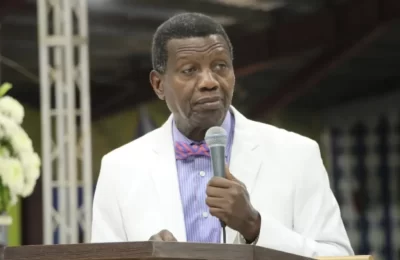
Fast-forward to 2010 – Several years after our Poly Ibadan days our paths crossed again in the University System. I had settled at the University of Lagos while she was at Lagos State University. She invited me to collaborate with her on a biographical project on Pastor E.A. Adeboye of the RCCG. I gladly obliged and the book was published as: Enoch Adejare Adeboye: The Story Behind the Glory, edited by Modupeolu Faseke (Lagos: CIBN Press, 2011).
Professor Modupeolu Faseke’s Research Interests and Contributions to Knowledge
Her research interests could be summarized as Administrative History of Nigeria, Gender and Women’s History, International Relations/History, and Christianity in Nigeria.
Administrative History: This is her first love as demonstrated in her PhD research titled: “The Southwestern Nigeria Civil Service: A Study in Origins, Development and Role” (University of Ibadan, 1997). Other publications in this area include:
“Awolowo and the Western Nigerian Civil Service” in Olasope Oyelaran, Toyin Falola, Mokwugo Okoye and Adewale Thomson (Eds.), Obafemi Awolowo: The End of an Era (Ile-Ife: University of Ife Press, 1988), 595-619.
“Simon Adebo and the Emergence of the Nigerian Civil Service, 1942-1962”, The Quarterly Journal of Administration, Vol. 25:2 (1991), 111-132.
The Civil Service in Nigeria: A Historical Perspective (Ibadan: Rex Charles, 1998)
“Corruption and the Image of the Nigerian Civil Service: A Historical Discourse”, The Constitution: A Journal of Constitutional Development, Vol. 6:1 (2006), 101-111.
“Ethical Foundation of the Nigerian Civil Service: A Preliminary Overview”, Journal of History and Diplomatic Studies, Vol. 5 (2008), 171-185
My favourite Quote from her works: After identifying some corrupt practices of the Civil Service and its impact on the nation, she made the following submission:
“The way forward is to re-orientate the Civil Service and the Society and review the educational system so as to make room for moral education in schools and Universities. Leadership by example should be stressed while people of proven integrity should be promoted to leadership positions. Merit should be the yardstick for promotion rather than the obnoxious principles of federal character and quota system, nepotism, ethnicity and godfatherism, which stifle initiative and leads to mediocrity and dishonest practices. Until these vices are discarded, so long will the Civil Service continue to battle with image problem”. [From: “Corruption and the Image”, (2006, 110)].
Unfortunately, not much has changed in the Civil Service despite these recommendations. The National Orientation Agency continues to play its role but we still periodically hear frightening tales of official corruption. The recommendation for moral education in schools thus becomes very apposite and this is something the relevant government agencies may want to revisit. The same thing applies to the issue of integrity and merit in public appointments.
Gender/Women’s History: Professor Modupeolu Faseke has devoted substantial efforts to uncovering not only the trials and travails of women in different parts of Nigerian but also underscoring their successes and achievements. This is very important. Some other scholars emphasize only the trials of women, leaving out their accomplishments. Modupeolu Faseke has maintained a critical balance in her research on women by focusing on both the challenges and triumphs in the experiences of women. Her publications in this area include:
Nigerian Women Professionals: A Historical Analysis (Lagos: Tidings Publications, 2005)
The Nigerian Woman: Her Economic and Socio-Political Status in Time Perspective (Ibadan: Agape Publications, 2000).
Women, Marriage and Administration in Colonial Nigeria (London: Association of Commonwealth Universities, 1995).
“A Jewel in the Desert: History of the Nematologist” in Faseke (Ed.) Nigerian Women Professionals (2005), 29-34.
“Women and Governance in Nigeria” in Odion Akhaine (Ed.), Governance: Nigeria and the World (Lagos: Penal Press, 2004), 282-298.
“The Role of Women in Traditional Yoruba Society” in Deji Ogunremi and Biodun Adediran (Eds.), Culture and Society in Yorubaland (Ibadan: Rex Charles, 1998), 149-157.
“Women in Badagry Economy” in G.O. Ogunremi, M.O. Opeloye and Siyan Oyeweso (Eds.), Badagry: A Study in History, Culture and Traditions of an Ancient City (Ibadan: Rex Charles, 1994), 154-168.
“The Better Life for Rural Women Programme: An Assessment” in Lai Olurode (Ed.), Women and Social Change in Nigeria (Lagos: Unity Publishers, 1990), 149-161.
My favourite quotes from her research on Women: While assessing the future of the Nigerian woman she wrote:
The point must be made, however, that the general populace still needs to be more sensitized and enlightened on gender issues. Nigerian women will have to be mobilized for greater empowerment in order to change the low level of participation in decision-making bodies. The mobilization must be done by governments, non-governmental organizations and well-meaning individuals who share the vision. We need to impart the knowledge that it is when the interests of women are adequately represented that the society can develop faster. This is largely because women’s interests have a bearing on children (able or disabled, male or female) adults and elders. The mass media must portray women positively. [The Nigerian Woman, 63]
She further observed that:
In some of the developed nations of the world, full-fledged women studies departments exist in some of their universities. It is unfortunate that in Nigerian Universities, there is no full-fledged women studies department. In order to avoid the pitfalls of the advanced nations of the world, a women’s studies programme should be incorporated into the General Studies Curriculum. In addition, some Nigerian Universities should have full-fledged Departments of Women’s Studies. [“Setting the Agenda” in Nigerian Women Professionals, x].
This trend of having women’s studies programmes has already commenced in various Universities. Many disciplines are becoming gender-sensitive in their curricula. The NUC also encourages this. Before long, we may have whole Units and Departments dedicated to Women’s issues. University of Ibadan, abreast of other institutions already established WORDOC [Women’s Research and Documentation Centre] far back in the eighties. We thank Professor Faseke for already looking into the future.
International Relations/History: Much of her research her is focused on the Commonwealth and its relationship with African nations. She argues that thus far, the relationship between the Commonwealth and Africa has been effective and mutually beneficial.
Greater Multilateralism: Nigeria, International Organizations and the World at Large (Lagos: NIIA Printing Press, 2020)
“Africa and the Commonwealth” in R.T. Akinyele (Ed.), History and Diplomacy: Essays in Honour of Ade-Adefuye (USA: Goldline & Jacobs, 2017), 291-306.
“Nigeria and the G 77” in Bola Akinterinwa (Ed.), Nigeria’s National Interests in a Globalizing World: Further Reflections on and Beneficial Concentrism (Ibadan:International Publishers, 2005), 441-470.
“The Commonwealth” in Alade Charles (Ed.), Our Ever-Changing World: Diplomacy, Politics, War and Peace (Lagos: Ken Anibaba Publications, 1999), 316-333.
“Africa and the Commonwealth: What Relationship since 1994? Asian Research Journal of Arts and Social Sciences, Vol 14:2 (2021).
Quote:
Africans must use the Commonwealth to come up with decisions that will forbid the developed members from providing safe haven for looted funds from Africa. African members should continue to use the Commonwealth for effective and collective articulation of their interest in world politics [Africa and the Commonwealth, 2021]
Its time to thank God for grace and mercies over the years
Christianity in Nigeria:
Enoch Adejare Adeboye at 70: The Story Behind the Glory (Lagos: CIBN Press, 2012).
“Missionary Enterprise in Agricultural Development in Nigeria” in NACS (Ed.), A Historical Survey of Christianity and Development in Nigeria (1989), 54-73.
“The Woman of great Faith” in M. Faseke (Ed.) Nigerian Women Professionals, 239-244.
Quote: According to her, many scholars as skeptical about the veracity of knowledge produce through biographies. In her biography of Pastor E.A. Adeboye, she writes:
“We are undaunted by some historians’ mistrust of biography. Many historians hold the view that biography tends to celebrate exceptional individuals and exaggerate their historical significance. When critically analyzed, biography is a veritable tool for historical reconstruction”. [Enoch Adejare Adeboye at 70, iv].
Service In the Church of God – RCCG
Professor Modupeolu Faseke has also been active in the RCCG where she worships. She has served in various capacities as:
Sunday School Teacher and Coordinator of Sunday School Department.
House Fellowship Leader
Deaconess, Parish Pastor, Assistant Area Pastor.
Mentor and Patron of the RCF in LASU
Member, Governing Council, St. Joseph Seed Nursery and Primary School, RCCG LP 11, Festac, Lagos.
Resource Person at Capacity Building Training Sessions at LP 11.
Family Life
Mother, Role Model and Mentor to Babajimi Faseke and other biological and spiritual children and grandchildren.
Conclusion
It has been a fruitful and fulfilling career marked by hard-work, diligence and commitment.
It has been a career marked by a full submission to the will of God and empowered by the grace of God.
It has been a career dedicated to mentoring and nurturing young people to be the best they can be and fulfil their potentials.
It has been a career marked by selfless service to the academic community, church community, wider Nigerian Community and the global community.
It has been a career that attracted recognition from far and wide in terms of local and global awards.
We celebrate you ma and pray for more grace and strength as you begin the next phase of your life. We pray for good health and a sound mind and peace with yourself, your environment and with your maker.
Psalm 128: 1-6
Verse 2 – for you shall eat the labour of thine hands; happy shall thou be, and it shall be well with you.
Verse 3b – Your children shall be like olive plants round about your table
Verse 5 – The Lord shall bless you out of Zion; and thou shall see the good of Nigeria all the days of your life.
Verse 6 – Yea, thou shall see thy children’s children, And peace upon Nigeria.
Psalm 23: 6
Surely goodness and mercy shall follow you all the days of your life and you will dwell in the house of the L