By
S. Ademola Ajayi
Professor of History
University of Ibadan
Ibadan, Nigeria.
Introductory Remarks
The practice of professional historians, like other academics in the humanities and allied disciplines, honouring their colleagues when they reach a significant milestone in their life and career is now well-established. Equally well-known is the convention that one of their colleagues should appraise the career and works of the scholar chosen as being worthy of the honour. That Professor Ezekiel Oladele Adeoti deserves this honour and heartwarming celebration marking his formal disengagement is not in debate. My task or mission here, therefore, is my response to the invitation of my colleagues at the Department of History and International Studies, Lagos State University (LASU) that I should dissect the man- Adeoti, a teacher and historian, who is being honoured on this particular occasion – as part of the activities commemorating the imminence of his 70th birthday anniversary and official disengagement from the services of this citadel of learning. X-raying Adeoti, the honouree, even on an occasion like this, can be as engaging as it is challenging, especially in a piece that makes no pretension to being an exhaustive treatise. Not even a more personal appraisal to a meaningful and eventful life from the vantage position of acquaintance with Dele as a colleague who passed through the Ibadan School of History, could ever solve all the problems posed.
Professor Adeoti is an intensely private person who has not achieved the kind of public visibility associated with some of his past and present colleagues in the same Department, such as Professors Deji Ogunremi, Kunle Lawal, Siyan Oyeweso and Adebola Adeniji, among others. To the best of my knowledge, Dele Adeoti’s relative invisibility and comparatively slower career progression are explicable in terms of certain challenges, fears, and uncertainties he faced intermittently along the way. The most obvious has had to do with visible health-related issues, which, I am aware, denied him the opportunity of displaying the best in him as a researcher. This partly explains why at a point, he got partially stuck, especially after becoming a Senior Lecturer.
The above, notwithstanding, today’s honouree’s contributions to historical scholarship in Nigeria, as well as to the nation-building process through the nurturing of young men and women, many of whom today occupy the commanding heights of their respective careers and callings in and outside academics, both at home and abroad, have been quite seminal. Thus, in spite of Adeoti’s careful cultivation of solitude and relative silence, his deep and abiding interest in impact-making scholarship cannot be doubted. At any age, anywhere in the world, any academic, with such an impact-making career can look back in fulfilment, even in retirement.

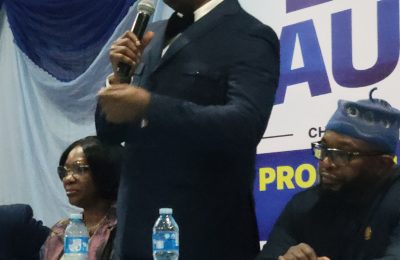
Prof Adeoti,giving his Vote of Thanks
Dele,
When upon life’s billows you were tempest tossed,
When you were discouraged, thinking all was lost,
Count your many blessings, name them one by one,
And it will surprise you what the Lord hath done.
Count your blessings, name them one by one;
Count your blessings, see what God hath done;
Count your blessing, name them one by one;
Count your many blessings, see what God hath done.1.
Yes, in spite of enormous vicissitudes of life, and obvious verisimilitudes, Professor Adeoti has not only paid his dues, he is also leaving his footprint in the sands of time. Here thus lies his honour.
The Man: Ezekiel Oladele Adeoti
A teacher at various levels of education – primary, secondary and tertiary, Dele Adeoti was born on May 23, 1954 at Efon-Alaye in present-day Efon Local Government Area of Ekiti State. His personal recollections of his early childhood testifies to a momentous childhood, made more purposeful by the strong presence of an array of extended family relations and personages.
Although an introvert, Dele exudes tremendous warmth, and genuineness of the human spirit that is compellingly absorbing. He has consistently remained a very organised man. Whereas he is an enemy of rigid conventions, he has a knack for being conventional in many respects.
Adeoti: The Teacher and Historian
In broad terms, Ezekiel Oladele Adeoti’s contributions have been in two dimensions; first as a trained teacher and, second, as a trained historian. A balanced assessment of him, therefore, must take into cognisance two main areas of his activities, namely, teaching and publications. This is more so, as these two areas of his activities are almost inseparable, as shall be demonstrated presently.
As a teacher, Dele Adeoti has had teaching stints at various levels of the educational system comprising secondary school, college of education and university. Details of his teaching career and exploits at these various levels need not delay us here2. Suffice it to remark that it is at the university level that he has made the most profound impact, details of which will unfold as we proceed with this presentation.
Many of his publications have examined the roles of education, and some major actors in the sector, in nationalism, politics and the economy in the overall process of nation-building in Nigeria. Although he equally veered into biographies, this has been done within the context of the contributions of the subjects of discourse to educational development. Moreover, even though he also has some works in the areas of health/medical history, as well as sanitation and environmental studies, his focus as a scholar of social history, with a more specific focus on educational development, is very clear and defined.
His Core Publications on History of Education
Adeoti’s major publication, with which he is more closely associated, is entitled Alayande as Educationist, 1948-1983: A Study of Alayande’s Contribution to Education and Social Change.3 Perhaps, the most appropriate offering, which an analyst from the Ibadan School of History can make to a colloquium celebrating Dele Adeoti is his copious analysis of Western education from the lenses of Emmanuel Alayande, a key actor of this revolutionary phenomenon. Adeoti’s classic and encyclopaedic volume, in this respect, is a study of the contribution of Archdeacon Emmanuel Alayande, a foremost educationist, to Western education and social change in Ibadan during the study period.
This publication is a revised version of a PhD thesis which he took in 1995 in the University of Ibadan, unarguably a most fertile centre for historical scholarship in Nigeria, since the University College, Ibadan days. Dr Adeoti had the singular fortune of being supervised by the legendary doyen of History in Africa, Emeritus Professor J.F. Ade Ajayi (now of blessed memory). Based on written and oral sources meticulously cross-checked, the work is an insightful discourse of the role of an individual in societal development through changing historical scenes. The study depicts Alayande as not only a product of history, but also as a maker of history through the different facets of his career as an educationist, politician, religious leader, trade unionist, philanthropist and a patriot to the core. The cardinal principle of Alayande, as deduced from Adeoti’s study, revolved around human capital development, along the path trodden by the legendary Obafemi Awolowo. This study, which is in the field of Social History in general, and the History of Education in particular, is well researched and a reference point in the educational development of Ibadan in particular and Western Nigeria in general. At its appearance, it was justifiably well-received. In a nutshell, this is a well-written account of the contributions of a major actor of the educational development in post-colonial Western Nigeria in particular and the newly-independent Nigerian nation-state in particular.
One of his other papers is: “The First One Hundred Years of Western Education in Ibadan, 1852-1952: An Historical Analysis”, published in An Historical, Cultural and Socio-Economic History of An African City 4. The paper discussed a hundred years history of Western education in Ibadan between 1852 and 1952. It traced the foundation to the European type of formal education started by Christian missionaries and later built on by the colonial administration. As the author argues, in spite of initial reaction, time and events ushered in positive changes in the people’s reaction to Western education as individuals and voluntary agencies continued to show appreciable interest in the need to expand educational facilities. This is another insightful study in the area of social history.
A related publication in the area of History of Education by Adeoti is his joint publication with Emeritus Professor J. F. Ade Ajayi, entitled: “St Andrew’s College, Oyo: Pioneer of Tertiary Education in Nigeria”5. This is a study of the pioneering role of St Andrew’s College, Oyo in the development of tertiary education in Nigeria, especially between 1896 when it was established, and 1948, when the University College (now University of) Ibadan was founded. As the authors vividly analyse, the college became remarkable for its success in providing liberal education of high quality and enjoyed stability in its leadership role in the educational sector. As the paper highlights, St Andrew’s College had close affinity with Fourah Bay College in Sierra Leone, as an effective pioneer of tertiary education in Nigeria, and contributed to the nation-building process in the country through changing historical eras.
Other Publications on Aspects of History of Education
One other publication by Adeoti is, “Education and Sustainable Development in Nigeria: An Analysis of the Contributions of UNESCO, 1960-2018”6. From the standpoint that education plays crucial role in national development, and thus an instrument of social change and societal transformation, the paper examined the contributions and impact of UNESCO on education and sustainable development in Nigeria between 1960 and 2018. It highlights the various challenges in the Nigerian educational system and UNESCO’s efforts towards ameliorating the deplorable situation. It further argues that UNESCO’s assistance to Nigerian education in such critical areas as teacher education, technical and scientific education, adult literacy and girl child education has had the potential of promoting education and sustainable development in Nigeria.
Evaluation of Adeoti’s Primary Area of Research and Publications
At this juncture, it becomes imperative to make some brief remarks to demonstrate the import of Adeoti’s scholastic output in the area of Western education and socio-economic change, from the perspective of two of his core publications highlighted above, both of which mirror Western education in Ibadan, and to an extent, Western Nigeria in general, through changing eras. As rightly demonstrated by Ezekiel Adeoti, Western education had been introduced into Ibadan, as well as other locations in Western Nigeria in the mid-19th century, by Christian missionaries of various denominations. With the British invasion and subsequent colonisation of Western Nigeria, Western education was consolidated by the new colonial administration which built on the firm foundation laid by the missionaries. This was done by establishing more schools and colleges. A wind of change, however, blew over Ibadan, and indeed Western Nigeria when, following the Macpherson Constitution of 19517, the forward-looking regional government of Western Nigeria initiated a massive revolution in the education sector through its inauguration of free Universal Primary Education during the first half of the 1950s. It was clearly a new dawn of educational advancement. Naturally, Ibadan, the study locale of Adeoti, was a major beneficiary of the revolutionary educational scheme. The very high increase in pupils’ enrolment in schools in Ibadan during the early phase of the Free Education scheme8, and through changing eras, could be explained by the cosmopolitan nature of the city. Another factor was the influence of developing industries in the province, which had remarkable effects in that some people and their children who must have immigrated into the area in search of the wage-paying factory and white-collar jobs. At the same time, parents must have realised more fully that, without basic education, chances of securing such jobs were poorer. Besides, it should be noted that Ibadan was the political headquarters and seat of government of the Western Region. Because of this factor of proximity, the campaigns and propaganda of government about mass education during those revolutionary years must have given the town more advantage over outlying provinces in Western Nigeria that were relatively farther from the seat of government.9 Notably, Emmanuel Alayande, the pivot around whom Adeoti’s studies revolve, is immortalised for his indelible contributions to creating the basis for an irreversible revolution in education, and in the provision of social justice in society at both the micro and macro levels.
Distinguished audience, the rate of development that goes with education in Ibadan, as well as in Southwestern Nigeria, and indeed southern Nigeria, is there for all to see. Till date, the educational gap between the South and North is increasing phenomenally, in spite of inducements to “catch up” by the latter. This is apparently so, as the former is running while the latter is still crawling in this respect. There is no doubt that, today, the national crisis in Nigeria deepens largely because of the apparent dichotomy in education between the north and south. Banditry and various forms of terrorist acts in parts of the country increase their grip on virtually all sectors of the national life of the country, including educational developmental sector. Ethnic and religious rivalry have retarded the wheel of progress of Nigeria, the presumed Giant of Africa, in several embarrassing ways that are unimaginable. Lack of education, or inadequacy of education is a stumbling block against the enlightenment of the citizenry. Perhaps, if the desired lessons are drawn from studies by Ezekiel Adeoti, merging the vision of the likes of Obafemi Awolowo, S. O. Awokoya, Bola Ige, Lateef Jakande, and of course Emmanuel Alayande, the honouree of today and his scholastic output in this area of social history, may become a sounding-board for that revolutionary process that is capable of bailing Nigeria out of its present national conundrum. In a nutshell, therefore, Adeoti’s works on aspects of the history of education in Nigeria touch on important and fundamental philosophical and developmental national issues of our time and society. This, undoubtedly, has marked him out as one of the most notable historians on the history of education in Nigeria.
Be that as it may, Adeoti’s research and scholarship interests are not limited to the history of educational development in Nigeria, but extend to other areas of Nigerian and African History. Space and time constraints will, however, not permit us to delve into these other areas in details. Suffice it to just mention that, in his teaching and research, today’s honouree equally ventured into such areas as Historiography, Biographical Studies, Inter-group Relations and Nation-Building in Nigeria, Health and Medical History, Sanitation and Environmental Studies, Diasporic and International Studies, as well as aspects of history of Efon-Alaye, his country-home. The honouree’s papers emanating from the above related areas are lucid and published in high-impact outlets, both within and outside Nigeria. They are equally well-researched and of high quality. Of more significance is the fact that, in many of the publications, he has interrogated issues from an array of sources. In this respect, the candidate has demonstrated his understanding of the dynamism and subjectivity of sources. Consequently, he has been able to demonstrate the mastery and use of multidisciplinary approach.
Adeoti’s Stint in Administration
Mr Chairman, although Ezekiel Adeoti’s undoubted priority in the university system was teaching and research in which he was not only active but also steeped and naturally content to spend many hours conducting his studies, his services in the ivory tower were not confined to the classroom. It was natural that he should be involved in different university administrative positions, in various capacities, professionally and academically, at his base in LASU, and elsewhere. Right from the start of his teaching career in the university system, Adeoti functioned on a few committees in his department, the Faculty of Arts, and the university. Beyond the committee levels, he was also privileged to be in the administrative saddle at the department. In 2012, he was appointed Head of the Department of History and International Studies. In this position, he took charge of the teaching and research commitments of the department. He served for two years, up to 2014. During those two academic years, he embodied the bedrock of the fermentation of intellectual ideas that exposed the Department of History and International Studies, his micro constituency, to vistas of new possibilities. His effort paid off handsomely and succeeded in contributing to placing the department on a firm footing. Quite significantly too, he has devoted enormous time and attention to oversee the career advancement of many of his students at various levels: Diploma and Postgraduate Diploma, as well as Bachelors, Masters and Doctorate levels. He has had the rare privilege of coordinating all the programmes at various times in the course of his career. Naturally, too, he has supervised many Project Essays, Dissertations and Theses.
Professionally, therefore, there is sufficient evidence to demonstrate that Professor Ezekiel Oladele Adeoti has been actively involved in the three-pronged areas of teaching, research and community service, towards contributing his bit to societal development at the micro and macro levels. Put differently, there is, no iota of doubt that he has been consistently developing himself and the academic constituency he represents, both professionally and academically. “Seest thou a man diligent in his business? he shall stand before kings; he shall not stand before mean men”10.
Concluding Remarks
Ladies and gentlemen, this colloquium has provided us with a suitable occasion to look at Ezekiel Oladele Adeoti as a teacher, historian, and scholar and, in the process, analyse some of the major issues around which his scholarship has evolved. After an introspection on his life and career through changing scenes, one is left with the feeling that, given his modest academic and professional excellence, coupled with his strong sense of empathy and commitment to equity and fair play, he could not have chosen any other profession than teaching. This is more so as a History teacher at various levels, and consummating such with teaching History at the university level where he now retires. His is an embodiment commitment, high-mindedness and sacrifice required by his chosen profession. At 70, Adeoti can look back to a rich and successful career in the academia, and look forward to greater accomplishments in other areas of services to God and humanity and, above all, living hale and hearty. His accomplishments in teaching, research, and community service serve as an inspiration to the old and young, within and outside the ivory tower.
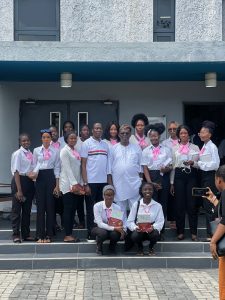
Prof Oladele Adeoti with students and admirers
The Scripture affirms that: “To everything there is a season and a time to every purpose under the heaven”;11. Seasons that are ordained by God cannot be revoked. Thus, there is a time to be born, a time to school (primary, secondary and tertiary), a time to serve one’s nation as a youth corps member, a time to begin work, a time to marry and raise a family, and a time to retire from formal public service work, among many human rituals in life. The beginning and ending of each season remain the reserved prerogative of God. In a nutshell, everyone answers to time. For Dele Adeoti, this is the time to formally disengage. But then, if Onirese, the axiomatic calabash carver of the Old Oyo Empire fame would not carve new calabashes here at the Lagos State University, the ones he has already carved would remain for posterity. The Yoruba rendition goes thus:
B’Onirese o fingba mo
Eyi to ti fin o lee parun laelae
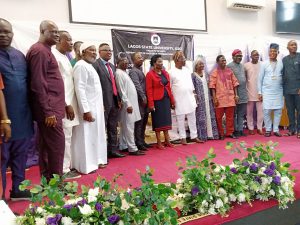
Adeoti,in group photograph with colleagues and friends during the Retirement Colloquim
At this point of his retirement, Ezekiel Oladele Adeoti’s modest contributions as a teacher and historian serve as an inspiration to old and younger academics. His adventures at Lagos State University, after close to three decades of meritorious service, is most deserving of celebration and honour even as he formally bows out of the system. The import of his being celebrated at this occasion where his colleagues, friends and former students converge to honour him as he retires, is immensely significant. Undoubtedly, it showcases, though modestly, a man who has been committed to the timeless ideals which human kind cherishes. It is also a due appreciation of a man committed to scholarship and humanity. All those who believe in these ideals cannot but join in wishing him a most-deserved blissful retirement. Professor Ezekiel Oladele Adeoti has come, he has seen, and he has conquered. I congratulate our distinguished alumnus of the Ibadan School of History, and a worthy ambassador here at Lagos State University, for the privilege to receive this uncommon honour at this historic occasion, before his very eyes.
Notes and References
Adapted from Baptist Hymnal, 1956 Edition, Hymn 318.
Records indicate that Dele Adeoti had had teaching stints at Yejide Girls’ Grammar School, Ibadan, and Oyo (later Osun) State College of Education, Ilesa, before joining the services of Lagos State University, Ojo-Lagos.
Published in Ibadan by Heinemann Educational Books (Nigeria) Plc, in 1997.
Edited by G. O. Ogunremi, G. O. (ed.), Lagos: Modelor Press, 1999
Published in A Golden Heritage: Essays in Celebration of St. Andrew’s College, edited by E.O. Olukoju, Ibadan: Heinemann Educational Books (Nigeria) 2001) pp. 113-120
Published in Jalingo Journal of Social and Management Sciences, Vol. 1, Issue 4, 2019, pp. 228-238.
In 1951, Nigeria adopted a Federal Constitution, otherwise called Macpherson Constitution. Through its provisions, the regional Houses of Assembly were empowered to make laws for peace, order and good government of their respective regions with respect to certain enumerated subjects, including education. Thus, responsibility for education devolved on the governments of the regions. The Western Regional government subsequently gave priority to education, and introduced a free universal primary education in 1955, a step that was later followed, to an extent, by the Eastern Regional government in 1957.
See the Enrolment in Primary Schools in the Western Region by Province, 1953-1960, computed from Western Nigeria Annual Abstract of Education Statistics, 1953-58 and 1955-60, pp. 17 and 19 respectively.
See S. Ademola Ajayi, The Development of Free Education in Western Nigeria, 1951-1966: An Historical Analysis. M. A. Dissertation, Department of History, University of Ibadan, 1984, pp. 69–70.
Proverbs 22:29
Ecclesiastes Chapter 3 verse 1