By Oyero Olurin
On July 11, 2023, Nigerian security operatives set ablaze a vessel carrying 800,000 liters of stolen crude oil.
The vessel, MT TURA II, was intercepted in the Escravos area of Delta State, and was preportedly headed to Cameroon. It is pertinent that we address the environmental, and legal issues raised by the spontaneous nature of the action of government operatives in this article.
As it were, burning of the vessel has raised a number of concerns. First, there is the issue of pollution. The burning of oil can release harmful pollutants into the environment, including particulate matter, sulfur dioxide, and nitrogen oxides. These pollutants can have a negative impact on human health, as well as on the environment.
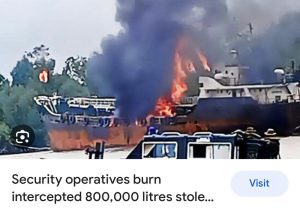
From my research, l learned that burning 800,000 liters of crude oil has a significant impact on accelerating climate change. Crude oil is a fossil fuel, and when it is burned, it releases carbon dioxide and other greenhouse gases into the atmosphere. These gases trap heat, which causes the planet to warm.
In other words , burning of 800,000 liters of crude oil would release approximately 2,400 tonnes of carbon dioxide into the atmosphere. This is equivalent to the emissions of about 500 cars for a year. Climate change is a serious threat to the planet, and it is important to take steps to reduce greenhouse gas emissions. Perhaps burning crude oil is one of the leading causes of climate change, so it is important that this concern is observed in subsequent actions.
Second, some people have questioned whether it would have been better to appropriate the 800,000 liters of oil. This would have allowed the government to sell the oil and perhaps the forfeited vessel and use the proceeds to fund its anti-corruption efforts.
Equally important, is the question of whether the government should have taken the matter to court before destroying the vessel. As l understand it, under the Nigerian law, the government is required to obtain a court order before destroying properties.
However, in this case, the security operatives reportedly acted without a court order.
There are a number of legal precedents that could be used to argue that the government’s actions were unlawful.
In 2016, the Nigerian Supreme Court ruled that the government could not destroy property without a court order. The court found that the right to property is a fundamental human right, and that the government cannot violate this right without due process of law.
One supporting argument is that in the past, efforts by the Nigerian Navy to make the crew and owners of a particular vessel pay penalties of N5million and $15million when their vessel was seized worked.
In the words of former Chief of Naval Staff, Vice Admiral Awwal Gambo; “It is to be noted that the vessel and crew will not be released until the penalty and restitution are paid as well as public apologies made in the print and electronic media in Nigeria and Llyod’s list.
“The successful arraignment and conviction of Motor Tanker HEROIC IDUN and her crew arrested last August, sentenced after a plea bargain to pay N5 million as a penalty for the charge and $15 million as restitution to the country, is a resilient indication that the Nigerian Navy, as the nation’s maritime sentinel, will stop at nothing to ensure the domain is safer for sustainable development of the nation’s blue economy.”
In the case of the MT TURA II, the government could argue that it had a legitimate interest in destroying the vessel in order to prevent the further theft of crude oil.
However, the government would need to demonstrate that the destruction of the vessel was the only way to achieve this goal. If there were other, drastic measures (legal )that could have been taken to prevent the theft of crude oil, then the government’s actions would likely be considered unlawful.
As a matter of fact, there exists the Petroleum Production And Distribution (Anti-Sabotage) Act.
Penalty for offence of sabotage reads thus:
Any person who commits an offence of sabotage under section 1 of this Act, shall be liable on conviction to be sentenced either to death or to imprisonment for a term not exceeding 21 years.
Methinks the solution has been provided by this Act. What is needful is the Will to enforce the law.
Ultimately, the legality of the government’s actions will depend on the specific facts of the case.
However, the burning of the MT TURA II has raised a number of important legal and environmental questions. It is important to ensure that the government’s actions are consistent with the law, and that they do not cause unnecessary harm to the environment.