By Adeoye Olugbenga ADEWOLU
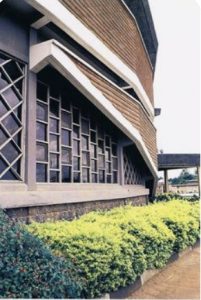
The Principal in the Case Study of Nigeria’s Model Green Building did not name his buildings ‘Green’ He was only interested in doing something sustainable and affordable. The Review below was carried out by Amber Sijuwade, Aljazeera Journalist. The pictures are courtesy of Andrew Esiebo/Al Jazeera.
Nwoko is a genius of sustainable architecture and Global Life-Service Award Winner 2023
In Idumuje-Ugboko, southeast Nigeria, Artist/Architect Demas Nwoko works at home, Monday to Friday. He is never too busy to instruct his mentees as shown in Figure 1.
The African Designs Development Centre is the only industrial enterprise in the community. It is Nwoko’s factory, and is run by an Architect and Contractor, Demas Nwoko’s 54-Year-old son Ashim. The idea is to hire and train locals to produce building and furniture components using indigenous materials produced locally that will be distributed nationwide. In the interim, Demas Nwoko’s building commissions are supplied by the workshop’s custom-built parts.
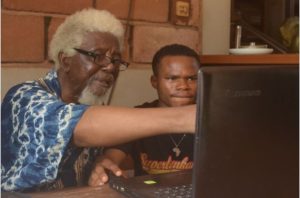
Demas Nwoko (l) and an undefined person
Nwoko insists, continuing to look off into the distance as if he could see his future self there. “I’m a realist, a concrete thinker, allergic to wasting effort,” he says. He still has a lot to accomplish as he continues to “keep pushing in my own small corner at what is positive and viable” according to his strategy.
Observing Patterns Worldwide
As the son of the local ruler, Nwoko was raised in a mud palace as a royal. The laterite-built palace, which has areas for private meetings and public gatherings, as well as clandestine ceremonies, was designed to resemble the Palace of His Royal Highness, the Oba of Benin, who is historically an ancestor of Demas Nwokos family.
Bottom of Form
However, he observed that “there was a complete absence of the study of our own traditional knowledge” when he arrived at Ahmadu Bello University in Zaria. Nwoko recalls how modern art was left out of the curriculum because ” Because teaching it would indicate that there is an African influence, the Europeans wanted to avoid doing so,” according to Nwoko.
He facilitated the establishment of the Arts Society in Zaria in 1958 with other like-minded art students as a team devoted to building their educational programme by researching the independent Nigerian indigenous artistic history. They had the moniker “Zaria Rebels.”
Demas Nwoko remembers how “all the things we undertook were aimed at adhering to the global pattern, irrespective of whether it functioned for us or otherwise” as a country. in his reflection on the prevailing ethos of the period. We were unwilling to seek out our own expertise.
Nigerian Conventional Wisdom Designs
Nwoko started his career when he was hired to assist in the establishment of the School of Drama at the University of Ibadan in 1961 having graduated from the Ahmadu Bello University, Zaria.
In Ibadan, Nwoko started constructing his own home using the methods that have come to stand in for him. To create the bricks, he used local the laterite earth that was excavated on the plot of land. The modest hue variations, which range from ochre to rust when left untreated, indicate the layers of the earth from which they were formed.
Recycled wood from the construction process was used for the roofing framework, floor coverings, openings, and window frame shutters. Walls that serve as accents both inside and out are constructed using stone from granite from nearby quarries. Minimal windows were used in the construction of the house to protect against the sun’s glaring brightness as well as heat, echoing the practical aspects of conventional Nigerian architecture.
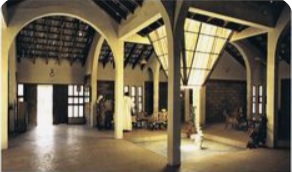
Through airflow portals, floor winds can enter, while hot air can leave via the ceiling as shown in Figure 2.
Because of this ambient cooling system and the ability of the walls of the earth to naturally adjust the ambient temperature, there is never a need for cooling systems.
The majority of Nigerians are still residing in colonial master’s mansions nearly 60 years after the country’s independence, yet this Ibadan home is nevertheless a shining example of how ancient technological advances in construction may be improved by modern creative architecture as demonstrated in his works
Foreign Problems, Adopted Solutions
Concrete construction is ubiquitous in the metropolis, which is currently thought to be the largest urban area in all of West Africa. The constant growth of Ibadan has also resulted in an overabundance of wrapping garbage that is becoming a small business in its own right.
Colonial Principles and Beauty
During the colonial era, using sand and foreign bricks made of cement for both domestic and significant government-owned buildings in Ibadan and across the country established the norm.
After calculating the financial implications associated with importing building materials, the Oyo State government began creating its own models of inexpensive housing using mud bricks in 1976. By using domestic coconut and palm timbers as rafters, officials hoped to show how using natural resources could be a practical and more cost substitute for concrete. Rich indigenous art is demonstrated in his various works.
People who praised the government’s efforts reportedly also inquired as to why these materials were not used by the state to construct housing for civil servants if the buildings produced were in fact more affordably priced and structurally solid. Local residents were successfully discouraged by the impracticality of such construction as well as the still-in-force municipal planning restrictions that forbade the use of mud in construction.
The Western Regional Law of Nigeria 171 of the colonial government, which specified methods of construction, dimensioning, and acceptable building materials for residential construction, was in effect as of June 2, 1960. It stated that new earth construction was not approved by local city planning offices and could be collapsed if built.
The same laws are still in place today, 60 years later.
Responsibility System
In Bere, where the historic colonial administrative building, Mapo Hall, is just a short drive from the concrete palace of the Olubadan (king) of Ibadan, inspired by Western architecture, traditional buildings are almost falling down. The ground from which the defensive structures rise and their base are virtually identical.
Nwoko thinks that Nigeria’s failure to reach its full potential is a result of the same breakdown in cultural and social relations. He asserts that young people nowadays are unable to react when asked what value they offer to society. He asserts that formerly, culture was structured as a “responsibility system” in which each individual was expected to meet a need within the group.
Nwoko, however, is quick to refute the fallacious idea that colonial rule was the cause of the cultural breakdown. Instead, he thinks that the management of funds following independence was what contributed to the start of the breakdown of society.
He recalls that the country began to get financial aid when valuable natural resources were discovered. Foreigners mined and shipped certain types of crude oil without employing local labour. Because they were supported by government handouts and scholarships made possible by the money they had not earned, the succeeding generations had a weaker sense of community.
He sees this trend as continuing the consequences of the slave trade because it is the most recent example of the export of human labour from Africa for the benefit of Western prosperity.
“And we’re still transferring human capital over there,” says Nwoko, alluding to the movement of people from Nigeria to the economies of the Western world. He further points out that more than 50% of Idumuje-Ugboko residents live and work overseas and claims that when students from his community attend school and receive an education, they do not go back to farming.
According to him, people “build mansions they never reside in and come back to be interred.”

Dr. Adewolu
The Cultural Product of Design
“I make sure that my creations are sturdy and long-lasting. I can give an appealing alternative to building with imported materials by way of my example, he claims, and whatever I make will endure for hundreds of years.
His buildings, such as the Dominican Chapel, University in Ibadan, the Akenzua Cultural Centre in Benin, and his private residence in Idumuje-Ugboko, are examples of his dedication to proving that traditional building techniques can be artistic and appealing in addition to being functional and efficient.
Some have massive columns supporting extraordinarily high ceilings, while others include impluvium mechanisms that provide fresh air from openings. Their majesty coexists with a feeling of seclusion and soft tenderness
According to Nwoko, “an emblematic form is an object of civilization.” His artistic additions to metal craftsmanship and ornamental sculpting mix classic Igbo forms with his own creations to produce a distinctive design that is incomparable to any contemporary builder’s.
Nwoko reflected on his career-long commitment to sustainable building practises, saying, “I have always put my beliefs into practise. And now that the world is still debating environmental awareness what would have been seen as his unique philosophical, political, and aesthetic choices sound exactly on trend — ‘green’ building methods are viewed as a vital tool in the war against global warming. A good living example is Figure 8. The Residence of Demas Nwoko himself.
Nwoko wonders if sustainable development could be a measurable indicator of actual sovereignty. “Independence is to become ourselves,” she argues.
According to him, it is imperative that “you become connected to the younger generations there and make your contribution felt wherever you are, wherever neighbourhood you find yourself in.”
Nwoko believes that the following subsequent generations will value what the previous one overlooked” by having samples of his design work all around the nation. That generation and the others will have to decide whether or not to follow his example.
ADE ADEWOLU, PhD, MNIA, ISTQB/CTFL
Senior Lecturer, Department of Architecture
Bells University of Technology
Ota, NIGERIA
Tel: +234.8067090770 E-ma
ADEWOLU, PhD, MNIA