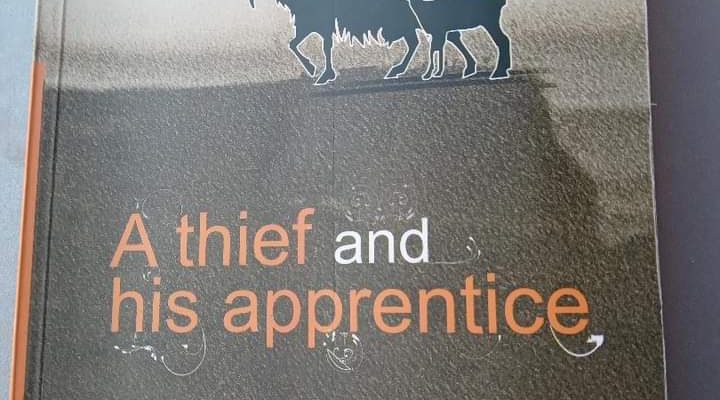

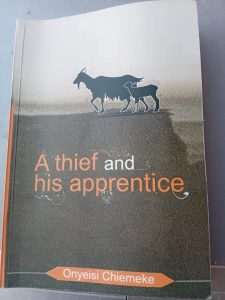
In A thief and his apprentice, Onyeisi Chiemeke brings within touching distance, what lawlessness and organised crime can do to a society
Sylvester Asoya
A thief and his apprentice is a book for all seasons.
At the centre of this provocative work by Onyeisi Chiemeke, a lawyer who obviously loves literature, is criminality. So, it will not be too difficult for a reader with good judgement on literary matters to notice that this book is essentially about power, politics, prejudice and perversion. The author also explores in detail, the criminal metamorphosis and the larger-than-life image of exceptional thieves and their surrogates. To prepare his readers for what await them, he defines his objectives and warns about power in Sowing Seeds which opens the book. “I have come to understand something about power—power is necessary to transform the lives of men, and power is also necessary to stagnate the lives of men or even completely destroy the lives of men too. So, who would not worship something such omniscient and omnipotent?” he asks. He goes further, this time, with a full dose of sarcasm and adds that power “creates impotence in those who do not have it, and also makes murderers of men who ordinarily would be angels”.
A thief and his apprentice is an eye-opening account of corruption, oppression, immorality in high places and miscarriage of justice. It is also about underground workings of politics, from selection of candidates and electioneering to the influence of god fathers and the activities of other ignoble characters behind the scenes. Chiemeke writes eloquently about the electoral process and how outcomes are determined by strong men and women long before voting and announcement of results. But the narrative takes another dimension when the narrator speaks to an impending election. “We have won the election already. Even the seer said so. You think I would be staking my money if we don’t have the winning ticket? We do not need to bribe the officers to throw the game open, after all they are our referees. Power everywhere is like the stock market, there will always be insider dealings.

It is evident that this author was inspired by the need to help and heal society with literature, and he says this much. “A thief and his apprentice is a kind of dissatisfaction with the political behaviours in the context of Nigerian politics. And the nature of this political behaviour seems to depreciate us as a people. Many scenes may have been comical but I felt it was a good way to laugh at the follies of our existence. There is a certain sense of anger about our society that can only be communicated by the relief that comes from the power of the literary art, of storytelling”. And for the author, everybody is a victim because according to him, “power seems to violate us one way or the other in our daily existence, and we all seem to be losing the capacity to resist”. He rounds off by acknowledging the fact that no writer has all the answers. Therefore, readers and citizens have a duty to look inwards, step back and take action, just like the writer.
Book review: Review Where there is a will
No one reads A thief and his apprentice without enjoying the exquisite storyline, the fluid characters, the flexible scenes and anecdotes that spice nearly all the short stories and dialogues. In this book also, the author writes like an active and sentimental headmaster who was once a pupil. He engages his reader and recalls the adventures and rascality of the past. He also educates his readers, especially young people, about trends, didactic stories of old and the music of his teenage years. His use of wise sayings, common expressions and even words that lack social refinement underscore his commitment to freedom and a better society.
No doubt, this is an interesting narrative with classic examples of real-life stories and dialogues that enliven. And it is important to add that this work, a satire, is directed at people and institutions: politicians, small and big business owners, founders of worship centres, captains of industry, the corporate world and even young people. And like a good writer, the author brings to bear, his knowledge of law, especially law of evidence which brightens the narrative and shapes the plot structure.
Beyond the misuse of power by men who play god on earth, there is also the book’s preoccupation with the celestial realm where it questions God and his authority to punish harbingers of suffering and death in God’s garden. The damning verdict on power from the writer’s perspective is that it is a deceiver that breeds misery, corruption, hunger, hopelessness, ignorance, wickedness, backwardness, hatred and death. But all these do not in any way detract from the fact that some of the stories paint incomplete pictures of the bigger frame. In truth, some of the narratives are winding, unfinished and endless but who knows, it may be the author’s way of expressing his thoughts.
This is a compelling work. For students of power and any one for that matter who is interested in the affairs of men, there could not have been a better book, especially now. But I hasten to add that I totally disagree with Chiemeke who discountenances God’s omniscient and almighty power to discipline and redirect His recalcitrant children on a road to nowhere. I also believe that the book’s recurrent mood of pessimism does not look justified in spite of all the challenges and hopelessness the world faces. In spite of the occurrence of a few typographic gaps and proof-reading errors, A thief and his apprentice is a good work of art.
A reader may not agree completely with Chiemeke’s style but no one can question his patriotism and desire for a better society. With this book, he has stamped his authority as a writer who understands social and political issues. As his parting shot, he insists that the world is troubled and that there will be no harmony until something is done to break the vicious circle of violence, chaos and death.
In conclusion, I would like to commend the author for sharing his thoughts and experiences in this book. Chiemeke may not have written many books but he writes purposefully, and this should serve as encouragement for other professionals who may be interested in literature.
This article was first published in alice, the in-flight magazine of Air Peace