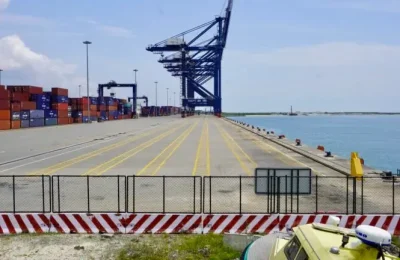
The Nigerian Ports Authority NPA,has announced plans to deploy Vessel Traffic Services,VTS in it’s bid to prevent and track crude oil theft.
Crude oil theft and Nigeria’s economy
Mohammed Bello-Koko ,Managing Director of NPA announced this at the 55th state house Ministerial press briefing.
He disclosed that in the first half of 2022, the Nigeria Ports Authority (NPA) produced income of N172.28 billion while also enhancing investor interest in the Eastern Maritime Corridor.
The ports of Calabar and Onne have already received ISO certification and have seen a significant growth in traffic for both imports and exports, with Onne emerging as the port with the quickest rate of expansion in the nation.
Calabar, Port Harcourt, Onne, and Warri are the principal ports along the Eastern waterways.
The Ministerial briefing held at Aso Rock Villa and was organized by the Presidential Communications Team.
“In terms of percentage input, Onne has done 11,800 metric tons half of this year. We are seeing that the increase in percentage is high, probably because it is easier to do business in Onne now.
“And because we have deployed more equipment in Onne and more personnel, we have paid attention to ensure that we made the port more competitive. In terms of export also, there is an export processing terminal within Onne itself.
“Again in the first half of 2022, NPA has generated about N172.28 billion in revenue”, Bello-Koko told the media briefing.
He also revealed that one of the Onne port operators, the West Africa Container Terminal (WACT), has spent more over $100 million on equipment and technology deployment, terminal expansion, and other related projects.
The head of the NPA revealed that some vessels involved in crude oil theft in the deep waterways of the nation typically turn off automatic identification systems to avoid being found by wise officials, costing the nation billions of dollars in lost revenue.
Bello-Koko said:“ The intelligence persons bringing in vessels to steal crude, one of the things they do is, they shut down the Automatic Identification Systems (AIS). This is what is needed in terms of transmission for you to even know when the vessel comes in and the location they are to go to.
“They come in legally but then they go by the left-hand side to commit illegal activities after switching of their AIS. We are going ahead to deploy the Vessel Traffic Service (VTS) and to also have information in terms of vessel movement.”
He also raised concern over the persistent theft of millions of naira worth of buoys from deep-water areas, which he observed had increased navigational risk and deterred some foreign cargo ships from using Nigeria’s eastern maritime corridor.
“Each of the buoys which serve as navigational route signs costs between N12 million and N20 million, whereas no fewer than 25 of this maritime safety equipment have been stolen from Nigerians waters this year alone. Apart from the cost of the buoys, it is even costly to install and deploy them on waters.”
The lack of buoys, according to Bello-Koko, puts ships at risk of running aground, and because of their fear, many foreign ship captains steer clear of particular sections of Nigerian waterways, which has a negative impact on tax collections at the affected ports.
The NPA boss claimed that management had been corresponding with the villagers and their leaders in the communities where the thefts take place in an effort to quell the vandals’ activities.
He claims that the vandals frequently transform the stolen buoys into junk.
“Some of the buoys have solar panels and sensors, and there is a beacon light there that flashes at night. So the first thing they do is to vandalize that sensor. Then you just have iron that has no light, and they can just drag it off without the sensors.”
“We can monitor it if it is not disconnected. At times we send in our boats to go round scouting for it. And to also be fair to the communities, we have had some instances where the buoys were naturally taken away by nature, they went adrift, they ended up on the shores of some communities.
“And to be fair to them, they have actually called us a couple of times to tell us that there is a buoy that has gone adrift and it is in our community and we thank them for that.”
“We believe probably the communities do not even know the individuals that are involved in these activities. So we are monitoring the buoys. And that is how we got to know how many are stolen any day it is stolen.”
“Because the captains are also taking vessels in and out of the water channels, they will naturally know when they can’t find the beacons on the buoys meaning that something is missing, and they normally report it”, Bello-Koko explained.
However, he reiterated the management team’s dedication to providing effective port services in a welcoming, secure, and safe environment.