
By Abdullahi Jhalil Tafawa -Balewa
KEYNOTE ADDRESS AT THE LAUNCH OF THE BOOK: NIGERIA THE JOURNEY TO DEMOCRACY by OLADIPO JIMILEYIN on 12th APRIL 2022.
NIGERIA’S DEMOCRACY- WHERE HENCE
Nigeria is probably the most strategically important country in sub-Saharan Africa.
At about 260 million people, Nigeria is home to over 20 percent of sub-Saharan Africa’s population. It is the largest oil producing state in Africa, it is the fifth largest supplier of crude oil to the United States, and the tenth largest global producer.
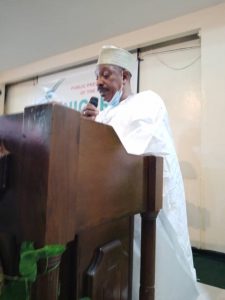
Abdullahi Jhalil Tafawa
It is home to the sixth largest Muslim population in the world, and it’s by far the largest country in the world with approximately equal numbers of Christians and Muslims. In the United Nations, Nigeria is the fifth largest peacekeeping contributing country in the world. It is a crucial continental power broker in dealing with African institutions and in resolving armed conflict. It is a vital player in the war on terror.
In 1849, Abraham Lincoln described democracy as a “government of the people, by the people and for the people.”
That is, a system of government where the eligible populace exercise their electoral power to rule directly or by elected representatives.
Thus, democracy provides institutions that express the supremacy of the popular will on social directions and policies. For instance, in the Greek City states where democracy started, economic equality, mutual feeling and liberty were desirable and so made it successful by the populace.
Accordingly, the common features of democracy include: the existence of periodic elections, equal rights of adults to vote and be voted for, equality for executive and judicial offices, freedom of speech, publication and association, and more.
These rights provide the opportunity for political participation, which is the right to choose rulers to decide the general lines of policies.
In the same vein, democracy provides opportunities for personality development, such as access to knowledge through state aided education, security against unemployment and minimum wage intended at reducing the disparities in the distribution of wealth, including provision against sickness, fair conditions for work and conditions to guide against economic slavery.
Although, democracy in Nigeria is as old as the country from 1914, it has been disrupted by series of military juntas from 1966 to 1979 and 1983 to 1999, with the major military rule credited to General Sani Abacha from 1993-1998, which ended as a result of his death.
Then the emergence of General Abdulsalam Abubakar from 1998-1999, who
transferred power to president-elect, Chief Olusegun Obasanjo on May 29, 1999, marking the return of democracy from military dictatorship.
The strangest of things, if General Olusegun Obasanjo was not the President in 1999, it is very doubtful that democrazy would have taken hold as firmly in Nigeria as it has. The fact that he was a military President before helped a lot, but he brought in some unusal characteristics to government that had not been seen before and not since.
He was a President, he then went through one of the harshest incarcerations ever, and got liberated in leading that country democratically. He had travelled more than any of the Presidents before or since, it was this type of exposure that aided him in being able to have the Nigerian Paris Debt erased in July 2006.
No President has even tried since, without his gargantuan efforts in those rarified days at the beginning of the third republic, Nigeria may be in the same position as Sri Lanka is right now. His examples of the new Nigerianized democracy gave way to peaceful handovers. His use of stick and the occasional carrot made him not so easily predictable that the country’s history will be kinder to him later.
It is essential to understand that a democratic government does not necessarily lead to good governance, even though it provides the basis for it. Good governance is characterized by accountability, transparency, combating corruption, participatory governance, political equity, the rule of law, due process, as well as free and fair elections. An engaged electorate and active civil society and strong institutions trump strong men. We have had strong men and very few institutions.
The political and economic success of Africa depends a great deal on the effectiveness, sustainability, and reliability of its democratic institutions. That means a focus on people, process and progress, not personalities and personal gain.
We seem to be struggling with holding on to the ethos of self-survival that we had the United Nations dictate our basic growth patterns in what is referred to as MDGSs which now produced an undersecretary of the UN for us If we cannot think for ourselves, our old colonialists are an arms-lenght away to continue their underdevelopment of our zeitgeist and continue to rape our minds and land with the full acquiescence of our illiterate leaders.
By illiterate, I am not saying that they cannot read, write or even understand letters that are used, but for being so under-exposed that give the future of our race away for such uncouth baits as been given the opportunities to invest and squander our commonwealth in their lands.
The end of military rule brought about a new era of regular elections, as well as civil liberties; freedom of the press, independent judiciary, the rule of law, checks and balances and the end of arbitrary arrests and torture associated with the military era.
Hence, the recognition of democracy day over the years on May 29 to commemorate the restoration of democracy in the country, however, the date was changed by President Muhammadu Buhari on June 6, 2018, to June 12, to mark the election of Chief Moshood Kashimawo Olawale Abiola(MKO), on June 12, 1993; adjudged to be the freest and fairest election ever conducted in Nigeria.
Those were the days when Nigeria had leaders, as opposed to our wallowing in the cesspool of mediocrity with our inbred zombies that are forever recycling themselves, some since the birth of our beloved country.
Who is going to be our Jerry Rawlings. In days of old, we had the likes of Chief Obafemi Awolowo, Ahmadu Bello, Sir Abubakar Tafawa Balewa, Mallam Aminu Kanu, Chief S L A Akintola, Dr. Nnamdi Azikiwe, Adelabu Adegoke (Penkelemesi) and so many others, who are known to have particular ideologies about growing this beloved country, they have acolytes who they referred to as their boys because they had the same ideas. That was how our democracy was, ideological, focused, nationalistic and patriotic. Now we have cabals, this is a nicer way of naming them MAFIOSOs.
The cabal has no focus except to acquire, fraudulently, goods, materials and materiel and have boys that are equally incognizant of the rule of law, a total lack of understanding of democratic principles and a murky descent into bloody feudalism. This is where we are and may the Almighty see us through.
Some major achievements have been accomplished in more recent times, especially in our infrastructure developments, road, rail and bridges. There are critical areas where we still have a heck of a lot more to do.
YOUTH
One group that is still grossly neglected even the gains of improved infrastructure is the youth. Nigeria as the giant of Africa is experiencing political instability and lopsided policy making body without including the youth.
At the global level, the youth are seen as significant dividends of the global population, such that they need to be included in every decision-making process.
They are also recognized as key agents of socio-economic and political movers of the society. Despite this fact on the ground, youth are marginalized and excluded from the political and important decision-making processes. This is truer in Africa than elsewhere in the world.
Most politicians in Africa are failing to recognize this basic concern of the continent. The Nigerian case is a typical example where most leaders are between 60 and 80 years of age, Though some legal protections and advocacies have
been attempted by Nigerian Youths, most of youth-related policies and programs are paper values.
Hence, it is recommended that Nigeria as a country should create enabling and youth-friendly environments that pave the way for an effective and meaningful youth political participations.
Likewise, facilitating youth inclusion in the national and local electoral and consultation processes is another means for upgrading the level of political participation of youth. Finally, if the Nation is not proactive towards their youth population, it may become a ticking political time bomb. Thus, young people should have a voice in their own future.
Despite growing evidence of youth activism and mobilization, Nigerian youths have yet to achieve the level of inclusion required to gain representation in politics.
Leadership deficits, money politics, poor internal democracy among the older parties and an absence of a strategic political agenda pose ongoing barriers to young people playing a role in national development.
Africa’s political history is not complete without appreciating the roles that youths played in achieving their countries’ independence. In the years leading to independence, youths were the driving force behind the nationalist activities that led to the dismantling and eventual overthrow of colonialism and the colonial masters.
Despite this, the role of youths in African politics has received less than commensurate attention in studies on democratisation.
In Nigeria, the activities of Herbert Macaulay, Nnamdi Azikiwe, Obafemi Awolowo, H.O. Davies, Tafawa Balewa, Ahmadu Bello and Samuel Akintola among many others in their 20s and 30s are legendary. Some of these youths are reputed for the formation of political parties such as the Nigerian Youth Movement (NYM), which was the first political party in Nigeria, the Nigeria National Democratic Party (NNDP), and the National Council of Nigeria and the Cameroons (NCNC). These young Nigerians each used the media to speak against the evils of colonialism and demanded independence.
Through these avenues, they created awareness of the evils that foreign domination posed to the country and, despite various constitutional reforms, these young people demanded independence.
Their tenacity and determination eventually saw the country gaining independence from British colonial rule on 1 October 1960.
In the years after independence, particularly during the military era, young people opposed and fought gallantly against the profligacy and youthful not very-well-thought-out utterances of the military regimes of Yakubu Gowon and Olusegun Obasanjo, and during the martial and stringent regimes of Ibrahim Babangida and Sani Abacha in the 1980s and 1990s an entire generation of youth and student organizations formed under umbrella organizations such as the National Association of Nigerian Students, the
Campaign for Democracy, the Civil Liberties Organization and the Committee for the Defense of Human Rights. These took the struggle to the streets of major cities across the country.
Despite the track record of older generation youths, Nigerian politics is fast becoming the exclusive preserve of the older politicians, as seen from the constant recycling of government officials, especially those in their 60s.The older generation youths it seems, took to politics as if it is the only profession in existence.
As opposed to the very well educated ‘freedom fighter old generation youths’, there came a cadre of ill-educated or uneducated bunch that got mixed p in between and we delved into a feudal democracy which exists till today.
For many years, particularly after the country’s return to democratic governance in 1999, youths were at best seen as supporters, mobilisers or political foot soldiers hired to instigate violence, manipulate elections and intimidate opposing parties.
While this image is not completely the fault of the older generation, these groups enjoyed the idea of youths as political mercenaries rather than competitors.
With the signing into law of the Not Too Young To Run Bill in 2019, led by President Muhammadu Buhari, this trend seems to be changing as youths are beginning to see the importance of their role in governance. The Bill was part of the advocacy role of YIAGA AFRICA – the Youth Initiative for Advocacy, Growth and Advancement – and the Not Too Young to Run Movement which opened up the space to increased youth participation. Among other changes to the electoral law, it reduced the age for presidential candidates from 40 to 35 and for House of Representatives candidates from 30 to 25 years.
As a result of the Bill, there is a positive trend in youth participation, with youth candidacy increasing from 21% in 2015 to 34.2% in the 2019 elections. Despite these changes, the number of youths aged 18–29 (based on the youth definition given by the National Youth Policy organization), voted into elective positions in Nigeria is less than 1%. Further, there are no youth in the new cabinet formed by President Buhari, and neither is there a youth in the National Assembly. This is despite youths making up over 67% of registered voters, on average, which means that whoever they decide to vote for is sure of winning the election.
Poor funding and high costs of nomination forms for various offices remain a major obstacle to youth representation in politics. In the run up to the 2019 general election, the cost of nomination forms was as high as 45 million naira (US$125,000) for Presidential aspirants, 22.5 million (US$60,000) for governorship aspirants, 7 million (US$19,000) for the Senate and 3.8 million (US$10,500) for the House of Representatives.
Few Nigerian youths are financially buoyant to pay these sums and, since donors and godfathers usually prefer older men whom they believe have the chances of winning, young people are naturally disenfranchised.
Thus while in theory they are Not Too Young To Run, in practice, the youth find themselves Too-Poor-To-Run and in a dilemma of how to mobilize sufficient funds to be ‘eligible’ for representation.
With a rapidly expanding population, the future of Africa in general, and Nigeria, in particular belongs to the youth who have a vital role to play in national development.
The onus therefore rests on African leaders to ensure that young people are given the pride of place in African politics. A subset of the youth are the young women What do Golda Meir of Israel, Mrs Sirimavo Bandaranaike of the old Ceylon, (now Sri Lanka), Attila the Hun, Margaret Thatcher of Great Britain, Ellen Johnson Sirleaf in Liberia, Indira Ghandi in India, Mrs Corazon Aquino in Philippines all have in common. All are women, all were great leaders of their countries. As progress is continuing for the true emancipation of our youths, our next evolution should be looking forward to better participation of our women in the body politique, they might just be able to swing the screwups in a more positive direction. With a population strength of almost 53% to the men’s 47% with focus they might just lead us to the promised land. There is no conclusion, but in my opinion Nigeria’s democratic evolution has much fewer ecdysis, if more of its citizens are made to understand what it is. Politics is a game of numbers, a game of cooperation, each zone cannot stand alone They must cooperate with other zones, it is this type of amalgamation that will be fair to this type of democratic growth.
Being Keynote Address at the launch of the Book:Nigeria,The Journey to Democracy by Chief Oladipo Jimilehin,12,April 2022
…Dr. Tafawa Balewa,MB,BS,MD, MSc (enz), PhD (nucl.chem)