
Reports Oba Olufemi Ogunleye
The International Organisation for Migration (IOM) in association with Netherlands Ministry of Foreign Affairs and Nigeria’s National Orientation Agency have just concluded a week’s intensive training at the Green Legacy Resort of the Olusegun Obasanjo Presidential Library complex, Abeokuta, for different cadres of members of the public on how to control and eradicate irregular migration and human trafficking, the vices which have eaten deep into the social fabrics of Nigeria.
In the programme code named ‘Community Dialogue’ parents, guardians, traditional rulers, religious leaders, community leaders, civil society organizations and others who have a role in the migratory decision of young persons, were grilled on the methodology to control and eradicate the prohibited human trafficking and irregular migration from Nigeria. Participants, were further tutored on how to rehabilitate returned or rescued migrants, trafficked persons and prevent new migration or re-trafficking of persons.
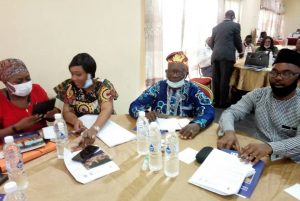
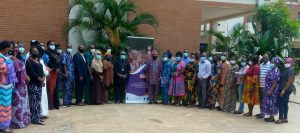
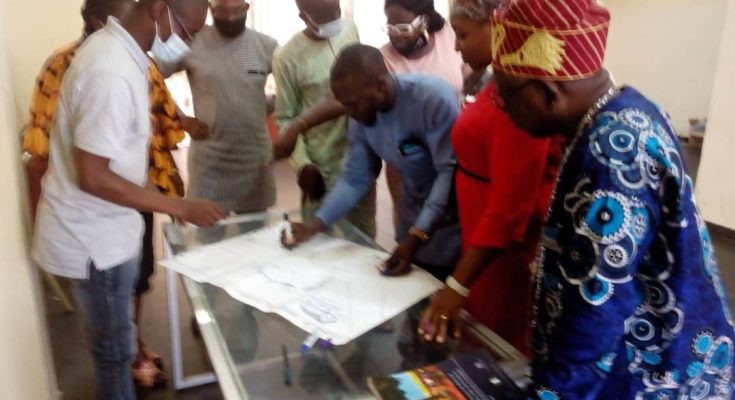
Participations at the irregular migration workshop
Against the backdrop of uncontrolled population in Nigeria, rising to over 200,000,000 (two hundred million) with unemployment rate equally rising to about 14 per cent with high dependency ratio of people under the age of 15 years and those above 65, Nigeria’s vulnerability to multifarious security challenges, has been identified as a contributing factor to the rise in irregular migration and associated vices such as child’s right abuse and human trafficking.
Human trafficking, though has become a global phenomenon that has historically manifested itself in many forms and dimensions across the world and Africa in particular, its impact on the Nigerian society has become worrisome that the Federal Government of Nigeria has not only enacted the Trafficking in Persons (Prohibition) Enforcement and Administration Act 2015 which replaced the same Act of 2003 but also domesticated all extant laws enacted by the United Nations, African Union, International Labour Organisation and other relevant bodies to protect the humanity against these heinous crimes, prohibit them, punish violators of the law and rescue and rehabilitate the victims.
Article 3 of the Palermo Protocol (2000) of the United Nations to prevent, suppress and punish trafficking in persons says: “Trafficking in persons shall mean the recruitment, transportation, transfer, harbouring or receipt of persons by the means of threat or the use of force or other forms of coercion, fraud or deception, of the abuse of power or of a position of vulnerability or of the giving or receiving of payments or benefits to achieve the consent of a person having control over another person for the purposes of exploitation. Exploitation shall include, at a minimum, the exploitation of the prostitution of others or other forms of sexual exploitation, forced labour or services, slavery or practices similar to slavery or the removal of organs.”
There has been a prevalent evidence of Nigerian children and adults being exploited into modern slavery of child labour, such as house-helps, workers in farms and quarry sites, among others, all at cheap stipends while a significant number of Nigerian young girls have been trafficked across the borders of Nigeria into forced labour, forced prostitution, begging for alms and harvesting of human organs and tissues. Many of the victims had been cajoled by traffickers with a story of purported rosy pictures and fortunes in the foreign land only to discover on arrival that they were in modern slavery to engage in forced prostitution, forced labour and other despicable duties for survival. The illegal migrants or trafficked persons often become liabilities to Nigerian Embassies at whichever foreign countries they find themselves. When they are eventually deported, they face new challenges of rejection by their families or communities, making their rehabilitation tenuous.
The Community Dialogue placed emphasis on community reintegration of returning migrants, reduction or elimination of the potential resentment of the victims, who may have been stigmatized with perceived vices associated with their failed trips by their communities. Sustained efforts should be made to upgrade the status of the returning migrants within the community by providing for them sustainable empowerment facilities.
Ogun State Task Force of the NAPTIP chaired by the Attorney General and Commissioner of Justice, Akingbolahan Adeniran, has been exceptionally responsive in the fulfillment of the objectives of NAPTIP by providing the enabling environment in the state to cater for rescued migrants and trafficked persons as well as prevent new irregular migrants and human trafficking. Besides providing shelter, rescued or returned traffic persons are granted facilities to empower them and reabsorb them into the society while their traffickers are found and prosecuted accordingly. It is a credit to Ogun State government for incorporating traditional rulers, who as custodian of culture and traditions of the people with closeness to the grassroots, into the body of Task Force of NAPTIP, to fast track both the protective and restorative mechanisms for victims of irregular migration and human trafficking.
At the training sessions, participants were considered as facilitators who in turn are expected to transfer their acquired knowledge to members of their communities as intervention that would play rewarding roles in dissolving any prevalent barriers that might want to inhibit effective rehabilitation of rescued or returned trafficked persons as well as preventing the recurrence of the crime.
Ends/