
By Omolara Akintoye
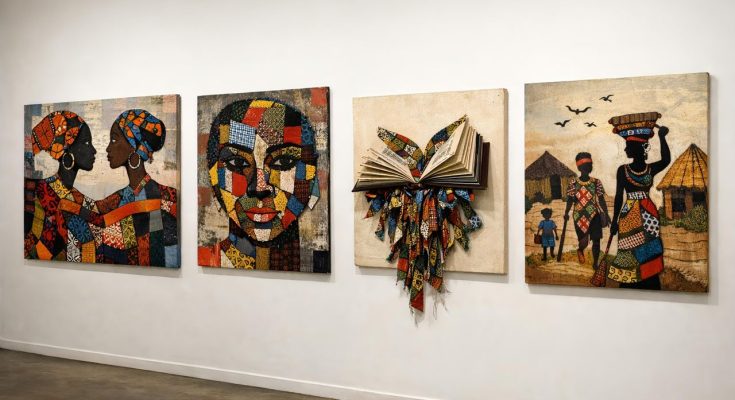
When Fabric Becomes Language concludes at Circle Art Gallery Kenya, a solo exhibition by Nigerian multidisciplinary visual artist Goodluck Jane, held from January 18th to January 22nd, 2021, in Nairobi. The exhibition invited audiences to explore the ways textiles, particularly African Ankara fabrics, can move beyond their traditional roles as clothing or decoration to become instruments of narrative, memory, and cultural expression. Jane’s works combined painting, drawing, and mixed media to transform fabric into a visual language, where every pattern, fold, and texture carried meaning, emotion, and identity. Over five days, visitors experienced compositions that reflected both technical skill and conceptual depth, offering an immersive opportunity to engage with contemporary African visual art while considering the storytelling potential inherent in everyday materials.
Over the five days of the exhibition, visitors experienced a meticulously curated selection of works that emphasized both the tactile qualities and conceptual depth of Jane’s practice. Audiences were invited to consider how every fold, pattern, and texture carried meaning, emotion, and narrative, engaging with the works on both formal and intellectual levels. The exhibition space was arranged to encourage deliberate movement, contemplation, and dialogue, allowing viewers to explore the relationships between color, form, layering, and symbolism across the series. Many visitors remarked on the way Jane’s work bridged tradition and contemporary artistic inquiry, demonstrating how textiles historically associated with domesticity and adornment could become instruments of cultural discourse and visual storytelling.
Jane’s exploration of form, gesture, and symbolism resonated deeply with attendees. Several works that juxtaposed the human figure with fabric inspired reflection on identity, lineage, and community, while compositions that layered paint, paper, and textile drew attention to the precision and care behind each creation. The exhibition emphasized that fabric is not only material but also medium, capable of conveying complex narratives that speak to personal, communal, and cultural histories. Attendees were struck by the way repetition, rhythm, and pattern in Jane’s work functioned as a visual language, demonstrating that textiles can communicate subtle yet powerful stories in ways that transcend words.
The post-event reception highlighted the impact of When Fabric Becomes Language on Nairobi’s cultural and artistic landscape. Visitors engaged in conversations about the role of textiles in contemporary African visual arts, the significance of cultural memory, and the intersections between craft, conceptual rigor, and artistic expression. The exhibition also sparked dialogue about the contribution of women artists in redefining traditional materials and artistic practice, positioning Goodluck Jane as a prominent figure in contemporary textile-based visual art. Many attendees praised the exhibition for its ability to balance visual beauty with intellectual and emotional engagement, reflecting both the technical skill and conceptual depth of the artist.
Circle Art Gallery noted the exceptional turnout and enthusiasm throughout the exhibition, with participants expressing admiration for Jane’s ability to translate material into meaning, to elevate fabric from utility to discourse, and to present contemporary African art in a context that was both accessible and thought-provoking. The exhibition reinforced the gallery’s commitment to showcasing artists who push the boundaries of traditional media, encouraging audiences to engage with art that challenges perception, celebrates cultural heritage, and fosters dialogue.
When Fabric Becomes Language stands as a testament to Goodluck Jane’s mastery in combining craft, concept, and narrative. The exhibition succeeded in demonstrating that textiles, when treated as both medium and subject, can carry memory, communicate stories, and explore identity in nuanced and profound ways. Audiences left the gallery with a renewed appreciation for the narrative potential of fabric and a deeper understanding of how contemporary African visual artists are redefining materials, traditions, and artistic practice.