
Sylvester Asoya
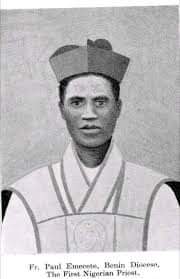
Reverend Father Paul Obodoechine Emechete is West Africa’s first indigenous Catholic priest. In Ezi, his community in Aniocha North Local Government Area of Delta State and the entire Issele-Uku Catholic Diocese, Emechete is remembered and revered. Those who hold him in awe do so for many reasons. Aside being regarded as a beacon of light for his pioneering efforts, there are also those who celebrate his courage, vision and resourcefulness. This is so because Father Paul became a Christian at a time Christianity was unpopular and considered an abomination in most villages in Africa where traditional forms of worship were the only acceptable way to God Almighty. Today, the narrative around Christianity and Christian missionaries and evangelism has changed radically because of the sacrifice and interventions of Africa’s early priests and missionaries like Reverend Paul.
In 1895 at the age of seven, the young Paul came under the influence of Reverend Father Carlos Zappa, the famous Italian Catholic priest of Asaba who had ecumenical influence covering nearly every part of today’s South-South and South-West. Zappa who came to Ezi to celebrate Mass caught the attention of this lad who joined the missionaries immediately after the initial contact.
Born in 1888 to the Ofiwe Emechete family, Father Paul’s year of birth coincided with the arrival of Catholic missionaries in Asaba, and this is significant in many ways. But despite his record breaking feats and accomplishments, the odds were heavily against Paul who fell in love with Christianity as a child. With a polygamous father, a family and community dedicated to the practice of traditional religion, becoming a Christian was an uphill struggle but the young man surmounted all the obstacles on his way. First, he turned his problems to advantages by turning out well under a strict and disciplinarian father who was feared. He would leave home at every opportunity unceremoniously even with the dire consequences of being part of Zappa’s celebration.
In many ways, this Ezi extraordinary cleric remains one of the biggest outcomes of Zappa’s excellent missionary journeys that took a new turn in 1893 shortly after the return of Rev. Father Poirier, his colleague, to Europe. So, it was during one of those early masses and visits to Ezi that Paul was converted. Zappa’s presence was also heavily felt in neighbouring communities like Illah, Onicha-Olona, Ogwashi-Uku, Okpanam, Ibusa, Issele-Uku and Agenegbode, a town that significantly aided the spread of the gospel to the entire Afemmai and Edo State.
The book, THE LIFE AND MISSION OF PAUL EMECHETE, First Indigenous Priest From West Africa by Rev. Fr. Jude Ifeanyi Ifezime sheds some light on this enigma and his amazing earthly journey. The author, a priest and an intellectual says a mouthful particularly with regard to Reverend Paul’s childhood and priesthood. According to Ifezime, this unusual pioneer was not only a clergyman of note; he was also a thinker. He adds that the pioneer priest was also a disciplined, stable, courageous and very cosmopolitan servant of God.
At the Emecheta family home in Ezi, alice engaged surviving members who spoke glowingly about their worthy son who, through his choices, brought great honour to the black race. Mr. Uche Emechete who spoke on behalf of the family described his well-known uncle as an iroko. “We are happy about our father and his contributions to the Catholic faith. Everybody knows that we gave West Africa and even the Black World, the first Catholic priest. This singular achievement also reveals a lot, knowing full well that our brother brought light to this town and beyond. Our prayer is for more Father Paul, not just in Ezi and Delta State but across Nigeria”, he says.
In a similar vein, Patrick George Ifezime, father of the author of THE LIFE AND MISSION OF PAUL EMECHETE, First Indigenous Priest From West Africaalso gives insight on the man Paul and his legacies. “Paul Emechete was an extraordinary pathfinder; he influenced my decision to encourage my son to become a Catholic priest. Today, Ezi, his home town has nearly a dozen reverend fathers and many reverend sisters and the religious across the country. Without him, I am not sure it would have been possible to have such a huge number of dedicated men and women in the God’s vineyard. Therefore his priesthood contributed immensely to the growth of Catholicism in Ezi and we are grateful for his contributions to the church of Christ”, he remarks.
It will be recalled that after Reverend Paul’s initial six months stay with a certain Biose from Onitsha who was a Catechist at Ezi, he proceeded to Illah where he attended the mission school with other boys. His exceptional academic performance at Illah led to his move to Asaba Mission House where he equally distinguished himself. The initial plan, according to the missionaries was for Paul to be trained as a Catechist to help the evangelists as an interpreter and support staff. But unknown to Paul and his superiors, God had a bigger plan.
So, in no time, Bishop Broderick wrote Ireland, home of the missionaries, insisting that they had found a worthy young man for the priesthood. Eventually, another clergy was sent on a fact-finding mission from Ireland and he returned with a positive verdict after a comprehensive character analysis on young Paul. Interestingly, the conversion to Christianity of his father on his sick bed, the dying man’s baptism, his family’s decision to become Catholics unconditionally and their excommunication by a community of traditional worshippers who were unhappy on account of the family’s new faith further emboldened young Paul.
In just three years, Paul achieved in a most unprecedented manner, another academic feat as he rounded off his studies from Standard One to Standard Six and graduated in flying colours in 1900. After a brief work experience with the United African Company, UAC, he was taken by French Reverend Fathers who later trained him. But before Father Paul’s priestly journey, there were no formal training centres for the local clergy like today’s seminaries. So, his formal training and his march to priesthood which was approved by all the missionaries he served was basically made possible by his impeccable character, enthusiasm and ability. Sadly, Paul the pioneer did not have the good fortune of becoming a priest by enjoying the rare privilege of consecration by his mentor and the man who saw tomorrow. In 1916, Father Zappa had become critically sick, a condition that eventually led to his death. The first indigenous priest from Africa was therefore referred to Lagos for the honour of priestly ordination. After a five day journey, he arrived Nigeria’s former capital where he was conferred minor orders afterwards.
On June 15th, 1919, Paul Emechete was ordained sub-deaconate by Fr. Thomas Broderick. Then on October 26th, 1919, he became deacon at St. Joseph’s Catholic Church, Asaba on the Feast of Epiphany as West Africa’s first indigenous Catholic priest. A polyglot of note, Father Paul spoke many languages, including Nigeria’s three major languages. He will be remembered forever for his vision and mission.
This article was first published in alice, the in-flight magazine of Air Peace.