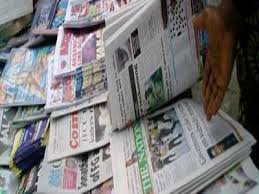

Recently, I had a cause to spend few days in Ibadan. After observing my subuhi prayer, I switched on the radio; all the navigated frequencies were reviewing newspapers in Yoruba language. I quickly noted the involved stations and decided to do a follow-up on them. The findings and experience were noble.
Ibadan, the Oyo State capital, appears to be the toast of investors in the electronic media industry; this is no longer restricted to Lagos state and other major cities. Those that readily come to mind are Naija FM, Beat FM, Space FM, Lagelu FM, Fresh FM, Premier FM, Family Radio, Impact Business Radio, Star FM, Diamond FM, Amuludun FM, Inspiration FM, Raypower FM and Splash FM. There are other stations in Ogbomosho and Oke Ogun areas of the state. What is however common to all of them is the review of newspapers by their various stations in the early hours. There seems to be healthy rivalry among them. I am of the opinion that in no distant time, they will become forces to be reckoned with.
It would be recalled that under the leadership of Chief Ajibola Ogunshola, Newspapers Proprietors Association of Nigeria (NPAN) sued the electronic media based on the perceived infringement on the copy rights of print media. After a while, the case was withdrawn for an out of court settlement. Status quo has since remained.
I noticed that newspapers’ reviews are being done in English and Yoruba languages with Yoruba taking a very huge chunk. In Ibadan, newspapers’ reviews in Yoruba language is one of the most listened to Yoruba programme; this is applicable to all the radio stations. I reliably learned that it ranks between first and fifth positions on their menus.
It has assisted listeners in understanding Yoruba language the more. It has also broaden the knowledge in public sphere. Arguably, similar reviews by electronic stations in Lagos State cannot compare with what I listened to. The Ibadan reports were purely in an undiluted Yoruba language.
Shortly before 6am, most mornings, any print “exclusive” will have already been eaten alive by radio stations and follow-ups will have been done. This runs till midday and afternoon in some stations. They have various names. Sponsors outwit one another to place adverts during the review. In other words, broadcast stations are benefiting financially thereby smiling to the banks at the expense of the print media. In fact, it is another revenue stream to those stations. Amid newspapers review, a very strong priority is placed on some newspapers especially Nigerian Tribune and The Punch.
Most of the time, the presenters inflame passions and incite hatred associated with hyperbolic interpretations. Presentations often tilt towards some individual newspapers’ agendas because they are occasionally spiced with “gossips”. Airing of some newspapers stories is challenging and complex but distortions of facts creep in, sometimes. Style of reading the news and articles is very unique. Reviews are not being done in briefs but everything written on a chosen news item. Presenters are always engrossed to the point of not informing the listeners to visit newsstands and pick copies of the reviewed newspapers.
Newspapers’ readers now wait for electronic newspapers review instead of buying copies. My visit to the newspapers distribution centre at Oke Padre revealed more. Filling stations
increase the volume on their radios for all and sundries to listen, the same thing in commercial buses and Micra brand of car that is being used for intra city transportation. Market women move around with transistor radios.
The potential readers/buyers can be excused for this approach as they can only buy and read print if the coverage is insightful, sharp, well-edited, covers topics not dealt with on electronic media, provides solutions and gives context to an event or happening. Furthermore, there is still a place for capturing a moment in time in print. This is quite different to just covering yesterday’s news.
Electronic media is better than print media because it is easily accessible, very wide, engaging in nature, minimises the users effort, contents are available free of cost in most cases, contents are delivered faster than print media and easily distributable. Also, the information can be shared easily using electronic media as compared to print media besides the fact that broadcasting is easier in electronic media as compared to distribution of information using print media.
Electronic media has assisted print media in no small measure because it is through it that potential readers are still aware of existence of some newspapers. It serves as a promotional tool that creates awareness and draw attention to the numerous dailies that are waiting for buyers at the newsstands.
Vendors’ means of livelihood has been terribly dealt with because of the few copies that are being sold. This manifests in the number of copies that are being sent to the biggest city in Africa; the total average daily supply figures of all newspapers is slightly above 3,000 copies and the average sales per day hover between 45% and 65%. This is not sustainable at all.
Some media managers get angry that their newspapers are not being giving necessary attention during review time; they end up moving round the electronic media stations and have pep talks with the presenters.
Finally, owing to low circulation figures of newspapers that have abbreviated their reach, electronic media, especially radio, has come to the rescue of the print media through the reviews being done on a daily basis.
In conclusion and on a lighter note, print media should be paying the electronic media because of the publicity being rendered since most of these newspapers don’t even advertise their weekdays and weekends menus in their publications.
Abiola Ayankunbi, MD/CEO at AbingMO3 Marketing Management Consultancy.
0802 305 1315
abiolaayankunbi@yahoo.com