
By Abiola Ayankunbi
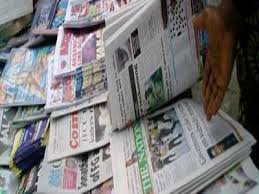
Herd or pack journalism is the characterization of news reporting in which reporters from different news outlets “collaborate” to cover the same story thereby making news reporting homogeneous. This is the practice whereby reporters use the same sources of information for their stories. When reporters need to cover a specific person for a story, these individuals will often move from place to place, and crowd together in masses at the scenes of newsworthy locations. This thereafter leads to near sameness in the concerned newspapers and leaves the news unvaried.
It can conveniently be said that the occurrence of pack journalism is mainly due to reporters’ reliance on one another for news tips and use of one single source for their information. Government at various levels are the major beneficiaries of this type of journalism. Reporters often make use of the facilities in these government places to file their stories.
I read interviews granted by top media echelons and virtually all of them agreed that newspapers get their stories from almost the same sources. The interviews were edited by Richard O. Ikibe and published in a book titled: Nigeria Media Leaders. Voices Beyond The Newsroom, Volume Two. Those who featured in the book were Gbenga Adefaye, Femi Adesina, Dam Agnese, Frank Aigbokun, Chidi Amuta, Clem Baiye, Ray Ekpu, Victoria Eziokoli, Lanre Idowu, Nosa Igiebor, Emeka Izeze, Femi Kusa, Ben Lawrence, Chris Doghudje, Yakubu Mohammed, Agbeke Ogunsanwo, Gbolabo Ogunsanwo, Dapo Olorunyomi, Ademola Osinubi, Garba Sheu and Bilikisu Yusuf.
Gbenga Adefaye, GM/E-I-C of Vanguard newspapers said that “we publish to peddle influence here. There is too much of politics, less emphasis on interrogating policies, and I think that is still a major failing for us. The copies are the same. We pull from the same source and it is all about the activities of government and partisan actors”.
Femi Adesina who was ex MD/E-I-C of The Sun Newspapers but presently a media aide to President Mohammadu Buhari said “when something breaks, we will all swoop on it, feasting till another one breaks, and we all abandon the current one and swoop on the next one. Till something else breaks and we abandon that also without getting to the bottom of it. That is an issue in Nigeria Media”.
He went further: “it is quite that now once you have read one Nigerian newspaper, you have almost read all. Unless we make a conscious effort to change this, it will not change and readership will continue to dwindle because in the past you needed to read about four newspapers to get a broad picture of what was happening but now, one is about enough. Now, we all draw from the same pool, you almost can envisage the headlines of the paper the next day, and headlines are almost the same”.
In an interview granted by Ademola Osinubi MD/E-i-C of The PUNCH in May 2013; the interview was conducted by Obianuju Asika. He alluded to the sameness in the news being published by nearly all the newspapers but delved on the news presentation by his newspaper.
He said “Nigerian newspapers cover virtually the same stories and, if you are not careful, you find that almost all the newspapers on particular days leading with the same story. So what are the people buying? They are buying your presentation, your approach to the story; and if they notice over time that your own approach to treating stories is better than how others are doing, they will remain with you. The likelihood is that some of them would even switch from other papers and come to you. That is the staying power”.
Some Editors are of the opinion that unless a particular story appears in their medium, such is not known or heard by the reading public. Their inactions have caused disequilibrium to the system, to the extent that companies can no longer fulfill their financial obligations and many have lost their jobs owing to this. At any point in time, their minds should be preoccupied with how build enduring newspapers that will stand test of time. Once news breaks, their preoccupations should be “what happens next?
I cannot agree less with what Femi Kusa, Director of Publication/E-I-C of The Guardian between 1992 and 1999 when he said that “editors are not mature before they are appointed. So, apart from the lack of the business handle, they are not sufficiently professional”.
Specifically, on May 31, 2020, Rtd Colonel Umar wrote a public letter to President Muhammadu Buhari. Surprisingly, that was the lead stories of many newspapers on July 1, 2020 without any fresh angles; not even reaction from the Presidency! Also, some people were kidnapped on June 25, 2020 in Ondo state. Regrettably, The Sun used it, after 72 hours, as a second lead story on June 28, 2020. It was captioned: Gunmen kidnap 9 passengers in Ondo.
Recently, Nnamdi Omini, the Rivers state Police Public Relation Officer (PPRO) issued a statement on June 29, 2020 on the alleged kidnapping and killings by Anthony Ndubuisi. The Nation published the story on its cover page, issue of Saturday, July 4, 2020 and Sunday Independent of July 5, 2020 published the same story on its cover page. None of the two publications was able to interview the suspect or his fleeing wife. Having taken a long time to publish this news, one would have expected the concerned Editors to send their reporters to Ngo-Okpala where the suspect hails from, for background information about him. The earlier the Editors realised that they are not writing for themselves, the better. There may be a need for the creation of Content Editor.
As if the above examples are not enough, some people were killed in Ejigbo, Osun state on July 6 and 8, 2020 in a manner suspected to be ritual killings. The police addressed the press on the incident. Vanguard of July 10, 2020 reported it on page 6. Saturday Independent of July 11, 2020 reported same on its cover page. This is almost a daily occurrence. I want to believe that editors have access to publications of their competitors and should be able to spot already published news and do a follow up where necessary.
Mallam Yakubu Mohammed, co founder of the defunct Newswatch Magazine was sent to Glasgow in Scotland to do a programme in management in order to prepare him for a leadership position. As at the time, he was an Associate Editor at New Nigeria Newspaper and was being considered for the position of the Managing Editor. This kind of action is practically lacking in the industry these days.
If one looks at the media leadership, all the best happened in the past tense. If one examined any particular media manager and say he is very bad, the one that follows is often worse, the one that follows that one regrettably gets even worse! In other words, previous years are better than the current years, a Nigeria factor?
Sameness in most newspapers has indirectly limited the choice of readers to just only one newspaper. This is where newspapers availability and brand loyalty play prominent role in the sales of the products.
Dwindling readership started in 1986 when General I.B. Babangida (Rtd) introduced Structural Adjustment Programme (SAP). Unless the economy improves radically, purchasing power to buy more than a copy of newspaper will be a mirage. Media can come up with agenda that will shape the economy. Besides, media should set agenda that will promote a very good reading culture.
People from 40 years downwards are more interested in making money than in reading of newspapers. Generation that are hooked to purchasing of newspapers are getting older but lesser financial muscles hinder purchasing power. Media managers need to interrogate what will appeal the younger generation who is believed to constitute the higher percentage of the population.
Everyone in the industry seems to know the problems, especially before and after occupation ot the offices of the Editor and MD but the will to make the difference is lacking.
Reading public increasingly sees the press as part of an establishment from which it feels alienated, rather than as a public surrogate acting on its behalf. The solution to this kind of isolation is not to repudiate the concept of independence, however. The solution is to recruit more people from a diversity of classes and backgrounds and interests in the newsroom to combat insularity. The journalism that people from a diversity of perspectives produce together is better than that which any of them could produce alone.
Revenues squeezed, other media has taken away not only the readers but principal sources of income. It is unfortunate that everybody is just printing newspapers without knowing what the readers actually wanted.
Synergy between circulation and advert departments occasioned by good editorial judgement and coupled with an improved economy will make serious newspapers to sour higher.
Finally, the gospel truth is that the current business model has outlived its usefulness and truthfulness had been removed from the equation.
Abiola Ayankunbi is MD/CEO of AbingMO3 Marketing Management Consultancy.
0802 305 1315
abiolaayankunbi@yahoo.com