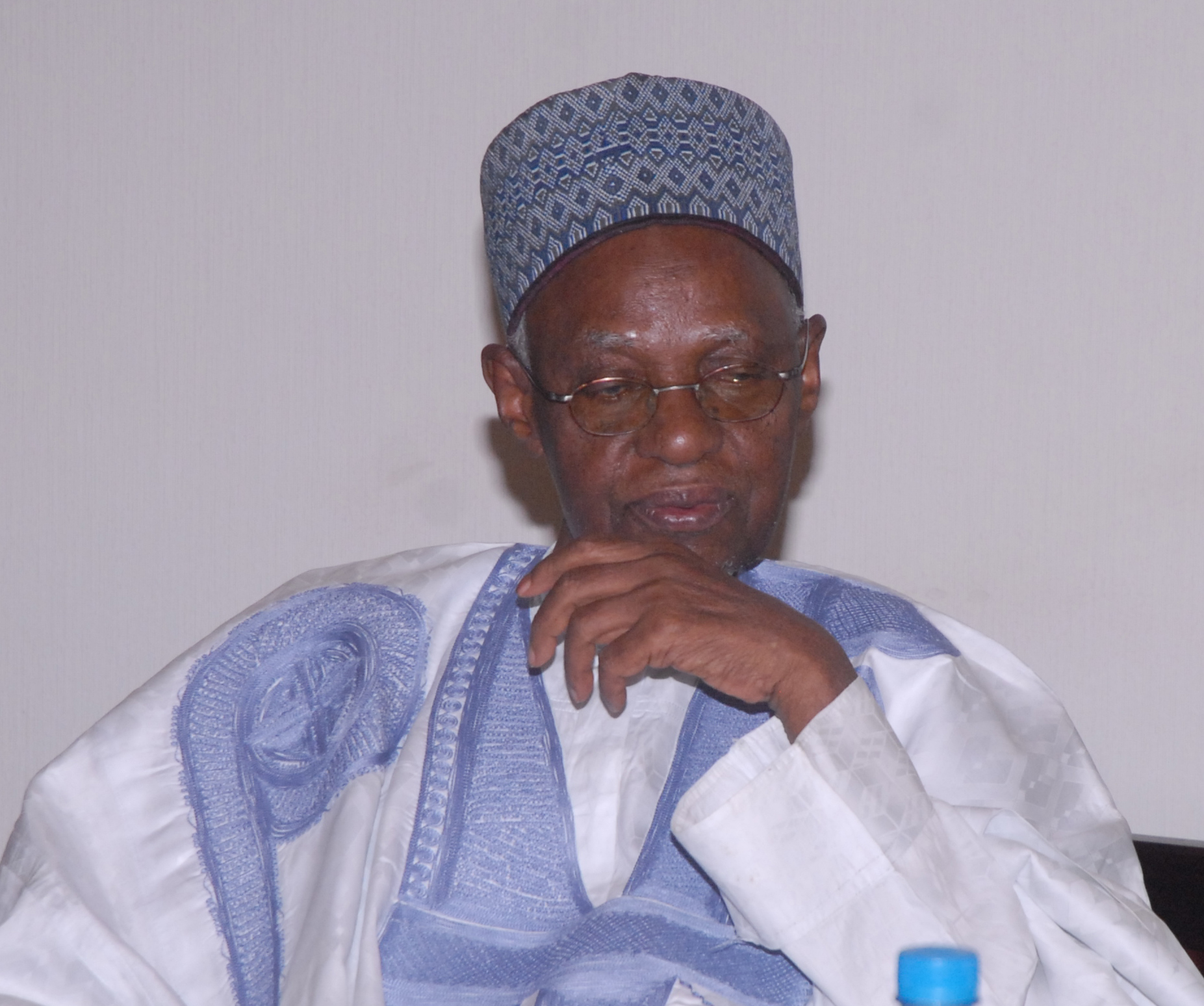

It is no longer news that Nigeria’s first Executive President, Alhaji Shehu Usman Aliyu Shagari is dead. The former President and gentleman passed on after a brief illness in Abuja. He was a statesman of repute. Nigerians went to bed Friday 28th December with the shocking news of Shagari’s demise. ADEDAYO EMMANUEL in this piece briefly recaps the life of the departed Second Republic President.
On Friday 28th December 2018, Nigerians received the death of former President, Alhaji Shehu Usman Aliyu Shagari with a great shock.
Shagari, 93, was receiving treatment at the National Hospital, Abuja when he passed on. His grandson, Bello broke the news via his twitter handle @Belshagy stating that his grandfather had passed on. The news Friday night dominated discussions on the social media with thousands of tweets and comments in few hours.
Alhaji Shehu Usman Aliyu Shagari was born 25th February 1925 in his village, Shagari founded by his grandfather now in present day Sokoto State. His father Magaji Aliyu and mother, Mariamu were both of Fulani origin.
Young Shehu was enrolled at age four into a Quranic school before attending a primary school in Yabo. He later attended Sokoto middle School before proceeding to the famous Kaduna College where he excelled in his studies. He was said to have loved reading which gave him early advantage. He later taught briefly in his alma mata.
Kaduna College was a school dedicated to training teachers, hence Shagari after his studies in the college secured a job as a science teacher at the Sokoto middle school where he once trained. Continuing in his teaching profession, the former President later became the Head Master in a primary school in Argungu.
In 1946, Shagari and Mallam Gambo Abuja jointly formed the Youth Social Circle, a Sokoto-based political organization. The organization was however supported by some northern elites like Mallam Ahmadu Bello, Ibrahim Gusau, and Mallam Ahamdu Dabbaba.
Shagari was in 1958 appointed Parliamentary Secretary to the Prime Minister, Abubakar Tafawa Balewa and shortly within that period, he was also elected to represent his constituency of Sokoto Southwest in the parliament.
In 1954, Shagari who had also developed interest in national politics, contested for an office and was elected into the Federal House of Representatives. Afterwards he held several political positions. He was also in government in the first Republic after Nigeria’s independence in 1960. After the military coup of 1966 that ended the first republic, Shagari returned to his village.
The administration of General Yakubu Gowon in 1971 appointed Shagari as a Federal Commissioner for Economic Development, a position he took over from the late Chief Obafemi Awolowo who he later contested the presidency against in 1979. Shagari won the election narrowly and the then Head of State, Lt. General Olusegun Obasanjo returned Nigeria to civil rule; handing over government to Alhaji Shehu Shagari at the famous Tafawa Balewa Square in Lagos to resume the Second Republic after 13 years of military rule.
Shagari then became Nigeria’s first Executive President since former President, Chief Nnamdi Azikiwe was a ceremonial President. Shagari was a member of the National Party of Nigeria (NPN), the party that had its stronghold in the north but with a national spread.
Nigeria was divided into 19 states structure and a proposed Federal Capital in Abuja during the second republic presided over by Shagari, a northern politician.
The NPN again won the 1983 election to continue for a second term but the government was characterized by massive corruption headed by the ruling class. The administration also led a dwindling economy due to massive fraud in high places.
One of the saddest days of the late President was the day he lost four children in an accident. Shagari took courage in Allah and forged ahead after mourning his beloved children.
However, on 31st December 1983, a palace coup dethroned the second republic. The coup led by Major General Muhammadu Buhari was welcomed by Nigerians who were tired of the corruption in the civil service and an economy on the verge of collapse.
The coupists also arrested many politicians including Shagari who was kept in a house arrest. In 1986, Shagari was cleared of personal corruption and was released from detentions but banned from participation in Nigerian politics for life.
In 1981, Alhaji Shagari pardoned exiled former Head of State and his former boss, General Yakubu Gowon who was stripped of his rank due to his alleged involvement in the coup that led to the death of General Murtala Ramat Mohammed in 1976. Gowon’s rank was however restored by General Ibrahim Babangida during his administration (1985-1993).
Another important feature of the Shagari administration was the deportation of over two million Ghanaians from Nigeria, the incident is still fresh in some quarters. One of the then government’s explanations was that it had taken the step in order to help the economy that was on a downward trend.
The former President married three wives, Aishatu, Amina and Hadiza. His wife, Aishatu died in 2001 after a brief illness in London.
At his side during his transition to the great beyond at about 7.04pm were the Sokoto State governor, Aminu Tambuwal, his sons, Hon. Aminu Shagari and Major Bala Shagari (Retd.)
One of the former President’s grandsons, Nuradeen Mahe had disclosed Shagari would be buried on Saturday in Sokoto State according to Islamic rites.
Mahe who told journalists that his grandfather was moved to the National Hospital in Abuja on Christmas day when his health worsened, also announced that the remains of the former President would be flown to Sokoto for burial on Saturday according to Islamic rites.
Shagari would be missed by Nigerians and the world at large.