Cleanliness they say is next to godliness. If this is true in the real sense of it, then the city of Lagos, Nigeria’s former capital and commercial nerve centre of Africa’s largest population is far away from godliness.
In recent years, the city has had to grapple with waste management which has continued to be a thing of concern.
Home to over 20 million residents, the state, a former British Colony, was merged with the protectorate of Southern Nigeria shortly before the amalgamation of the southern and northern protectorates in 1914.
In 1967, seven years into the independence of the country, the area now referred to as Lagos State gained the status of a state and had since been operating as a state headed by a governor.
Now divided into six administrative units namely Lagos Island, Lagos Mainland, Ikeja, Ikorodu, Epe and Badagry, the state government is preparing the state to obtaining a mega city status.
The government has also in the past few years heightened on infrastructural development to keep up with the plan of transforming the state to a mega city.
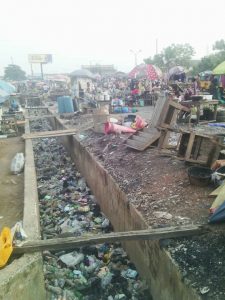
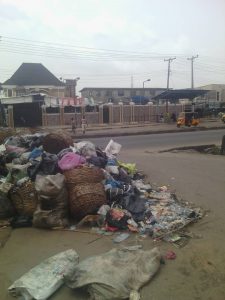
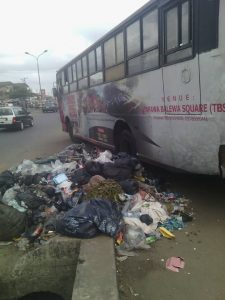
However, as the metropolis continues in its journey to becoming the refuse capital of Nigeria, it is worrisome that the state seems not to be in charge of waste management.
As far back as 1977, the state had established the Lagos State Waste Management Authority (LAWMA), formerly known as Lagos State Refuse Disposal Board (LSRDB), which was saddled with the responsibility of waste management in the metropolis.
Definitely, managing waste being generated by over 20million people is not a tea party as adequate infrastructure must be in place.
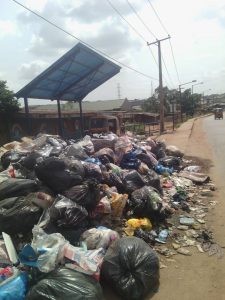
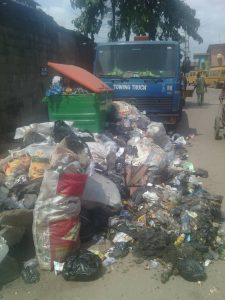
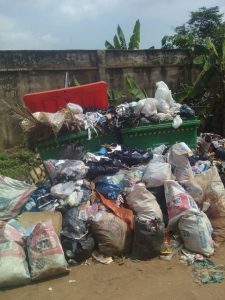
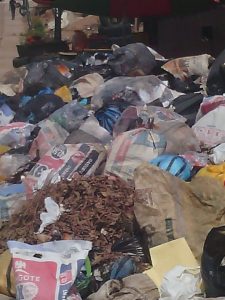
A first timer in Lagos would easily notice the heaps of refuse at different locations and ask questions since the state is seen as one hybrid state among others going by the income being generated.
A landlord in the Agege area of the metropolis, Alhaji Ajani Ibraheem, expressed his worry to Newdawnngr over the emerging refuse dumps around the locality.
“We are not happy with the refuse situation in Lagos. It is not a thing of joy and it has never been this bad,” he said, enjoining the government to wade into the situation before an epidemic occurs.
“During the past government, we used to bring out our refuse once a week and there were trucks that come around to collect them but in the past few years now, there has been nothing like that and that is what has brought back the cart pushers.
“We must patronize them now because in most communities there is no alternative and sadly enough when these boys collect the refuse and we pay them they would just dump the refuse anywhere they see which is not ideal,” he complained.
However, while some Lagos residents have blamed the government for withdrawing the earlier established PSP operators evacuating waste from the metropolis, others have blamed citizens for their bad attitudes in waste disposal.
A Lagos resident also told Newdawnngr that the problem the city is grappling with is that of attitude.
Mary Adekunle resides at Agbado-Okeodo and according to her if the people refuse to change their attitude the city cannot be clean. “Many people keep complaining about the withdrawal of PSP and introduction of Visionscape, for me the people are the problem,” she said, adding that, “Bring the refuse management experts from America, if the orientation of our people does not change they would still not dispose of their waste properly. Just wait for it to rain and see how people pour refuse into the drainages, do you blame a governor for that? She queried. She also enjoined the government to give adequate orientation to the people and create recycling centres in the three Senatorial centres. “Plastics for instance, form a large percentage of our waste and it is money because it is recyclable and at the same time very dangerous because when it blocks the drainage it won’t decompose. If the government can buy used plastic bottles and other plastics wastes people’s orientation would change and about half of the waste problem would be solved.”
Someone who believes in Adekunle’s argument is an ecologist and President, Ecologistics Integrated Services Limited, Dr. Paul C. Abolo.
Abolo recently told environmentalist in Lagos that the environment must be catered for in order for humans to live well.
Presenting a paper at the 2018 Lagos Climathon event at the Lagos State Environmental Protection Agency (LASEPA) facility, Alausa, Ikeja, he enjoined Nigerians to place values on plastics which form a major component of wastes.
“Let us emphasize on plastics. The problems they cause us are more than the values of the plastics themselves. They block the drainage and cause flooding,” he said.
Stating further, Abolo said, “$8bn is the value of eight metric tonnes of plastic. In Nigeria a ton of plastic is valued at N30,000 and there is a problem if we don’t pick these plastics because a ton of plastic would cost N360,000 problem.”
The ecologist, however, advised the government to legislate on plastics which forms a chunk of wastes since they cannot decompose. The expert wants Nigeria to replicate what obtains in the civilized world where plastics are picked and recycled.
According to him, “When we get to a point where people are paid for picking plastics for recycling, you would be surprised the beggar will knock on your window to collect plastics when he knows he would get reward of money for picking plastics.
“If we have such mechanism in place, people would go into the drainage and collect plastics. It will create behavioral change. If the people know that if they pick plastics, they get food. They will pick them. Also if there is a tax relief for you for sorting your waste, people in Lagos State will sort their plastics. We have to be realistic and deliberate,” he said.
Apart from what the government may not have been doing, the people must have a change of attitude in refuse disposal. The government on the other hand must support the people with mass orientation and provision of infrastructure.
Similarly, in the words of one of the PSP operates that operates in Iju Ishaga area (her name and that of her company withheld), “what does he (Ambode) wants us to do with the waste trucks we bought? These are trucks we bought with bank loan and we cannot convert them to something else. We cannot use them for transportation of any kind. We cannot turn them into pleasure cars. Yet we must pay back the loan. Where are we going to get the money to repay the loans that came with huge interest? Aside that, he has also thrown many into labour market. Thousands of people who work with the different PSPs have been thrown into labour market again. Can Visionscape alone absolve all of them? No. He never thought of all these in his quest to make Visionscape a monopoly in waste collection and disposal in a big state like Lagos. The world is moving away from monopoly, Ambode is taking us back there with his Visionscape.”
With the huge debt he has plunged the PSP operators into and the unemployment, he has unknowingly brought about the high cost of waste disposal Lagosian now pay to evacuate their waste.
Before the coming into existence by Visionscape, Lagosian who then partionise PSPs, pays as low as N500 to do so while cart pushers, which has also been outlawed to pave way for Visionscape, even collects less than that amount to evacuate refuse to so many designated dumpsites across the state.
But with the coming of Visionscape and the banning of PSP operators and cart pushers, Lagisians now pay through their noses to dispose their refuse. A bag of refuse that can be disposed for N100 before the era of Visionscape, now goes for as much as N1000 and one cart pusher who gave his name to Newdawnngr simply as Audu, had this to say “nor bi our fault. We dey charge high now because of Kai. Dem dey catch us and we dey contribute money give dem. Dem dey also charge us high for where we dey carry the dirty go throw way. Na him make us dey charge high.”
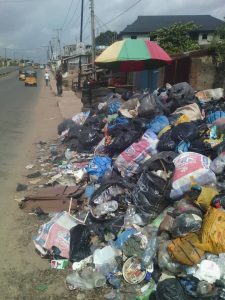
And those who cannot afford to pay the high fee charged by the cart pushers have devised a way out. That is, dump the wastes in the unholy hours along the roads, open spaces in the streets or the highway midans thus making Lagos more dirty and smelly.
A resident of Ogba area of Lagos who simply identified himself as Muftau Abubakar is of the opinion that, “except the unexpected happens, Lagos, is likely to remain fifthly and smelly until government begins to match action with its cleaner Lagos sloganeering.”
The various dump sites in Lagos should be well rehabilitated to support the tonnes of refuse generated daily within the metropolis. The recycling centres too must function maximally in order to achieve a cleaner Lagos.