
Reviewer: Prof. Akin Alao, Department of History, Obafemi Awolowo University Ile-Ife Nigeria.
An “Auto-Memoir-Graphy” of Survival, Scholarship, and Statecraft
Some memoirs narrate a life, and then there are rare ones that narrate a nation through a life. Dapo Thomas’ Lagos Boy and Lagos Politics belongs firmly in the latter category, a sprawling, irreverent, and deeply intelligent work that traces one man’s journey from the mosquito-coil-hawking streets of Surulere and Mushin to the upholstered inner sanctum of the Lagos State Governor’s Office in Alausa. Across seventy-eight creatively titled chapters and roughly four hundred and fifty pages, Thomas accomplishes something few Nigerian authors have dared: he fuses the textures of street-level memoir with the analytical rigour of political science to produce a hybrid he playfully christens “Auto-memoir-graphy”. This neologism accurately captures the book’s refusal to be confined by genre. It is encompassing and refreshingly so.
The scope is ambitious: the author’s life from 1967 to 2015, deliberately anchored to the year following Nigeria’s first post-independence crisis so that he can position himself as both “victim and participant” in the nation’s unfolding drama. As he writes in the Preface, “the book is about my life and the story of Nigeria beginning from 1967… I intentionally made 1967 the starting point to present myself as an eye-witness to all that happened in Nigeria.” The result is an unbroken narrative in which personal milestones, primary school suspensions, bus conducting, university activism, dodging coup bullets, are mapped onto national upheavals: The Civil War, the Naira-and-Kobo currency change, the “Ali Must Go” student protests of 1978, the Buhari-Idiagbon crackdown, the Babangida transition programme, the Gideon Orkar coup, and the democratic returns of 1999 and subsequent consequential happenings.
Also Read:The NADECO Story,’ The Book Nobel Laureate Wole Soyinka Vouched For
BOOK REVIEW ‘The Gun Hegemony’ By Ayo Opadokun: An Unusual Chronicle About The Nigerian Military
Tinubu cannot subscribe to any Islamisation agenda- Dapo Thomas, aide for eight years
From “Olodo Rabata” to the Round House
The first half of the book is arguably its most original contribution to Nigerian letters. Chapters with titles like “Gowon’s Convoy and My Broken Mosquito Coils,” “In Primary 3, I Was Slammed With an Indefinite Suspension,” “My Life in Rainbow Cinema with ‘Darasingh,’” and “From Danfo Driver to Special Assistant”, chronicle a childhood of staggering precarity and staggering resilience. Raised primarily by his great-grandmother, Iya’Badan, in the crowded compounds of Surulere, young Dapo fails Primary 1, earns the humiliating chorus of “Olodo Rabata,” graduates to hawking Tiger mosquito coils in a tenement he dubs “The Mosquito Emporium,” runs a “Try Your Luck” gambling stand, conducts buses on the Yaba-Aguda route, and eventually apprentices himself as a trainee thug under the notorious Darasingh at Rainbow Cinema, Mushin.
What elevates these chapters above mere entertainment is Thomas’ analytical self-awareness. He does not romanticize the street; he dissects it. The reader learns the class politics of fish crumbs (“the children of the rich would buy the fish, we would buy the crumbs that we would eat in instalments”), the social architecture of communal compounds where sixty people queue for a single lavatory by four in the morning, the ritual economy of Sara (Islamic charity feasts) in which children serve as “innocent emissaries of God,” and the unspoken rule of street masculinity: “Omo’ta does not cry.” The author recalls his schoolboy failures with a tongue-in-cheek candour that is both disarming and philosophically pointed: “I was a perfect epitome of stupidity… my stupidity in primary school was my own creation and invention… I really enjoyed this stupidity while it lasted, because it afforded me the opportunity to develop an inspiration for critical interrogation about life.”
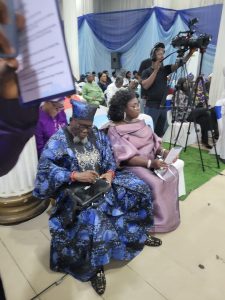
Mr Allan Aroyewun,Dapo mentor and hubby
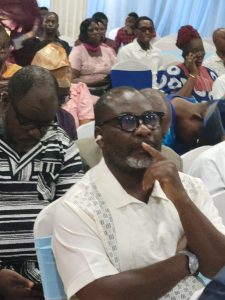
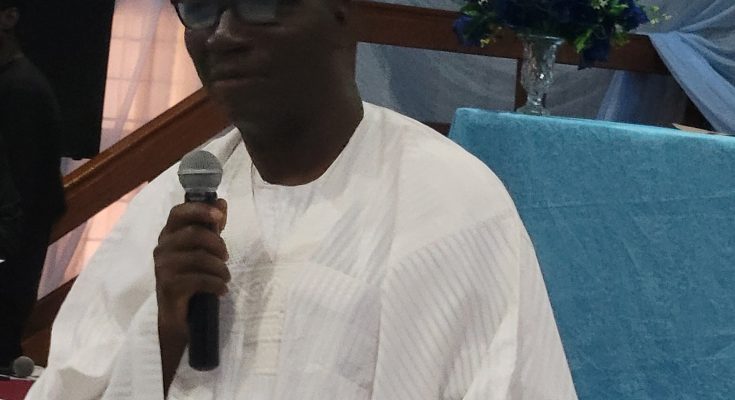
A friend of the author
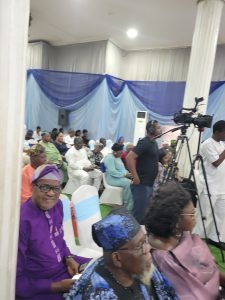
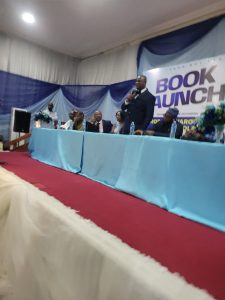
A cross section of the audience
The turning points are rendered with equal vividness: the death of his elder brother Sehinde in 1972 and of Iya’Badan in 1974, whose sickbed prayers “soaked” him in a spiritual reckoning that propelled him toward education. From Benevolent High School to Eko Boys High School, through the 1976 Dimka coup chaos experienced first-hand in a classroom, to A-Levels at Comprehensive High School, Ayetoro, where he was “banished” and “deported” to Abeokuta before being recalled, the narrative never loses momentum. At the University of Ife (UNIFE/Great Ife), he studied History and International Relations, edited the satirical King Cobra magazine, and ran afoul of the Buhari-Idiagbon regime, which alleged that he and Prof. Wole Soyinka plotted to overthrow the government. This accusation is vividly presented and rendered with both gravity and dark humour in Chapter 57 of the book.
The Insider’s Lagos: Tinubu, Fashola, and the Architecture of Power
If the book’s first half is a sociology of survival, its second half is a political science of governance, and it is here that Thomas’s dual identity as scholar and practitioner yields its richest dividends. Chapters 67 through 77 take the reader inside what he calls the “Round House,” the nerve centre of Bola Ahmed Tinubu’s governorship, where Dapo served as Special Assistant on Policy and Programmes from 1999 to 2007. The access is extraordinary, and the author knows it. We learn of the “Burial Ground” for files, a shelf in Tinubu’s office where “padded” or inconsistent files from untrusted commissioners went to die, treated. We learn of the “Not Today” philosophy which was a strategic refusal to grant requests immediately after hospitality, lest the petitioner “lose focus” or use generosity to “spell” the Governor’s judgment. We learn of a controversial circular, drafted to route all government files through Thomas to curb rampant duplication. Needless to say, this noble intention was blocked by no other person than Chief Lai Muhammed in his capacity as the Chief of Staff to Mr Governor. Chief Lai Mohammed’s power struggle with the author is chronicled with refreshing frankness in Chapter 70.
The book’s political climax arrives in Chapters 74–77, which dissect the Tinubu-Fashola rift and the 2014–2015 “Battle for the Political Soul of Lagos.” Thomas pulls no punches: he describes Fashola as “losing control of the cabals he nurtured,” with the Governor’s “boys going gaga hauling insults at Oga in public places.” He reveals that Tinubu initially withdrew support for Fashola’s second term, that Fashola had to lobby traditional rulers to intercede, and that the succession battle saw Fashola attempt to “raise Supo Sasore from the blue” against Tinubu’s chosen successor, Akinwunmi Ambode. Thomas himself played an active journalistic-intellectual role in this drama, writing syndicated articles — “Tinubu-Fashola: Crossroads, Not Dead-End” and “BRF’s Successor: Is Ambode the Final Choice?”. These op-eds functioned as public signals from the Bourdillon “Oracle” to the party faithful.
These chapters will be mined by historians of Lagos politics for years to come. They offer a granular, behind-the-scenes account of how power is actually exercised in a Nigerian state house: the role of gatekeepers, the friction between technocrats and political appointees, the choreography of loyalty and betrayal, and the unwritten codes — often expressed in Yoruba aphorism that govern elite behaviour in and out of politics.
Style and Voice
Thomas writes in a register that is sui generis — at once conversational and analytical, and reflective. Professor Adigun Agbaje of the University of Ibadan, who contributes a generous Foreword, praises the author’s “uncanny capacity for recall of names, faces, places, dates, issues and events” and his ability to capture reality “in the plain and relatable language and colours of the street,” producing a work that is “captivating in detail, vivid in style, and therefore difficult to put down.” This is not hyperbole.
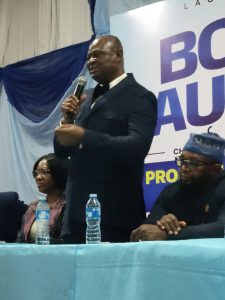
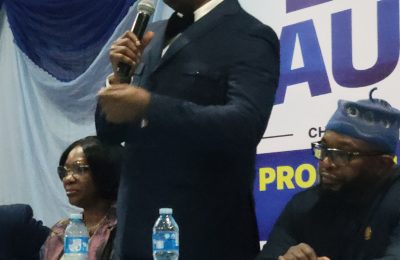
Professor Dapo Thomas,addressing the gathering
The prose moves fluidly between pidgin-inflected street dialogue, self-deprecating anecdote, and scholarly disquisition, often within the same page. Chapter titles themselves function as miniature short stories. For instance, “Looking for Joy in Failure,” “From ‘Try-Your-Luck’ to ‘Here-Is-Your-Luck,’” “Banished from Ayetoro, Deported to Abeokuta – My New Life in the Mansion of Deities”. Each is a hook that pulls the reader forward and move into the evolving narratives of facts, and fiction.
The use of Yoruba and Nigerian English is organic and untranslated, which may occasionally challenge non-Nigerian readers but authentically preserves the cultural soundscape. The humour is often physical and earthy. According to Dapo, a teacher who “stretchered me neatly and nicely on three tables collapsed for this flogging spectacle” — serves a serious purpose of demystifying institutions, puncturing pretension, and humanizing power.
Themes and Contributions
Several thematic threads run through the book despite its many chapters:
Redemption through education and faith. The arc from juvenile delinquency to a PhD from the University of Ibadan (completed in 2014 while serving as a Senior Lecturer at LASU) is the book’s moral spine, and Thomas is careful to attribute it not to lone grit but to mentorship, divine providence, and the disciplining effects of loss.
The inseparability of personal and national history. Every life event is contextualized within a national event, making the book as much a social history of Post-Civil War Lagos as an autobiography. As the author insists, “the story of my life [is] a branch of the history of Nigeria.”
A civic-republican political philosophy. Thomas consistently advocates meritocracy, institutional reform, critical intellectualism, and truth-telling. He is sharply critical of cronyism, ethnic chauvinism, the “pervading culture of silence,” and the manipulation of state power for private ends. His insider account of the Tinubu-era government is notably free of hagiography. He praises the leader’s strategic brilliance while documenting the authoritarian habits and patronage structures that accompanied it.
The sociology of the Lagos underclass. The childhood chapters constitute an important ethnographic record of non-elite urban life in 1960s–70s Lagos — a subject on which, as Agbaje notes, there is a “dearth of knowledge.” The book captures a world of compound living, street hustling, communal child-rearing, and informal economies that has largely vanished from the city’s contemporary landscape.
Critical Assessment
No review worth its salt should avoid honest caveats. The book’s sheer length and chapter count (seventy-eight sections) occasionally produce a narrative that feels over-stuffed. Some anecdotes, however entertaining, could have been tightened without loss. The unbroken chronological structure, while philosophically justified by the author’s rejection of formal “parts,” sometimes makes it difficult for the reader to discern larger argumentative arcs amid the torrent of incident.
The political chapters, for all their richness, are written from a clearly positioned vantage point. Thomas was a Tinubu loyalist who eventually broke with the machinery, and while Agbaje praises the “fidelity to truth” and absence of “vainglory and self-righteousness,” readers may occasionally sense the author settling scores, however gently. A more explicit methodological reflection on how memory, partisan affiliation, and the passage of time have shaped the account would have strengthened the work’s academic credentials.
That said, these are minor reservations about a book that is, on balance, a remarkable achievement. Lagos Boy and Lagos Politics is at once a coming-of-age story, a street ethnography, a political thriller, and a work of applied political science. It fills a genuine gap in the literature on Lagos governance, offers an unparalleled record of non-elite urban childhood in post-independence Nigeria, and demonstrates that the best political analysis often comes not from the seminar room but from those who have navigated both the motor park and the state house.
Final Impression and Recommendation
For scholars of Nigerian politics, urban sociologists, historians of Lagos, and general readers drawn to stories of transformation against the odds, this book is essential reading. Dapo Thomas has produced what may prove to be the most candid and comprehensive insider account of the Tinubu era in Lagos — wrapped, disarmingly, in the tale of a boy who once sold mosquito coils and drove a danfo bus to pay off his debts. That he lived to write both stories into a single volume is itself a testament to the redemptive power of education, discipline, and what he would call the “Unseen Hand.”
One closes the book with the lingering impression that the real subject is not Dapo Thomas, nor even Lagos, but the strange, brutal, often comic machinery by which Nigeria turns street boys into scholars and scholars into power brokers. It demonstrates the moral vigilance required to survive the journey with one’s integrity intact, despite the odds.