
By Our Reporter
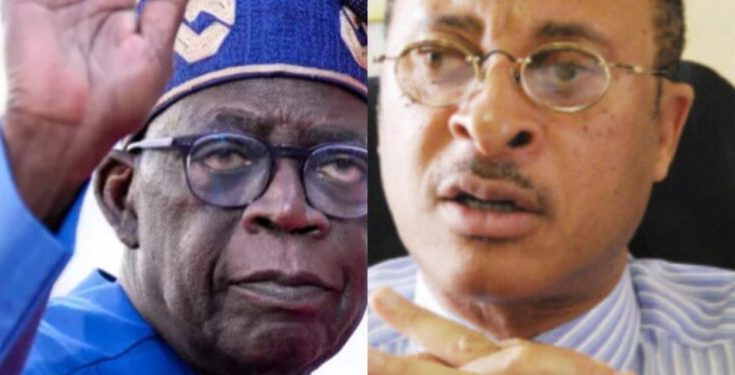
Political economist smd activist Prof. Pat Utomi, has issued a stark warning that Nigeria may be heading toward a deeper economic crisis, blaming what he described as ridiculous and poorly structured policies under President Bola Ahmed Tinubu.
Speaking on the widely followed monthly interview discourse, Boiling Point Arena, Utomi painted a grim picture of the nation’s economic trajectory, warning that current reforms are pushing in more Nigerians into poverty while failing to attract meaningful investments needed for sustainable growth.
According to him, the government’s economic approach resembles a “Ponzi scheme,” where initial gains are projected as success, but the long-term consequences could be devastating for ordinary citizens.
Utomi who featured as Guest alongside Presidential Adviser, Mr Daniel Bwala over a two-hour duration on the programme anchored by a seasoned media professional and public relations strategist, Dr Ayo Arowojolu.
Also Read:The Tinubu Enigma Part 6: Political Intelligence as Power — The Mind Behind the Machine
Ogun APC Guber Endorsement: Adeola appreciates Tinubu,Osoba, Abiodun, stakeholders
The once-in-a-month programme, now in its 42nd episode, was transmitted via Zoom and broadcast live on seven partner radio stations in Lagos, Ogun and Delta States.
“Nigeria will soon be in deep trouble,” Utomi declared. “They are using the same explanations, but we are not seeing the investments that will drive the promised growth.”
He cautioned that Nigeria risks mortgaging its future if it continues on the current path, especially with rising debt levels and weak capacity for debt servicing.
He accused policymakers of repeating the mistakes of past economic frameworks similar to the Structural Adjustment Programme (SAP) of the Ibrahim Babangida Era, despite lessons from global financial crises and admissions of policy failures by institutions like the IMF and World Bank.
He argued that rather than prioritizing the welfare of citizens, the government appears more focused on gaining external validation from Western capitals.
“They moved away from the Nigerian people and sought external validation—from Washington and Paris—forgetting the people at home,” he said.
The professor warned that the current policies have widened the gap between the rich and the poor, enriching a small elite while leaving the majority of Nigerians worse off.
He noted that declining household savings have crippled local investment capacity, while foreign investors—once seen as a solution—are increasingly pulling out.
“Investments flow from savings. Nigerians have no savings anymore. So who will invest?” he queried.
Utomi also took a swipe at the government’s handling of fuel subsidy removal, arguing that while subsidies were indeed riddled with corruption, a blanket removal without addressing systemic leakages has worsened hardship.
He maintained that as much as 70 percent of the subsidy regime was compromised by corruption, and tackling that alone would have yielded significant benefits without inflicting widespread suffering.
“You don’t just remove subsidies and cripple the people. That creates double jeopardy,” he said.
Drawing comparisons with global practices, he pointed out that even advanced economies like the United States and the European Union maintain various forms of subsidies to protect their citizens and industries.
The Septuagenarian further criticized state governors for failing to utilize increased revenues from subsidy removal to improve infrastructure and support economic productivity.
Instead, he alleged that many states have not demonstrated the strategic thinking required to transform the business environment or create value for citizens.
In his concluding remarks, Utomi stressed that unless there is a shift toward people-centered policies that empower Nigerians to produce and create value, the country risks sliding into a deeper socio-economic crisis.
“The policies have been against ordinary Nigerians. Poverty is increasing, inequality is widening, and the benefits they promised have not come,” he said.