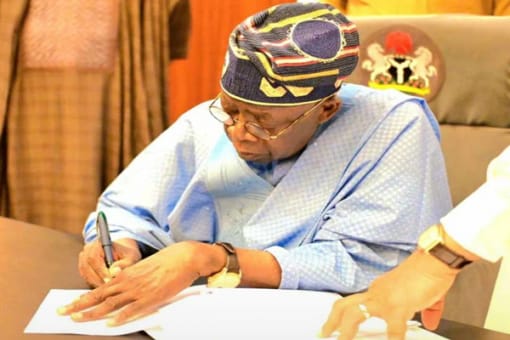

Caption:President Tinubu
The Federal Executive Council (FEC) has approved Nigeria’s 2025 budget proposal, amounting to N47.96 trillion, setting the stage for its presentation to the National Assembly by Tuesday,December 17,2024
This represents a significant step in the Tinubu administration’s commitment to bolstering fiscal and economic reforms.
Key Details of the 2025 Budget Proposal
The budget, which aligns with the 2025-2027 Medium-Term Expenditure Framework (MTEF/FSP), reflects a revenue projection of N34.82 trillion and expenditures totalling N47.96 trillion, leaving a substantial fiscal deficit.
The capital expenditure component constitutes 33% of the total, reinforcing the administration’s focus on infrastructure development and economic growth.
Oil production, a critical revenue driver, is projected at 2.06 million barrels per day (bpd), supported by improved security in the Niger Delta region. Other macroeconomic assumptions include:
GDP growth rate: 4.6% for 2025
Crude oil benchmark price: $75 per barrel
Exchange rate: N1,400 to $1
Minister of Budget and Economic Planning, Atiku Bagudu, confirmed the framework’s approval, stating that all “grey areas” had been resolved, paving the way for President Bola Tinubu to present the budget for legislative deliberation within the next 48 hours.
Performance of the 2024 Budget
During discussions, the FEC reviewed the performance of the 2024 “Renewed Hope” budget, which had a total expenditure of N27.5 trillion ($36.7 billion) and a revenue projection of N18.32 trillion ($24.4 billion).
READ ALSO: EFCC busts international cryptocurrency and romance scam syndicate in landmark operation
As of September 2024, the federal government achieved 75% of revenue targets, equivalent to N14.55 trillion, with optimism for improved year-end results.
Key revenue contributors in 2024 included:
Oil revenue: N7.68 trillion
Non-oil taxes: N3.52 trillion
Government-Owned Enterprises (GOEs): N4.07 trillion

NASS must rise up to save Nigeria
Expenditures in the 2024 budget were distributed as follows:
Non-debt recurrent expenditure: N9.92 trillion
Capital expenditure: N7.72 trillion
Debt service: N8.25 trillion
Legislative Projections and Approvals
In approving the MTEF/FSP, the National Assembly endorsed projections for oil benchmarks at $75, $76.2, and $75.3 per barrel for 2025, 2026, and 2027, respectively. Crude oil production targets were set at 2.06 million bpd, 2.10 million bpd, and 2.35 million bpd for the same periods.
The framework also projected inflation rates of 15.75% (2025), 14.21% (2026), and 10.04% (2027), signaling an anticipated gradual reduction in inflationary pressures.
Background and Economic Outlook
The 2025 budget comes amid lingering economic challenges driven by high inflation, currency depreciation, and fiscal deficits. Since taking office, President Tinubu has implemented bold reforms, including the removal of fuel subsidies and a managed float of the naira, which have had mixed outcomes.
While these policies have sparked inflationary pressures, the administration remains optimistic about long-term economic stabilization. With the 2025 budget prioritizing capital projects and enhanced oil production, Nigeria aims to address its infrastructure deficits and position itself for sustainable growth.
Also Read:Five takeaways from Tax Reform Bills
Looking Ahead
The approval of the 2025 budget reflects the federal government’s intent to recalibrate fiscal policies while fostering transparency and economic diversification. Analysts anticipate robust legislative engagement to refine the proposal and align it with Nigeria’s socio-economic goals.
As the administration targets ambitious GDP growth and declining inflation, the budget underscores Nigeria’s commitment to creating an enabling environment for domestic and foreign investments, paving the way for economic recovery and resilience.