
With the recent report of wives of military officers fighting insurgency, war crimes, terrorist attacks, among others complaining that these officers are experiencing strange behavior as a result of trauma, Omolara Akintoye writes about reasons for these officers’ strange behaviours, its impact on their mental health, their loved ones and how it can be managed by their immediate family members and the society at large, among other issues
Soldiers
“No, not again, why did you also have to die, please don’t leave me ” this was the voice of Sergeant Okoli, an army officer shouting from his sleep and sweating profusely and also weeping having discovered that it was a dream.
Srgt. Okoli was woken up by his wife, Nnena, who couldn’t bear it any longer. The reason is that since her husband came back from fighting insurgency in the Northern part of the country, it has been one problem or the other. Sergeant Okoli was always talking about his experiences either in the day time or in his dreams. This no doubt is taking its toll on Okoli’s health and the family members as well.
“I’m tired of all this, ever since you came back for vacation, you’ve been experiencing bad dreams, if you are not talking about how your colleagues were shot in your presence at the battle field, it was how you saw innocent children, men and women who were gruesomely murdered, you also relive how sad you were because of your inability to save these people’, Mrs Okoli lamented.
Abdul’s case was also similar to that of Okoli: “Aminat our troops were under attack, but I’m fine,” my husband uttered over the phone.
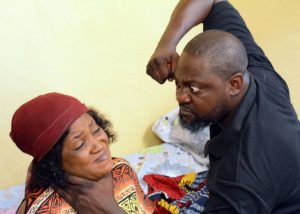
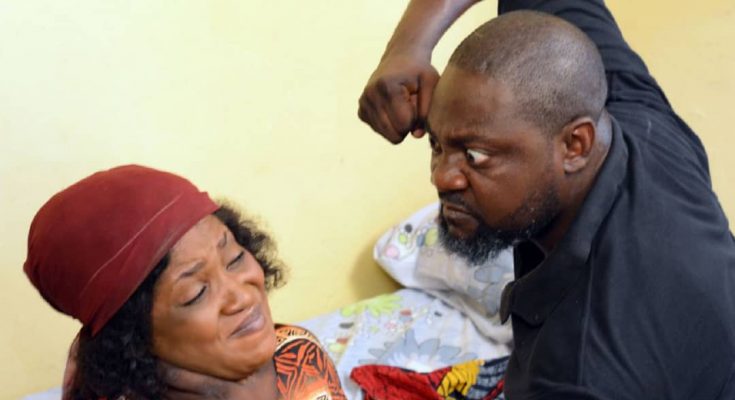
Soldier pummelling his wife
In 2019, Abdul was an Army officer also deployed to the North-East to fight insurgency and terrorism. “His words were rushed, and it was as if he was trying to catch his breath. Amina (Abdul’s wife) couldn’t tell if he was eager about providing this news or still spinning from the adrenaline of his close shave with death.
Either way, the information crashed into me and the certainty of how close I’d come to being a war widow left me stammering and shocked….. the trauma of which lasted for years.
When Abdul came home few months later, I never knew that although my husband made it back physically unharmed, he was emotionally damaged and so is every member of the family.
He was always recollecting images of the bullet and bomb ravaged bodies he couldn’t save, men, women and children, combatants, comrades and civilians. Besides sleep, he also lost the ability to feel much of anything. Abdul was doing all he could to be a wonderful husband and father, but when it came to being emotionally involved, he was lacking in this area.
Mrs. Okoli and Amina’s stories can be said to be what most family members of security personnel are going through, how their spouses are experiencing strange behaviors as a result of fighting wars, insurgencies and so on is which has led to trauma.
Research has shown that an estimated 354 million adult war survivors globally have Post Traumatic Stress Disorder (PTSD) and/or major depression according to the European Journal of Psycho-traumatology, 2019.
According to the National Institute of Mental Health, to reach a diagnosis of PTSD, healthcare providers must confirm that the patient has experienced all of the following for at least one month:
One or more re-experiencing symptom (flashbacks, bad dreams, frightening thoughts)
One or more avoidance symptom (avoiding places, events, objects, thoughts, or feelings that relate to or could remind someone of the traumatic event)
Two or more arousal and reactivity symptoms (feeling startled, tense, restless, angry)
Two or more cognition and mood symptoms (misremembering the event, having negative thoughts, feeling guilty, losing interest in enjoyable activities)
PTSD affects the cadence of everyday life. “Trauma shrinks a person’s world,” says Shauna Springer, Ph.D., a psychologist at Hidden Ivy Consulting based in California. “It creates tunnel vision and leaves people in a sustained state of ‘survival mode.’ We are flooded by anxiety and may vacillate between feeling angry and feeling detached from those we love.”
People with PTSD are also more susceptible to other mental health problems such as depression, anxiety disorders, substance abuse among others
Trauma, if not properly managed can lead to spousal and child abuse
says a Consultant Psychiatrist, Federal Neuro-Psychiatric Hospital Yaba, Lagos. Dr. Raji Ayantunde Luqman, in an interview with Omolara Akintoye
War is one of those entities that can lead to trauma, one can experience trauma from varying range of experiences such as road traffic experience, spousal abuse, even loss of loved ones can lead to trauma. So trauma can come from anywhere, but in this case we are limiting ourselves to trauma from the perspective of officer which has to do with what they face when they go to serve the nation during war or in the case of insurgence which is now all over the country especially the north-east. Of course this is also ravaging the whole country now. Most of them have been killed and some are being attacked by this insurgency and of course they could experience trauma.
 Dr. Luqmam
Traumatic event can make a victim to either ‘fight’ or ‘flight’
Trauma is the response to deeply distressing and disturbing events that overwhelms as individual’s ability to cope causing feelings of helplessness, diminishes their sense of self and their ability to cope and feels full range of emotions and experiences. From this definition, one can say that to be traumatic is a very big concept. When someone is traumatized such a person is not just having anxiety or depression, depending on the scale of this trauma, or the way the person is wired up and depending on the experience of this person before that trauma. Such that some traumatic event can actually make significant changes in the brain structure, of course the way God has created us, our body has the ability to respond to occasions of trauma, in our own parlance, we call it either ‘Flight’ or ‘Fight’. This implies that when you are faced with trauma, its either you face it headlong and overpower it or you think you can run away to re-coop and re-strategize. The body is a master of itself in the sense that it deploys several things; a lot of hormonal changes, bio chemical changes, the particular one is that the adrenaline jerks up. So the body in itself regulates in a manner that those non-essential body functions are shut down whereas the essential functions you needs to ‘fight’ or flight at that period of time what the body priorities in supplying the nutrients to, for instance you can’t be having a flight in trauma and wanting to eat so the body shut down the blood supplying to the stomach and increases the blood supplying to the heart because at that time you want to run and you want to do a lot of activities, so the blood supply to your feet and your eyes increases. So it has a way redistributing all these essential things especially blood at that point in time. But in that same way, the body has been endowed with the ability to reverse this process, however depending on the enormity of this trauma.
Several factors can be responsible for this such as the acuteness of the trauma, how experienced the person is, the way the person is wired up, sometimes gender, such that if the trauma is so enormous there could be some permanent changes in the body, particularly the brain.
Organs responsible for trauma
In dealing with trauma, three important areas of the brain are responsible: namely the Hippocampus, Pre-frontal Cortex and the Amygdala and the functions of these 3 organs is what dictates largely what happens when an individual is traumatized. The Hippocampus for instance is the area of the brain responsible for remembering past and present events such that in case of extreme trauma, the person is so rewired that they actually don’t want to relive these experiences and it becomes a disease disorder. The Pre-frontal cortex is the seat of executive power in the body; interaction, relationship with people and all that, such that in extreme trauma, there could be volume loss in these two areas, such that post trauma, the person might lose his ability to relate appropriately, to function and integrate appropriately. This is where the definition of trauma comes in where I mentioned the person’s inability to feel full range of emotions and experiences; it is because these organs are involved.
The amygdala: the seat of emotions such that when trauma is so enormous, the volume of amygdala can be enlarged and the emotional responses of such an individual to normal events would have been impacted because after the trauma there could be a permanent damage to the brain, the person might not be able to rewire back to normalcy. That is what trauma does.
How officers experiencing trauma or intense trauma could react in a manner that the spouse could complain?
Of course, there are several ways just like we used it for other war veterans too, the event of war itself is a traumatic one such that if you are in a war front, you live in a world of uncertainty, you are not even sure you could make it; right in front of you and beside you a garland officer like you is dying, this period is a period of intense emotion for them, and I don’t want to emphasize the peculiarity of our country relating to the inadequacies of the equipment which our officers are working with, they are likely to be left with psychological conditions such as anxiety, depression, acute stress reaction, post-traumatic stress disorder and depending on the genetic make-up of such an individual, the event could be a trigger to having schizophrenia (this is one of the most debilitating mental illness such that when a person comes down with it, it changes their personality in a way that they begin to see things and interpret things in bizarre forms) In essence, a person having trauma can come down with any form of psychiatric illness. When the individual get home, he suddenly becomes unduly agitated for no just reason, because they’ve been set on overdrive, they worry for no reason; their sleep quality and sleep duration is affected because of their inability to adjust to normal life after what they’ve been through.
Depression can happen as a result of the loss of close friends, loved ones, such a person comes down with extreme low mood, social withdrawal, thought of hopelessness, worthlessness, guilt, even suicide, and there are instances of officers committing suicide (the recent one that happened in the north central where the officer shot his commanding officer, then shot himself.
Use of psycho-active substance can trigger trauma
Use of extreme psycho-active substance can also lead to trauma (a chemical substance that acts upon the central nervous system where it alters brain function, resulting in temporary changes in perception, mood, consciousness and behavior) Some of these officers believe that they can’t prosecute war and insurgencies with clear eyes so they make use of drugs. So for post traumatic disorder, you see them after the war they becoming unduly agitated, they begin to relive their experiences during war, the death they’ve seen, gunshots, this to an extent affect their quality of life and their relationship with their immediate family and the larger society. Of course the person that will feel the heat most is their immediate family members. Mind you, one thing about the mental health is such that it stands on a tripod; you begin to feel the distress, the immediate family members the work place and the larger society will begin feel it. For those who experience this, the society is not so savvy in terms of psychological wellbeing, they get home and their spouses cannot translate these strange behavior of theirs and rather than give them support, they tend to escalate it and of course this can lead to spousal and child abuse, among many other things.
The way out:
It’s from different angles, but looking at it from the psychological point of view: at the point of employment, before the officers are being enlisted, a thorough psychological assessment should be conducted on them to ascertain their psychological wellbeing, to rule out cases of psycho active substance use and personality disorders during employment and after exposure to traumatic events, war case, fighting insurgency, this has to be done regularly.
Another way to curb this is to do an enlightenment program; enlighten their spouses to educate them on the flag signs that they should look out for in these officers, so that they can notify the appropriate authority and the authorities won’t take it as punitive measures against them. They must also be adequately informed on what trauma is all about: what their spouses are going through such that when they come they will be able to meet them with corresponding emotions, when their spouses are throwing tantrums, they will know what to do and how to call the appropriate authorities to intervene. For officers who abuse psychoactive substance, their spouses should also inform the authorities involved when they begin to take it and when it goes out of control. For the officers themselves there is need to psycho-educate them such that when they begin to see the early signs of psychological breakdown, let them know that as mundane as sleep problems, undue worries, irritability, undue agitation, remembering past events, not wanting to relate with people, is, once they begin experience these they should seek help before it escalate to a point where it cannot be curbed.
How the society can help officers suffering from war trauma
For those sufferers of trauma, the appropriate thing is for them to be taken for adequate psychological evaluation, i e they are to undergo thorough psychological evaluation, after which they should be given adequate support, to make them feel wanted, they are heroes and should be remunerated, show them love, boost their confidence, let them know that we appreciate all their efforts while they are at war front or dangerous zones. Psychological intervention comes in diverse forms, you have to bespoke the treatment to the need of a particular officer: an officer might be suffering from just anxiety, so you manage the anxiety, for those with depression which can be mild, moderate or severe, you manage appropriately. But suffices to say that biological intervention alone will not be enough, the mainstay of treatment will be psychotherapeutic intervention, which has to be ongoing. Mind you their follow-up care is also very important.