
Today I bring to us some of the bizarre marriage rites practices in Africa. Like we all know from our basic knowledge that marriage is the union between man and woman who have willingly consented to live with one another.
While several cultures holds various belief about marriage others believe it is more than just union though the process of marriage might be simple for some tribes and nations others is a rigorous and painful process where the man or woman will have to prove themselves worthy of the marriage, so what are we waiting let’s look at those practices already.
HAMAR PEOPLE OF ETTHIOPIA:
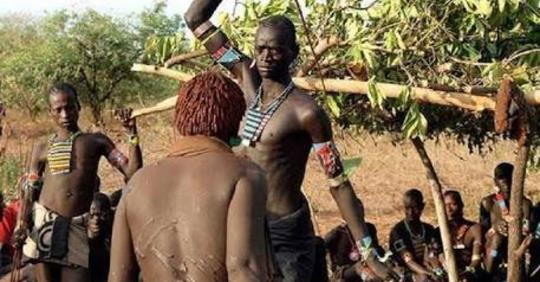
The hamar people are a set of small settlement in the omo valley in Ethiopia with a population of 46,532 people, this people are famous for their pastoral and polygamous nature, it is believe that before a man transit from childhood to adulthood i.es life of marriage he must undergo an exercise known as the ‘bull jump’ a traditional practice where the lad is made to jump about 15-30 bulls naked before he is considered fit for marriage.
This process serves as a rite into becoming a maza (maza are men who have successfully passed through the rite and allowed to marry) failure to succeed in this exercise the man will receive whips from the women and be unable to marry.
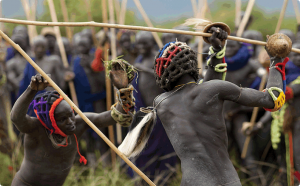

Men from the Suri tribe take part in a “Donga” or stick fight in Ethiopia’s southern Omo Valley region near Kibbish on September 24, 2016.
Traditionally the fight is a way to impress women and find a wife. The fights are brutal and sometimes result in death. The combatants fight with little or no clothing and sometimes no protection at all. The Suri are a pastoralist Nilotic ethnic group in Ethiopia. The construction of the Gibe III dam, the third largest hydroelectric plant in Africa, and large areas of very “thirsty” cotton and sugar plantations and factories along the Omo river are impacting heavily on the lives of tribes living in the Omo Valley who depend on the river for their survival and way of life. Human rights groups fear for the future of the tribes if they are forced to scatter, give up traditional ways through loss of land or ability to keep cattle as globalisation and development increases. / AFP PHOTO / CARL DE SOUZACARL DE SOUZA/AFP/Getty Images ** OUTS – ELSENT, FPG, CM – OUTS * NM, PH, VA if sourced by CT, LA or MoD **
During this process the bulls are lined up side by side and each naked boy must run cross the lines of bulls jumping from bull to bull on their backs if he fall he get laughed at by the women however he does this to become a man and also to be respected by the women and to get married a process he repeat four times.
Though before the man jump women and girls in his family must also partake in what is known as whipping ceremony a process where women are been whipped by other men who have recently completed their bull jump known as the whippers.
This people use stick fashioned into makeshift whip to hit the women and girls this whipping signifies the woman strength and their commitment, the more the whipping the better because scars from the wounds are also considered beautiful and desirable in this tribes culture.
The number of scars on the back also shows the new MAZA who loves him best; they take in the beating on the condition that he remembers them when they face difficulties.
On completing this process they proceed to the Evangadi (night dance) before the families of the new MAZA announce his first wife, their clothes are made from goat skin they also adorn their bodies by cutting their skin and adding ash and charcoal to the cuts.
The fulani’s are one of the tribes that has preserved their tradition in terms of marriage although most marriages in Nigeria are sacred but among the fulanis a lot of spirituality and traditional values are accorded to marriage.
The Fulani people are one of the most widely spread tribes in the world they are predominantly found in West Africa and northern parts of central Africa. Some of this countries includes Nigeria, guinea, mali, Burkina Faso, Cameroun and Senegal.
The fulani’s speaks hause, French, English and Fulfulde language, they are Muslims and follow the Islamic laws like the hausa.
The Fulani in Nigeria are mainly pastoral and move across a vast areas of land and come across different culture unlike other tribes in Nigeria the traditional marriage rites among the fulani’s is different in the sense that most men marry in their twenties while the women marry in their early or late teens, they practice a system of marriage known as endogamy whereby the marriage is kept within the ethnic group.
The Fulani are expected to marry off their first cousin before considering other wives this is done to keep the tribe stronger and also keep the wealth among their tribe and at the same time they are also permitted to marry more than one wife.
Read also: Trouble looms as Ndume opposes Lawan’s adoption as Senate President
The Fulani people of northern Nigeria have a traditional practice called sharo which means flogging a process whereby the potential groom is been flogged before the actual marriage in other to demonstrate that he is strong enough to be worthy of a bride, during this process the arms of the men is usually akimbo and hold a stick while they dance to drumbeats with chants and incantations, he is to demonstrate perseverance and strength as he endures several floggings.
The ceremony is usually done in public and witness by many including tribes from other region and could stretch for days
To make the ceremony interesting the groom is usually accompanied by his friends and relatives who support him during flogging sometimes the wing man could assist the groom if he is unable to withstand the flogging .
Credit: Steemit