
Located in Yaba Local Government Area of Lagos State, Makoko community is almost synonymous with slums and poverty.
Originally a fishing post on the Lagos Lagoon, Makoko is now a meeting point for fishers and people in logging business from the Ilaje area of Ondo State while the majority of the fishers come from badagry, Togo and Benin Republic.
Of course the area has since been opened up for several other activities brought about by modernisation and inflow of people of all sorts.
As Lagos plans to secure a mega city status, slums communities may need to be evacuated for a befitting landscape and better living condition for the population while inhabitants of such slums are relocated for better living.
Mr. Gerald is from the Egun stock who resides in Makoko. According to him, he has been in Makoko for many years where he trains young people of his Egun group how to sew. “I have been here for many years and we train our young people how to cut and sew,” he said.
Gerald who spoke through an interpreter obviously does not understand the Yoruba and English languages. According to him, “A journalist from The Nation Newspaper, Adeola Ogunlade discovered him in the slums while he was running a classroom session for the apprentices.
“The journalist, Mr. Ogunlade was going round Makoko when he saw me teaching the apprentices how to read and write the Egun language and was interested,” he remembered.
“I think he was fascinated by how I was teaching and he asked questions through an interpreter. Many of them can’t read or write and we need to teach them to understand basic things before we teach them sewing,” he explained.
One of the apprentices, Opeyemi said she came from Otodogbame after the demolition of the settlement by the government. “I was living with my sister in Otodogbame and after the government demolished the place, I stopped going to school. There was a school i was attending then at Otodogbame but now after the demolition I couldn’t continue, I was in JS2,” she narrated.

When asked if she would like to return to school, she answered in the affirmative. “I will like to return to school but at the same time I don’t want to lose out in this sewing I am learning. I know the skill will give me job after I might have mastered it then I would return to school so I don’t end an illiterate like many other girls,” she said.
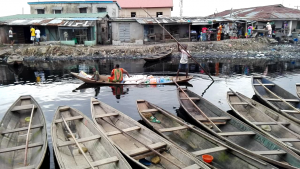
Makoko slum is home to a lot of people from outside Nigeria who have found home and means of livelihood in the area. Major means of transportation in the community is canoe which are the equivalence of taxis on the land.
Paddled majorly by young children and teenage boys, the canoes are wooden vessels used to move goods and persons from the mainland to the water side. The Eguns live in sheds built with planks on the black water and one would wonder how they survive the stench oozing from the water where they also defecate.
Meanwhile, Baale of Makoko, Prince Raymond Adekunle Olaiya-Akinsemoyin is the direct great grandson of Oba Akinsemoyin of Lagos.
“Makoko is an inheritance from our own great grandmother who also inherited it from her father who bought the place from the Oloto of Lagos,” the Baale said.
Olaiya-Akinsemoyin went down memory lane to tell New Dawn how Makoko land came to being. “I am a direct great grandson of the Oba Akinsemoyin of Lagos and Makoko is an inheritance from our great grandmother, Madam Ramotu Manuel who also inherited the place from her father who bought the place from the Oloto family of Lagos,” the legal practitioner said.
Giving the graphical illustration of the landscape, Olaiya-Akinsemoyin said, “The entire space called Makoko shares boundary with Oko Baba as far as Iwaya towards the University of Lagos and back toward Oyadiran towards Sabo and it covers the Casino area towards Panti, towards the Local Government to where you have Guinness and the Red Cross, towards Herbert Macaulay area.”
According to him, Egun people laying claims to Makoko are aliens and descendants of those his grandmother employed to fish for her at the waterfronts.
“Over the years, because we have accepted a lot of people to be with us, especially the Egun people that our grandmother mama Ramotu invited to be fishing for her, they are now laying claims,” he said.
Adding, he said, “We accepted them as customary tenants and there were letters they wrote to take permission to be fishing and be doing some trade and we allowed them but today due to a lot of activities by the so called politicians who come from all manner of places with all manner of characters.
“The rule of law is no longer in place in Nigeria the consequence is what we are facing in the north where you cannot differentiate between a Nigerian, a Chadian, a Sudanese, Boko Haram and Alqaeda people. In the south today, 99 percent of people you see on the waterfront in Makoko who called themselves Egun people are from Benin Republic, they have no link whatsoever with Nigeria and today they are the key people in the Local Government,” he said.
Lamenting the criminal activities being perpetrated by the people occupying the slums of Makoko, the Baale said, “These people trade in all manner of things and it is from these people you find all manner of criminals trading in hard drugs, and human trafficking.
“They are now digging borehole in the lagoon and the ecosystem is daily being damaged they do all manner of things, they do a lot of smuggling there and the so called government officials close their eyes and of course no tax is paid to the government from those illicit trades,” he said.
The Baale also lamented how the Egun people of Makoko prevent development of the area. “Cocacola and Guinness once came to me that they wanted to build a big water plant in Makoko, these Egun people revolted. They said it was their land and they drove the white people that came for the project away. Now the communities are enjoying the project, Makoko is at a loss,” he lamented.
Advising the government to take a stand, the Baale said the government must stand to the challenge. “Except the government stands on its feet, the problem may not be easily solved,” he added.
Confirming that the land of Makoko is good and can bring huge investment to Lagos State, he said, “Makoko is a very good area. I have got people who want to develop Makoko and invest billions of dollars, not Naira. But the immigrants are making it unworkable,” he lamented.
“What will it cost the government to give us approval to develop Makoko? I called the people and told them I will not drive anybody away, but we would build high-rise to house them all and develop the area and the whole of Lagos State would be proud of it.”
Talking about the civil society groups working in Makoko, the Baale said the NGOs are doing their part in developing the people, giving them enlightenment.
“Before I came in as Baale, hoodlums were raping openly in Makoko, when I came in , I drove them with the help of the police and today there is a little bit of sanity but I myself I have left them because I don’t know what they want us to do, if government is spending money billions to develop Lagos but now encouraging rubbish, let them go ahead in the rubbish,” he said.
He however canvassed the government to allow him to develop Makoko and bring glory to the state.
“Let the government answer the family who owns the land. We have been telling them we don’t need any money from Lagos State government. Just give me the go ahead to develop Makoko.
“I will not drive anybody away to create problem, we will give them an average of N500m from taxes from Makoko annually. I will call them to join hand with me to develop Makoko. I have written letters to the Lagos State government on this before. Makoko is a private property,” he insists.
Presently, Makoko is inhabited largely by the Egun people who still maintain strong ties with their families in Benin Republic and Togo.
Government of Lagos State should as a matter of urgency strive to develop the entire space called Makoko and give the local inhabitants a befitting experience.